
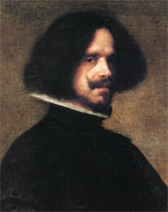
Diego Velazquez
Court Painter of King Philip IV and Master of Baroque Portraiture
Born on June 6, 1599
Died on August 6, 1660
Age at death: 61
Profession: Painter
Place of Birth: Seville, Spain
Place of Death: Madrid, Spain
Diego Velázquez, whose full name was Diego Rodríguez de Silva y Velázquez, was born on June 6, 1599, in Seville, Spain, as the first son of his family. His father, Juan Rodríguez de Silva, was a Portuguese-born lawyer of Jewish origin, and his mother, Jerónima Velázquez, came from a noble family. According to Spanish custom of the time, the first male child took the mother’s maiden name, which is why he became known as Velázquez. From an early age, he studied languages, philosophy, and painting.
Seville was the cultural and commercial center of Spain during this period. Recognizing his son’s extraordinary talent, his father sent Diego Velázquez in 1612 to study under the well-known painter Francisco de Herrera the Elder. A year later, Velázquez left Herrera’s workshop and entered the studio of the more academically oriented Francisco Pacheco. He worked with Pacheco for five years, learning proportion and perspective. Through his teacher’s intellectual circle, he closely followed contemporary literary and artistic developments, and Pacheco would later play a key role in Velázquez’s entry into the royal court.
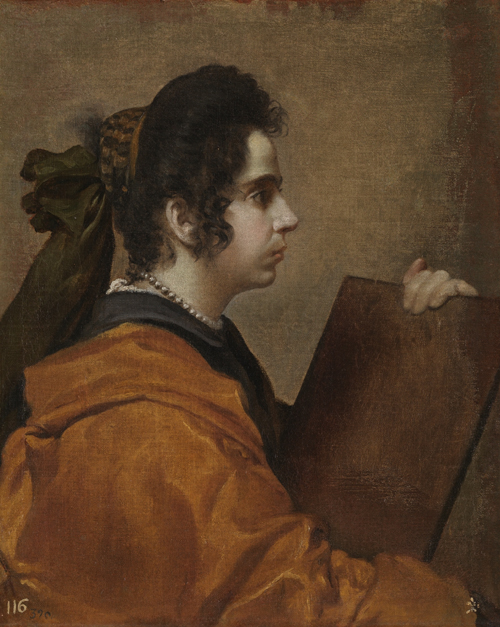
This profile portrait is traditionally identified as Juana Pacheco, the wife of Diego Velázquez. The restrained pose, muted background, and sculptural treatment of the face reflect Velázquez’s early Sevillian period, marked by realism and psychological depth. The calm dignity of the sitter and the tactile rendering of fabric demonstrate the painter’s emerging mastery of naturalism.
Diego Velázquez achieved recognition at a remarkably young age and was admitted to the painters’ guild before he was even seventeen. In 1618, he married his teacher’s daughter, Juana Pacheco. The couple had two daughters, born in 1619 and 1621. Their elder daughter, Francisca de Silva Velázquez y Pacheco, later married the painter Juan Bautista Martínez del Mazo. The younger daughter died in infancy. Velázquez’s portrait of his wife is considered among his finest works and is now housed in the Museo del Prado.
In 1622, Diego Velázquez traveled to Madrid and to the royal palace of El Escorial, where he painted a portrait of Philip IV of Spain. He was only twenty-six years old at the time. The king was highly pleased with the portrait, and in 1623 Velázquez was appointed court painter. That same year, he moved permanently to Madrid with his family. His portraits of the king, members of the court, dwarfs, and jesters secured his place among the immortals of art history.
In 1627, Queen Isabel organized a competition to determine the finest painter in Spain. The subject was the expulsion of the Moors from Spain, and Diego Velázquez won the contest. In 1628, the famous Flemish painter Peter Paul Rubens arrived in Madrid on a diplomatic mission. King Philip IV entrusted Velázquez with guiding Rubens through Spain’s artistic treasures. Acting on Rubens’s advice, Velázquez received royal permission to travel to Italy.
On September 19, 1629, Diego Velázquez departed for Italy, spending approximately a year and a half in Genoa, Venice, Ferrara, Naples, and Rome. Throughout this journey, his royal salary continued uninterrupted, and travel expenses were covered by the crown. He studied and copied works by Michelangelo Buonarroti and Raphael, absorbed the influence of Titian, and met Jusepe de Ribera in Naples. He returned to Madrid in 1631, deeply enriched by Italian art.
In 1649, Velázquez traveled once more to Italy on royal assignment to purchase artworks for the Spanish court. During this period, he painted portraits of Pope Innocent X and of his African-born enslaved assistant Juan de Pareja. Exhibited at the Pantheon on March 19, 1650, these works received overwhelming acclaim. He returned to Madrid in 1651 and resumed his duties as chief court painter.
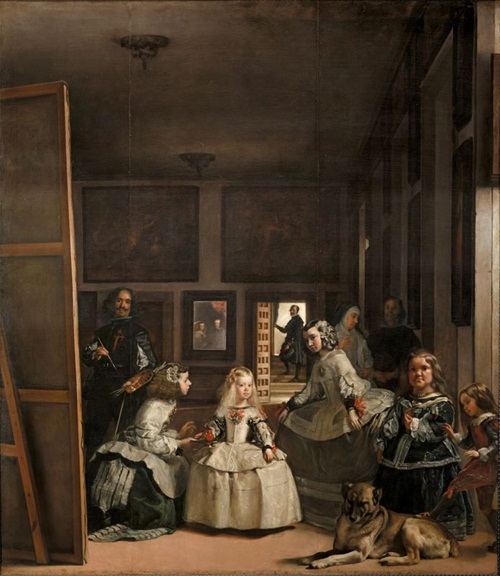
Las Meninas is considered one of the most revolutionary works in the history of painting. Velázquez places himself inside the composition while the king and queen appear only as reflections in a mirror at the back of the room. At the center stands the young Infanta Margarita Teresa, surrounded by her ladies-in-waiting, dwarfs, and a dog.
The painting redefines pictorial space by collapsing the boundaries between artist, subject, and viewer. Through light, perspective, and mirror imagery, Velázquez achieves an unprecedented sense of depth and realism, making Las Meninas a foundational work for modern visual thinking.
Among Diego Velázquez’s greatest masterpieces is Las Meninas (1656), known in English as *The Maids of Honour*. This revolutionary painting introduced an unprecedented sense of spatial depth to the canvas. Velázquez depicted himself within the composition, while the king and queen appear only as reflections in a mirror at the back of the room. The five-year-old Infanta Margarita Teresa stands at the center, attended by her ladies-in-waiting.
Another major work, Las Hilanderas (*The Spinners*, 1657), is considered the pinnacle of his artistic achievement. Though less famous than *Las Meninas*, it masterfully combines mythological narrative with everyday labor, portraying women working in the Santa Isabel tapestry workshop in Madrid, while the myth of Arachne unfolds in the background.
His celebrated nude painting The Rokeby Venus (1644–1648), also known as *Venus at Her Mirror*, was revolutionary for its time. It was the first major female nude painted by a Spanish artist, presented from behind in defiance of traditional representations. Today, it is housed in the National Gallery, London.
Diego Velázquez was knighted by King Philip IV in 1659, a distinction that freed him from the pressures of the Inquisition and allowed him greater artistic independence. In 1660, he organized the wedding celebrations of Maria Theresa of Spain and Louis XIV of France. Shortly after returning to Madrid, he fell ill on July 31, 1660, and died on August 6, 1660, at the age of sixty-one.
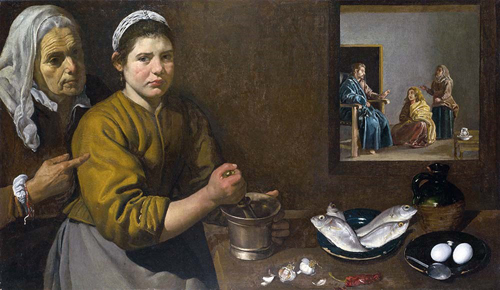
This early work by Diego Velázquez combines a genre scene with a religious narrative. In the foreground, two women are depicted preparing food in a kitchen, rendered with striking realism and tactile detail. Everyday objects such as fish, eggs, garlic, and ceramic bowls emphasize Velázquez’s mastery of the bodegón tradition.
In the background, visible through a window-like opening, appears the biblical scene of Christ with Martha and Mary. This juxtaposition contrasts worldly labor with spiritual contemplation, suggesting that the sacred exists within the ordinary. The painting exemplifies Velázquez’s early naturalism and his ability to merge religious meaning with scenes of daily life.
Velázquez was buried with great ceremony in the garden of the Church of San Juan. King Philip IV is said to have wept, declaring, “I am undone.” His wife died shortly afterward in the same room where the painter passed away and was buried beside him. A monument erected in Seville bears the inscription: “To the painter of truth.”
Known as “the painter of reality,” Diego Velázquez broke with idealized traditions by portraying nature as it truly appeared. His early *bodegón* paintings depicted humble figures and everyday objects, while his later court portraits defined Baroque realism. His influence extended far beyond Spain, shaping generations of European painters.
Source: Biyografiler.com
Frequently asked questions about Diego Velazquez
Who is Diego Velazquez?, Diego Velazquez biography, Diego Velazquez life story, Diego Velazquez age, Diego Velazquez facts, Diego Velazquez birthplace, Diego Velazquez photos, Diego Velazquez videos, Diego Velazquez career
Related Biographies

Lamine Yamal
Professional footballer

Erling Haaland
Professional footballer

Kylian Mbappe
Professional footballer

Keanu Reeves
Actor

Austin Abrams
Actor

Bad Bunny
Rapper, Songwriter


Hongjoong
Singer, Rapper, Songwriter, Composer

Ludacris
Rapper, Actor

Kwon Eunbi
Singer

Sarah Wayne Callies
Actress, Screenwriter, Producer, Director

LaTavia Roberson
Singer, Actress, Entrepreneur

Pedro Sanchez
Politician
Lamine Yamal
Professional footballer
Erling Haaland
Professional footballer

Claudia Sheinbaum
President, Politician, Scientist, Academic

Leonardo DiCaprio
Actor
Austin Abrams
Actor