
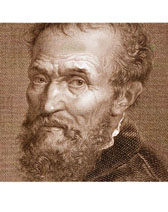
Michelangelo Buonarroti
The Divine Michelangelo – “The Man of Four Souls”
Born on March 6, 1475
Died on February 18, 1564
Age at death: 89
Profession: Sculptor, Painter, Poet
Place of Birth: Caprese, Arezzo, Italy
Place of Death: Rome, Papal States
Michelangelo Buonarroti, known simply as Michelangelo, was one of the towering figures of the Italian Renaissance, a supreme genius whose mastery of sculpture, painting, poetry, and architecture earned him the lasting title of “the man of four souls.” He is best remembered as the creator of the world-famous statue David, a symbol of artistic perfection and human strength.
Michelangelo Buonarroti was born on March 6, 1475, in the small town of Caprese in Italy. His full name was Michelangelo di Lodovico Buonarroti Simoni. His father, Ludovico Buonarroti, came from a noble family and was serving as the town’s mayor at the time of Michelangelo’s birth. However, that same year his term ended, the family fell into poverty, and they moved to Florence. During his early childhood, Michelangelo was placed in the care of the wife of a stonecutter. Years later, he would famously say, “Along with my nurse’s milk, I absorbed the hammer and chisel.”
Michelangelo received a strict education as a child, yet his growing passion for art could not be suppressed despite his father’s resistance. In 1488, he was apprenticed to Domenico Ghirlandaio and David Currado. His talent for painting was quickly recognized. Even at the age of thirteen, Michelangelo refused to color anything without first observing nature closely, testing whether his imagination matched reality. He frequently visited fish markets, carefully studying the shapes, eyes, and gills of fish before reproducing them with remarkable precision.
After leaving Ghirlandaio’s workshop, Michelangelo began studying sculpture at a school founded under the patronage of Lorenzo de’ Medici, also known as “Magnificent Lorenzo.” He soon attracted Lorenzo’s attention. One day, Lorenzo saw Michelangelo polishing a grinning face he had carved from discarded marble. Jokingly, Lorenzo remarked that the old man’s teeth were too perfect, reminding him that people lose their teeth as they age. Without hesitation, Michelangelo took his chisel and knocked out one tooth from the sculpture. Amused and impressed, Lorenzo summoned Michelangelo’s father and arranged for the young artist to live in his household. Michelangelo remained there until 1492, when Lorenzo de’ Medici died.
These years marked Michelangelo’s formative artistic period, during which the strong influence of Greek ideals, instilled by Lorenzo de’ Medici, became evident in his work. It was also during this time that his interest in poetry flourished. He was deeply influenced by Dante Alighieri. His unrequited love for Luigia de’ Medici intensified his literary passion, inspiring powerful sonnets. At the age of eighteen, he composed another series of love poems addressed to the young Tommaso Cavalieri. Yet his most profound poetic works were written for Vittoria Colonna, the widowed Marchioness of Pescara. In these numerous poems, Michelangelo expressed a mystical and spiritual love that also permeated his Christian works, writings on Platonic love, and reflections on the secrets of art.
Michelangelo’s poetic style was as intense and forceful as his personality. The passion and inner fire that defined his life were reflected not only in his sculptures but also in his writings. To his contemporaries, Michelangelo was known as quick-tempered, irritable, proud, sarcastic, and stubborn. In his youth, he even carried for the rest of his life the mark of a broken nose, the result of a punch from a fellow student whom he had harshly mocked.
After the death of Lorenzo de’ Medici in 1492, Michelangelo returned to Settignano, where he began studying anatomy. He later spent three years working in Venice and Bologna. When he returned to his native Florence, despite his young age, he had already reached artistic maturity. In 1495, he completed Sleeping Cupid, which was sold as an antique to Cardinal Raffaele Riario of San Giorgio. A year later, he traveled to Rome and sculpted the marble statue Bacchus. From this point on, he was recognized not only as a gifted painter but also as a highly productive sculptor.
In 1499, Michelangelo completed Pietà, considered the first true masterpiece of Christian sculpture. This work of extraordinary beauty is now housed in the Vatican. Returning once again to Florence in 1501, he created Madonna of Bruges a year later and, three years after that, the legendary statue David, completed in just eighteen months and standing over four and a half meters tall. During the same period, he worked on the statue St. Matthew and produced the design for The Battle of Pisa.
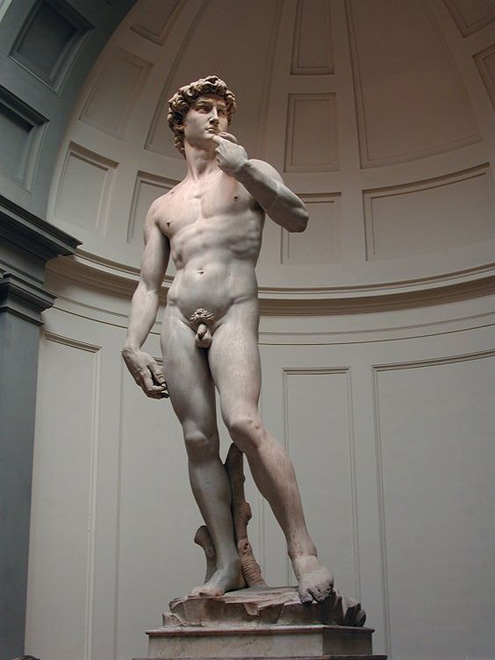
Michelangelo Buonarroti’s statue David is today exhibited at the Galleria dell’Accademia in Florence, where it captivates nearly eight million visitors every year with its monumental beauty and flawless anatomy.
Giorgio Vasari, regarded as the first art historian, described Michelangelo’s David with unmatched admiration, stating: “Anyone who has seen Michelangelo’s David has no need to see any other sculpture, living or dead.” He continued, “Without any doubt, this figure has eclipsed all other statues, ancient or modern, Greek or Roman.”
In 1505, Pope Julius II invited Michelangelo to Rome and commissioned him to create his tomb. After years of labor, the completed monument astonished all who beheld it with its extraordinary power and grandeur.
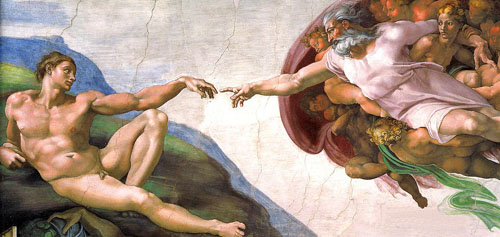
Three years later, Michelangelo was assigned the task of decorating the ceiling of the Sistine Chapel. Initially reluctant to accept the commission, he eventually agreed and gifted art history with a flawless masterpiece. The work on the ceiling lasted three years. On one of its most iconic sections, Michelangelo painted The Creation of Adam, an image that has since become one of the most recognized and celebrated works in the history of art.
By 1527, Michelangelo Buonarroti had become a figure of great public respect and was appointed General of Fortifications. In 1534, he resigned from this position, left Florence, and settled permanently in Rome. There, Pope Paul III appointed the sixty-year-old Michelangelo as the Vatican’s chief architect, painter, and sculptor. In the same year, Michelangelo began work on the Sistine Chapel fresco The Last Judgment, a monumental project that took seven years to complete. He also produced frescoes, paintings, and sculptures for the Pauline Chapel and, in 1574, assumed responsibility for the architectural leadership of St. Peter’s Basilica.
In February 1564, on a quiet afternoon, Michelangelo Buonarroti passed away. He never married, living a life devoted entirely to his art. Married only to his work, he poured all his energy and existence into his creations. When a priest friend once expressed sorrow that he had never married and had no children to inherit his work or fame, Michelangelo replied: “Art has been my wife more than enough. It has always made me work and strive. The works I leave behind are my children. Even if they are of no value, I live on in them.” As he himself foretold, he has indeed lived on for centuries through his art.
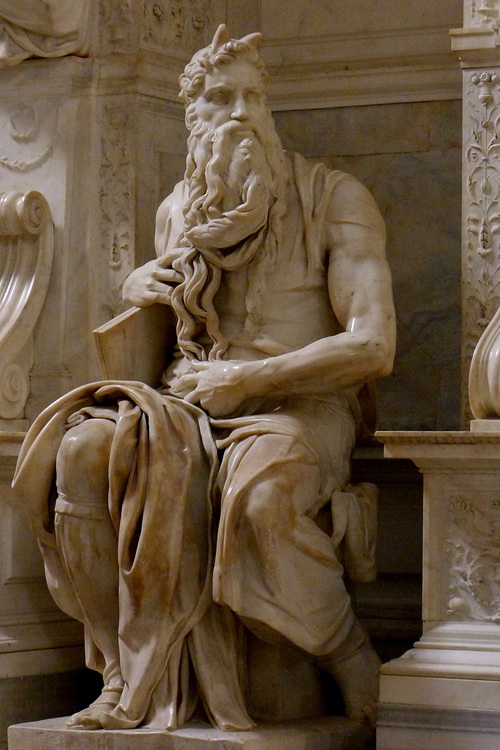
The sculpture Moses, created by Michelangelo Buonarroti, is the principal statue positioned at the center of the tomb of Pope Julius II. The figure depicted in the sculpture is the prophet Moses. Through its commanding posture, intense expression, and monumental presence, the work embodies Michelangelo’s unmatched ability to translate spiritual authority and inner tension into stone, standing as one of the most powerful sculptural representations in the history of art.
Source: Biyografiler.com
Frequently asked questions about Michelangelo Buonarroti
Who is Michelangelo Buonarroti?, Michelangelo Buonarroti biography, Michelangelo Buonarroti life story, Michelangelo Buonarroti age, Michelangelo Buonarroti facts, Michelangelo Buonarroti birthplace, Michelangelo Buonarroti photos, Michelangelo Buonarroti videos, Michelangelo Buonarroti career
Related Biographies

Lamine Yamal
Professional footballer

Kylian Mbappe
Professional footballer

Sam Altman
Entrepreneur, Investor, CEO

Erling Haaland
Professional footballer

Alice Weidel
Politician, Economist

Bad Bunny
Rapper, Songwriter


Hongjoong
Singer, Rapper, Songwriter, Composer

Ludacris
Rapper, Actor

Kwon Eunbi
Singer

Sarah Wayne Callies
Actress, Screenwriter, Producer, Director

LaTavia Roberson
Singer, Actress, Entrepreneur

Alfred Molina
Actor
Lamine Yamal
Professional footballer

Brad Pitt
Actor
Bad Bunny
Rapper, Songwriter

Leonardo DiCaprio
Actor

Keanu Reeves
Actor