
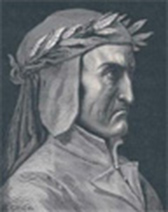
Dante Alighieri
The poet who bridged the Middle Ages and the dawn of the Renaissance
Born on May ??, 1265
Died on September 14, 1321
Age at death: 56
Profession: Poet, Philosopher
Place of Birth: Florence, Republic of Florence
Place of Death: Ravenna, Italy
Dante Alighieri was born in the mid-13th century in Florence, at a time when Europe was struggling to emerge from the intellectual and spiritual darkness of the Middle Ages. A man shaped equally by political conflict and poetic vision, Dante spent his youth on battlefields defending political ideals and later fighting for the interests of his guild. In return, he endured humiliation, persecution, and long years of exile. Yet it was precisely during these years of banishment that he composed some of the most noble and enduring poetry the world has ever known. By forging a new literary language and illuminating humanity through wisdom, he bestowed upon world literature his immortal masterpiece, The Divine Comedy (La Divina Commedia).
The Divine Comedy, Dante’s most celebrated work, narrates a metaphysical journey through the afterlife and consists of three monumental canticles: Inferno (Hell), Purgatorio (Purgatory), and Paradiso (Paradise). Through this epic vision, Dante transformed European literature and laid the foundations of modern Italian language and poetic imagination.
Dante Alighieri was born in 1265 under the given name Durante, which he later shortened to Dante. His father was a respected lawyer, and Dante grew up within the civic culture of Florence, one of the most vibrant cities of medieval Europe. For his education, he was entrusted to the care of Brunetto Latini, whose encyclopedic knowledge and rhetorical discipline introduced Dante to classical authors such as Cicero and Virgil. Florence in Dante’s youth was a cradle of lyrical poetry, particularly love poetry, and Dante absorbed both the troubadour tradition and the philosophical legacy of Aristotle, whose ideas reached him largely through medieval scholastic interpretation.
The central emotional and spiritual force of Dante’s life was his love for Beatrice, whom he first saw at the age of nine. She was slightly younger than him and belonged to a noble Florentine family. Dante encountered her again nine years later, an event he described with near-mystical intensity:
“As she passed by, she turned her eyes toward the corner where I stood and greeted me with such grace that I felt I had reached the very summit of blessedness.”Although Dante and Beatrice were never united in life, she became the enduring muse of his imagination. Attempts to forget her through other relationships failed, and Beatrice evolved into an almost sacred obsession. In The Divine Comedy, she appears not merely as a beloved woman but as a symbol of divine wisdom and spiritual salvation, echoing the theological ideals later systematized by Thomas Aquinas. Through her guidance, Dante ascends beyond earthly desire toward ultimate truth.
Beatrice’s marriage to Simone de’ Bardi and her untimely death in 1290 devastated Dante. His grief and philosophical reflections on love and loss found expression in Convivio (The Banquet), a work that blends personal sorrow with intellectual inquiry and reflects Dante’s engagement with the moral philosophy of antiquity and Christian theology.
Dante Alighieri gained his first political experience on the battlefield. He fought as a soldier in the Battle of Campaldino, where the rival factions of the Guelphs and Ghibellines clashed violently for control of Florence. Later, Dante joined the Apothecaries’ Guild, a necessary step for political participation. His courage and principled opposition to papal interference earned him respect, eventually leading to his appointment as a leading civic official. However, political success proved short-lived. Renewed civil strife erupted, and Dante was accused of corruption and condemned to exile in 1302, a fate that would later resonate with other exiled thinkers such as Niccolo Machiavelli.
From that moment until his death, Dante lived as a wanderer, moving from city to city in Lombardy, Tuscany, and Romagna. During his exile, he sought refuge under various patrons, including the Lord of Verona, and later dedicated the Paradiso to Cangrande della Scala, whose patronage enabled him to continue his literary work. Dante’s travels extended as far as Paris and possibly Oxford, where he encountered currents of thought that would later influence European intellectual figures such as Roger Bacon and the emerging scholastic tradition.
In his later years, Dante served briefly as an ambassador for the Duke of Venice, though this mission ended unsuccessfully. He ultimately settled in Ravenna, where he spent his final years in relative peace, continuing to refine his masterpiece. Dante Alighieri died in Ravenna in 1321 and was buried in the Church of St. Francis, in a modest tomb that later came to be revered by Franciscan monks as a sacred relic. Florence, the city that had exiled him, would later mourn its loss and unsuccessfully seek the return of his remains.
Even after his death, Dante remained a controversial figure. His Latin treatise De Monarchia provoked intense hostility from Church authorities. In this work, Dante argued for a universal political authority governing secular affairs independently of the Church, while acknowledging the pope’s supreme spiritual role. This radical separation of spiritual and temporal power anticipated later political theories and drew the ire of figures such as Cardinal Bertrand du Pouget, who ordered the public burning of the book.
Dante’s enduring fame rests above all on The Divine Comedy. Guided first by Virgil, the poet of ancient Rome, Dante journeys through Hell and Purgatory before being led by Beatrice into Paradise. Along this journey, he encounters and dialogues with historical and literary figures such as Homer, Ovid, Horace, and Saladin, transforming the poem into an encyclopedic portrait of medieval knowledge. By writing in the vernacular rather than Latin, Dante Alighieri elevated the Italian language to literary greatness and influenced countless later writers, from Giovanni Boccaccio and Francesco Petrarca to modern thinkers who regard him as the cornerstone of Western literary tradition.
Latin Works: De vulgari eloquentia (On Eloquence in the Vernacular); De Monarchia (On Monarchy); Epistulae (Letters); Eclogae (Eclogues); Quaestio de aqua et terra (The Question of Water and Earth).
Italian Works: Vita nuova (The New Life); Rime (Poems); Convivio (The Banquet); Il Fiore (The Flower); La Divina Commedia (The Divine Comedy): Inferno, Purgatorio, Paradiso.
Source: Biyografiler.com
Frequently asked questions about Dante Alighieri
Who is Dante Alighieri?, Dante Alighieri biography, Dante Alighieri life story, Dante Alighieri age, Dante Alighieri facts, Dante Alighieri birthplace, Dante Alighieri photos, Dante Alighieri videos, Dante Alighieri career
Related Biographies

Lamine Yamal
Professional footballer

Kylian Mbappe
Professional footballer

Erling Haaland
Professional footballer

Sam Altman
Entrepreneur, Investor, CEO

Bad Bunny
Rapper, Songwriter

Brad Pitt
Actor


Hongjoong
Singer, Rapper, Songwriter, Composer

Ludacris
Rapper, Actor

Kwon Eunbi
Singer

Sarah Wayne Callies
Actress, Screenwriter, Producer, Director

LaTavia Roberson
Singer, Actress, Entrepreneur

Austin Abrams
Actor
Erling Haaland
Professional footballer

Sadio Mane
Professional footballer

Susan Sarandon
Actress, Political Activist

James David Vance
Politician, Lawyer, Author

John Ratcliffe
Politician, Lawyer