
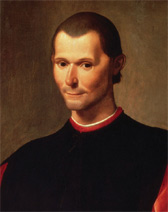
Niccolo Machiavelli
Founder of Modern Political Science and Realist Political Thought
Born on May 3, 1469
Died on June 21, 1527
Age at death: 58
Profession: Philosopher, Statesman, Poet, Political Theorist
Place of Birth: Florence, Italy
Place of Death: Florence, Italy
Niccolò Machiavelli was one of the most important figures of the Italian Renaissance. A Florentine thinker, statesman, military strategist, poet, and playwright, he is widely regarded as the founder of modern political science and political realism.
Niccolò Machiavelli was born on May 3, 1469, in Florence, Italy, as the third child of a lawyer. His family was among the most distinguished and wealthy Florentine families since the 13th century, though over time they declined from nobility to the bourgeois class. His father, Bernardo Machiavelli, was a modestly prosperous lawyer and one of the poorest members of the family. Due to unpaid debts, he was barred from public office and practiced law discreetly. This financial hardship likely prevented Machiavelli from receiving an education fully suited to his talents. Nevertheless, he is known to have studied classical Latin and Greek literature extensively.
In 1494, when Florence was invaded by King Charles VIII of France, the ruling Medici family, following Lorenzo de' Medici, was expelled from the city. Subsequently, the friar Girolamo Savonarola seized power and established a theocracy that lasted four years. After Savonarola was overthrown, the Florentine bourgeoisie restored a republican form of government led by a council known as the “Council of Ten.” On June 15, 1498, at the age of 29, Niccolò Machiavelli was appointed secretary to this council, a position he held for fourteen years until 1512.
In July 1500, Niccolò Machiavelli undertook his first diplomatic mission to France. He returned there on a second diplomatic assignment in 1504. In 1506, he was sent on behalf of the Florentine Republic to meet with the Pope, further expanding his diplomatic experience.
In 1512, following the Battle of Ravenna, Spanish forces occupied Florence and restored the Medici dynasty to power. As a result, Niccolò Machiavelli was dismissed from his position as secretary. In addition to losing his post, he was fined heavily and forbidden from leaving Florence for one year.
In 1513, Niccolò Machiavelli was accused of involvement in a conspiracy against the Medici family. He was imprisoned for three months and subjected to torture. Although he was eventually released, he remained unemployed. He then withdrew to a farm in the village of Santa Andrea, a few kilometers outside Florence, where he raised his five children in poverty. During this period, he wrote most of his major works.
While living on his farm in Santa Andrea, Niccolò Machiavelli began writing The Prince in 1513, completing it over six years. Although written in 1513, the book was published posthumously in 1532. In this masterpiece, he argued that the interests of the state must take precedence in politics, positioning him as a pioneer of realist political theory.
In 1518, turning to a different genre, he wrote the satirical comedy The Mandrake, which was staged within two years and achieved considerable success.
On September 23, 1513, Cardinal Giulio de' Medici assumed control of Florence’s government. Niccolò Machiavelli strengthened his ties with the Medici family and entered their patronage. This enabled him to publish The Art of War in 1521. Giulio de' Medici also tasked him with drafting a constitutional proposal and writing the official history of Florence. In November 1520, Machiavelli was appointed official historian of the Florentine Republic.
On November 19, 1523, Cardinal Giulio de' Medici was elected Pope under the name Pope Clement VII. Niccolò Machiavelli completed his historical work Florentine Histories rapidly and presented the eight-book manuscript to the Pope in June 1525.
In April 1526, Niccolò Machiavelli was elected secretary to a five-member commission overseeing fortifications. He later joined Francesco Guicciardini, the papal lieutenant, in the alliance formed by the Pope against the Holy Roman Emperor Charles V (Holy Roman Emperor).
Due to the inconsistent foreign policy of the new Pope, Emperor Charles V declared war on Florence and occupied the city in May 1527, once again ending Medici rule. Following the Medici collapse, a new democratic regime was established by the bourgeoisie. Distrustful of anyone associated with the Medici, the new rulers dismissed Niccolò Machiavelli along with many others from public service.
Disheartened by this loss of trust, Niccolò Machiavelli suddenly fell ill and died on June 21, 1527, in Florence at the age of 58. He was buried in the Basilica of Santa Croce. Throughout his life, he had struggled tirelessly for the ideal of a unified Italy.
The term “Machiavellianism” evolved into a pejorative label describing politicians who believe that any means are justified by their ends. Nevertheless, thinkers such as Denis Diderot, Jean Jacques Rousseau, Johann Gottlieb Fichte, and Georg Wilhelm Friedrich Hegel sought to reveal the constructive dimensions of Machiavelli’s thought. Hegel argued that Machiavelli’s true aim—the elevation of Italy to the status of a unified state—was misunderstood by those who saw only a defense of tyranny. Italian Marxist philosopher Antonio Gramsci famously described him as an “early Jacobin.”
Niccolò Machiavelli advocated the secularization and scientific grounding of political thought. Although critical of the Church and a defender of secular governance, he maintained that rulers should use religion instrumentally when necessary to maintain political power.
In The Prince, Niccolò Machiavelli outlined the qualities required of a ruler and the measures needed to strengthen sovereignty. These ideas later formed the basis of Machiavellianism. He argued that a ruler must be resolute, willing to do whatever is necessary to retain power, and should rule through fear rather than love—while avoiding hatred. He emphasized military mastery, pragmatic morality, and the strategic appearance of virtue.
Major Works:
1503 – The Way to Deal with the Rebellious Subjects of the Valdichiana
1508 – Portrait of the Affairs of Germany
1510 – Portrait of the Affairs of France
1513 – Discourses on the First Ten Books of Livy
1513 – The Prince (written in 1513, published in 1532)
1518 – The Mandrake
1520 – The Life of Castruccio Castracani of Lucca
1520 – Discourse on the Reform of the State of Florence
1521 – The Art of War
1522 – History of Conspiracies
1525 – Florentine Histories
Key Political Concepts:
Virtù and Fortuna: Virtù represents personal ability, strength, and initiative, while Fortuna signifies chance. Machiavelli argued that rulers who rely solely on fortune cannot remain in power without virtù.
The Army: A strong military is essential; laws are meaningless without armed force to uphold them.
Human Nature: Humans are inherently selfish and unreliable; therefore, political actors must act with suspicion and caution.
Religion: Religion should be subordinated to the state and used as a political tool to secure obedience and unity.
Niccolò Machiavelli remains one of the most influential and controversial thinkers in political history, whose ideas continue to shape debates on power, morality, and governance.
Source: Biyografiler.com
Frequently asked questions about Niccolo Machiavelli
Who is Niccolo Machiavelli?, Niccolo Machiavelli biography, Niccolo Machiavelli life story, Niccolo Machiavelli age, Niccolo Machiavelli facts, Niccolo Machiavelli birthplace, Niccolo Machiavelli photos, Niccolo Machiavelli videos, Niccolo Machiavelli career
Related Biographies

Lamine Yamal
Professional footballer

Kylian Mbappe
Professional footballer

Erling Haaland
Professional footballer

Sam Altman
Entrepreneur, Investor, CEO

Austin Abrams
Actor

Bad Bunny
Rapper, Songwriter


Hongjoong
Singer, Rapper, Songwriter, Composer

Ludacris
Rapper, Actor

Kwon Eunbi
Singer

Sarah Wayne Callies
Actress, Screenwriter, Producer, Director

LaTavia Roberson
Singer, Actress, Entrepreneur

Pedro Sanchez
Politician

Adam Sandler
Actor

Cillian Murphy
Actor
Lamine Yamal
Professional footballer
Austin Abrams
Actor

Brad Pitt
Actor