
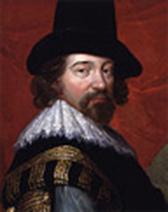
Francis Bacon
The Father of Empiricism
Born on January 22, 1561
Died on April 9, 1626
Age at death: 65
Profession: Philosopher, Statesman
Place of Birth: London, England
Place of Death: Highgate, London, England
Francis Bacon was an English philosopher, statesman, scientist, jurist, and essayist who is regarded as one of the central figures in the emergence of modern scientific thought. He is best known as the chief advocate of empiricism, the view that knowledge must be grounded in observation, experimentation, and evidence rather than inherited authority or abstract speculation. His ideas helped shape the intellectual climate that led to the Scientific Revolution and the Enlightenment.
Bacon was born into a powerful and well-connected family. His father, Sir Nicholas Bacon, served as Lord Keeper of the Great Seal during the reign of Queen Elizabeth I, placing the family at the heart of English political life. Bacon was educated at Trinity College, Cambridge, where he became dissatisfied with the dominance of Aristotelian philosophy, particularly the methods derived from Aristotle, which he believed produced little practical knowledge. He later trained in law at Gray’s Inn, preparing him for a career in public service.
Throughout his life, Bacon sought to reform human knowledge by rejecting reliance on medieval scholasticism and classical authorities. He openly criticized the intellectual legacy of Aristotle and argued that progress required a new method based on systematic observation and inductive reasoning. His ideas anticipated and influenced later scientists such as Galileo Galilei and thinkers who emphasized experimentation as the foundation of scientific truth.
Alongside his philosophical ambitions, Bacon pursued a distinguished political career. He served as a Member of Parliament and held major offices including Solicitor General, Attorney General, and ultimately Lord Chancellor of England under King James I. Despite his success, his political life ended abruptly in 1621 when he was accused of corruption for accepting bribes. Bacon admitted to the charges and was removed from office, an event that permanently damaged his public reputation but freed him to devote himself fully to intellectual work.
Bacon’s most influential philosophical text, Novum Organum (1620), proposed a new system of logic intended to replace Aristotle’s Organon. In this work, he introduced inductive reasoning as the proper method for scientific investigation and outlined the famous “Idols of the Mind,” which he described as systematic sources of human error. His broader intellectual vision, known as the “Great Instauration,” aimed to reorganize all fields of knowledge through a disciplined, experimental approach.
Bacon’s ideas strongly influenced later philosophers, including Thomas Hobbes, who briefly served as his secretary, and later empiricists such as John Locke. His emphasis on experience and observation also helped prepare the intellectual ground for figures like René Descartes, even where they disagreed with his rejection of pure rationalism. Although Bacon did not conduct major scientific experiments himself, his philosophy shaped the scientific culture that later produced institutions such as The Royal Society, which embodied his ideal of collaborative, evidence-based inquiry.
In addition to philosophy and science, Bacon made lasting contributions to literature. His collection Essays explores themes such as ambition, power, morality, truth, and human behavior with clarity and precision. These writings influenced later essayists and remain valued for their aphoristic style and practical insight into political and personal life.
Francis Bacon died in 1626, reportedly after contracting pneumonia while experimenting with methods of food preservation using snow. This anecdote has often been cited as symbolic of his lifelong commitment to empirical investigation. His enduring legacy lies in redefining knowledge as a progressive, methodical, and practical enterprise—an idea that continues to underpin modern science and philosophy.
Source: Biyografiler.com
Frequently asked questions about Francis Bacon
Who is Francis Bacon?, Francis Bacon biography, Francis Bacon life story, Francis Bacon age, Francis Bacon facts, Francis Bacon birthplace, Francis Bacon photos, Francis Bacon videos, Francis Bacon career
Related Biographies

Lamine Yamal
Professional footballer

Sam Altman
Entrepreneur, Investor, CEO

Kylian Mbappe
Professional footballer

Alice Weidel
Politician, Economist

Erling Haaland
Professional footballer

Giorgia Meloni
Politician, Journalist


Hongjoong
Singer, Rapper, Songwriter, Composer

Ludacris
Rapper, Actor

Kwon Eunbi
Singer

Sarah Wayne Callies
Actress, Screenwriter, Producer, Director

LaTavia Roberson
Singer, Actress, Entrepreneur

Kaia Gerber
Model, Actress

Zohran Mamdani
Politician, Musician
Sam Altman
Entrepreneur, Investor, CEO
Lamine Yamal
Professional footballer

Monica Bellucci
Actress, Model
Kylian Mbappe
Professional footballer