
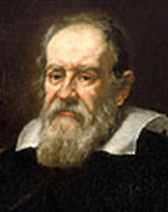
Galileo Galilei
Born on February 15, 1564
Died on January 8, 1642
Age at death: 78
Profession: Physicist, Astronomer, Philosopher
Place of Birth: Pisa, Tuscany, Italy
Place of Death: Arcetri, Florence, Italy
Galileo Galilei is regarded as the father of modern physics and one of the central figures of the Scientific Revolution. An Italian scientist whose name is inseparably associated with this transformative era, Galileo conducted extensive studies in physics, astronomy, and astrology, while also developing influential philosophical views on nature. Focusing primarily on motion, he advanced the physical foundations of the heliocentric astronomical system.
Born on February 15, 1564, in Pisa, Tuscany, Galileo Galilei was one of six children of Vincenzo Galilei, a well-known musician of his time. After completing his early education in Florence, he began studying medicine at the University of Pisa in 1581. Due to financial difficulties, he was forced to abandon his studies, and from 1583 onward he turned his attention to mathematics. His achievements in this field led to his appointment as a professor in Pisa in 1589.
Convinced that phenomena such as pendulums, floating bodies, and motion should be examined mathematically rather than through the lens of Aristotle’s physics, Galileo Galilei conducted groundbreaking experiments. By dropping weights from the Leaning Tower of Pisa, he demonstrated that all falling bodies experience the same acceleration, thereby disproving Aristotelian logic. He established that free fall is a uniformly accelerated motion and showed that the distance traveled during free fall is proportional to the square of time. These ideas brought him into conflict with senior scholars, and in 1592 he left Pisa to take up the chair of mathematics at the University of Padua.
In 1597, Galileo Galilei commercially introduced a compass that could be used for military purposes. Shortly after 1600, he invented a primitive thermometer and developed a pendulum device intended for measuring human heartbeats.
After learning in 1609 that the telescope had been invented in the Netherlands, Galileo Galilei constructed a more advanced version himself and began using it for astronomical observation. As the first scientist to employ the telescope systematically for astronomy, he made significant discoveries and recorded them in his 1610 book The Starry Messenger (Siderius Nuntius).
This work, which presented his first observations of the Moon’s surface, star clusters, and the Milky Way, and reported the existence of four moons orbiting Jupiter, attracted immense attention and earned him the position of court mathematician in Florence. While discussing the phases of Venus and the shape of Saturn, he critically examined the Ptolemaic system. Observing the Sun, he proved that the dark spots on its surface were sunspots, not shadows caused by Mercury or by small celestial bodies passing between the Earth and the Sun.
In 1611, Galileo Galilei traveled to Rome, where he became a member of the Scientific Academy. After returning to Florence, he published a book on hydrostatics that provoked strong objections from many professors, followed in 1613 by a work on sunspots. Because this latter publication openly defended the Copernican system, he faced severe pressure from the clergy and traveled to Rome in 1615 to defend his views. In 1616, a commission established by Pope Paul V did not ban his books but demanded that he abandon the claim that the Earth moves.
Turning for a time toward the practical aspects of science, Galileo Galilei improved the microscope. In 1618, the discovery of three comets once again brought him into conflict with the Church. Encouraged after a friend was elected as Pope Urban VIII, he published Dialogue Concerning the Two Chief World Systems in 1632. Summoned to Rome, he was tried by the Inquisition, and in 1633 his book was banned and he was sentenced to life imprisonment.
Imprisoned at the age of seventy and blinded while under house arrest in 1636, Galileo Galilei died on January 8, 1642, in Arcetri.
Source: Biyografiler.com
Frequently asked questions about Galileo Galilei
Who is Galileo Galilei?, Galileo Galilei biography, Galileo Galilei life story, Galileo Galilei age, Galileo Galilei facts, Galileo Galilei birthplace, Galileo Galilei photos, Galileo Galilei videos, Galileo Galilei career
Related Biographies

Lamine Yamal
Professional footballer

Kylian Mbappe
Professional footballer

Erling Haaland
Professional footballer

Sam Altman
Entrepreneur, Investor, CEO

Austin Abrams
Actor

Bad Bunny
Rapper, Songwriter


Hongjoong
Singer, Rapper, Songwriter, Composer

Ludacris
Rapper, Actor

Kwon Eunbi
Singer

Sarah Wayne Callies
Actress, Screenwriter, Producer, Director

LaTavia Roberson
Singer, Actress, Entrepreneur

Adam Sandler
Actor

Cillian Murphy
Actor
Lamine Yamal
Professional footballer

Brad Pitt
Actor

Pedro Sanchez
Politician
Austin Abrams
Actor