
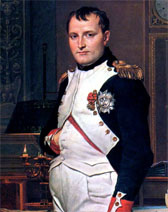
Napoleon Bonaparte
Born on August 15, 1769
Died on May 5, 1821
Age at death: 52
Profession: Statesman, Military Commander
Place of Birth: Ajaccio, Corsica
Place of Death:
Napoleon Bonaparte, whose original name was Napoleone di Buonaparte, was a general of the French Revolution and the first ruler of the French Republic. After assuming the name Napoleon I, he became Emperor of France and King of Italy, ruling as Emperor of France from 18 May 1804 to 6 April 1814.
Napoleon Bonaparte was born on 15 August 1769 in Ajaccio, Corsica, as the second son of Carlo Buonaparte and Marie Letizia Ramolino. He received his early education in Brienne in 1779 and entered the Parisian military academy École Royale Militaire in 1784. In April 1785, he joined an artillery regiment in Valence with the rank of second lieutenant. Later that year, while on leave in Corsica, he became actively involved in military and political affairs within the Jacobin movement and failed to return to his unit, which led to him being considered a deserter. However, after the outbreak of war with Austria in April 1792, he was pardoned and recalled to service with the rank of captain.
Continuing his involvement against Corsican nationalists who had launched an independence struggle against France, Napoleon Bonaparte eventually fled to France with his family. Upon returning to Paris, he joined the forces of Paul François Barras and Lazare Carnot to suppress anti-Convention uprisings. Due to his political activities, he was briefly imprisoned on charges of treason but was later released with the help of influential political allies, during a period when France adopted a new constitution and established the Directory.
In December 1793, at Toulon, Napoleon Bonaparte distinguished himself as an artillery commander against Royalist and British coalition forces, earning a promotion to brigadier general. In 1794, he was appointed commander of artillery units in Italy. On 5 October 1795, he became commander of the Internal Security Forces and quickly emerged as one of France’s most respected military authorities.
In 1796, Napoleon Bonaparte was appointed commander-in-chief of the Army of Italy. On 10 April of the same year, he married Josephine de Beauharnais, the widow of General de Beauharnais. Two days after the wedding, he launched a campaign in Northern Italy, defeating Austrian forces and forcing their withdrawal by January 1797. Advancing toward Vienna, he agreed to peace negotiations after Austria requested an armistice, resulting in a treaty signed on 17 October 1797.
In early 1798, assigned to plan an invasion of England, Napoleon Bonaparte argued that such an operation would fail without naval superiority and instead proposed occupying Egypt to cut Britain’s trade route to the East. He launched the Egyptian campaign in 1798, capturing Malta and Alexandria and advancing through the Nile Valley. He defeated the Mamluks at the Battle of the Pyramids. However, the British fleet under Horatio Nelson destroyed the French navy at Aboukir Bay, cutting off French supply lines. Subsequently, a coalition of Britain, the Ottoman Empire, Austria, and Russia, under the command of Alexander Suvorov, reclaimed the territories Napoleon had seized.
During the campaign, French forces captured coastal cities such as Gaza, Jaffa, and Haifa. After the fall of Jaffa, thousands of Ottoman prisoners and civilians were executed, marking one of the darkest episodes of the expedition. In February 1799, Napoleon Bonaparte advanced into Syria but was forced to retreat from Acre on 21 May 1799 due to strong Ottoman resistance led by Cezzar Ahmet Pasha and widespread disease among his troops.
Leaving his army in Egypt, Napoleon Bonaparte returned to France on 23 August 1799. On 9 November 1799, he carried out a coup d’état that ushered in a new political era. After constitutional reforms, power was vested in three consuls, with Napoleon becoming First Consul and the de facto ruler of France. During this period, King Louis XVI was deposed and executed. Napoleon initiated major reforms in administration, finance, the judiciary, and law enforcement, and founded the Bank of France in 1802.
Despite reforms, Austria and Britain remained hostile. In 1800, Napoleon Bonaparte re-entered Italy, captured Milan, and defeated Austrian forces. Following victories by Jean Victor Moreau and the signing of peace treaties in 1801 and 1802, Europe briefly enjoyed peace. However, Britain declared war again in May 1803 as France’s power continued to grow.
In 1804, Napoleon Bonaparte introduced the Napoleonic Code, which gained widespread public support. In May of the same year, he declared himself Emperor. On 2 December 1804, he crowned himself Emperor at Notre Dame Cathedral in Paris in the presence of Pope Pius VII, famously placing the crown on his own head before crowning Josephine Empress. On 26 May 1805, he also crowned himself King of Italy at Milan Cathedral.
Facing the Third Coalition formed by Britain, Austria, Russia, Naples, and Sweden, Napoleon Bonaparte suffered a naval defeat at the Battle of Trafalgar on 21 October 1805. Turning his focus to land warfare, he achieved decisive victories at Ulm and Austerlitz on 2 December 1805, defeating Austrian and Russian forces. Subsequent victories over Prussia at Jena and Russia at Friedland led to the Treaty of Tilsit in July 1807 with Tsar Alexander I.
In March 1810, Napoleon Bonaparte married Marie-Louise of Austria, a member of the Habsburg dynasty. Their son, Napoleon II, was born in 1811. On 22 June 1812, Napoleon invaded Russia with an army of 453,000 men, naming the campaign the Second Polish War. Despite initial successes, Russian scorched-earth tactics, harsh climate, and supply shortages devastated the French army. After the costly Battle of Borodino on 7 September 1812, Napoleon was forced into a disastrous retreat.
Following heavy losses and declining public support, Napoleon Bonaparte was defeated in 1813–1814. In 1814, with enemy forces approaching Paris, he was forced to abdicate and was exiled to Elba. Louis XVIII was restored to the French throne. Napoleon escaped Elba on 7 March 1815, returned to power for the Hundred Days, but was decisively defeated by British forces under Arthur Wellesley, Duke of Wellington and Prussian forces under Gebhard von Blücher at the Battle of Waterloo on 18 June 1815.
After his final abdication, Napoleon Bonaparte surrendered to the British and was exiled to the island of St. Helena in the Atlantic Ocean. He spent his remaining years there dictating his memoirs. He died on 5 May 1821 at the age of 52. His remains were returned to Paris in 1840 and buried at Les Invalides. The exact cause of his death remains uncertain, with theories including poisoning.
Throughout his rule, Napoleon Bonaparte won the admiration of much of the French population and achieved numerous military victories. However, internal unrest, resistance from occupied nations, the dominance of the British Navy, and rising nationalism within Europe ultimately undermined his empire. His legacy continued through his nephew Napoleon III, who became ruler of France in 1851.
Source: Biyografiler.com
Frequently asked questions about Napoleon Bonaparte
Who is Napoleon Bonaparte?, Napoleon Bonaparte biography, Napoleon Bonaparte life story, Napoleon Bonaparte age, Napoleon Bonaparte facts, Napoleon Bonaparte birthplace, Napoleon Bonaparte photos, Napoleon Bonaparte videos, Napoleon Bonaparte career
Related Biographies

Lamine Yamal
Professional footballer

Kylian Mbappe
Professional footballer

Erling Haaland
Professional footballer

Sam Altman
Entrepreneur, Investor, CEO

Bad Bunny
Rapper, Songwriter

Brad Pitt
Actor


Hongjoong
Singer, Rapper, Songwriter, Composer

Ludacris
Rapper, Actor

Kwon Eunbi
Singer

Sarah Wayne Callies
Actress, Screenwriter, Producer, Director

LaTavia Roberson
Singer, Actress, Entrepreneur
Brad Pitt
Actor

Sarah Jessica Parker
Actress, Producer
Lamine Yamal
Professional footballer

Stephen King
Novelist, Screenwriter

Quentin Tarantino
Film Director, Actor, Screenwriter

Zohran Mamdani
Politician, Musician