
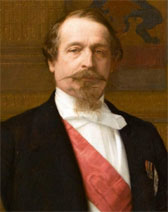
Napoleon III
The Last Emperor of France
Born on April 20, 1808
Died on January 9, 1873
Age at death: 65
Profession: Politician, Emperor
Place of Birth: Paris, France
Place of Death: Chislehurst, London, England
Napoleon III, who served as President of France from 1848 to 1852, dismantled the republican system through a coup d’état and proclaimed himself emperor. He ruled as the last Emperor of France from 1852 until 1870, marking the final chapter of imperial rule in French history.
Napoleon III was born on April 20, 1808, in Paris, France. His full name was Charles Louis Napoleon Bonaparte. His father was Louis Bonaparte, King of Holland from 1806 to 1810, and his mother was Hortense de Beauharnais, the stepdaughter of Napoleon Bonaparte. As the nephew of Napoleon Bonaparte, he considered himself the legitimate heir of the Bonaparte dynasty. Born into a family with strong imperial legacy, Napoleon III experienced an adventurous youth and received a solid education.
After the death of Napoleon II, Duke of Reichstadt, on July 22, 1832, and the political inactivity of his father and uncles, Napoleon III declared himself the rightful successor of the Bonaparte dynasty. In 1832, he published a political pamphlet titled Political Reveries, arguing that only an emperor could bring victory and freedom to France. In 1834, he joined the Swiss militia and became an artillery captain.
Believing he could rally the French army through his Bonaparte lineage, Napoleon III attempted to incite an uprising at the Strasbourg garrison on October 30, 1836. This failed coup led to his exile to Brazil by King Louis-Philippe. He returned briefly to see his dying mother, who passed away in 1837. Forced to leave Switzerland under French pressure, he settled in London in 1838.
In 1839, he published Napoleonic Ideas, transforming Bonapartism from a romantic legend into a political ideology. He argued that ideology and politics were shaped by both rational thought and belief, and that history advanced through great individuals chosen by divine will. On August 6, 1840, he led another failed coup attempt near Boulogne with 56 supporters. He was arrested and sentenced to life imprisonment at the Fortress of Ham. During his imprisonment, he wrote several works, including The Extinction of Pauperism, which earned him support among left-wing circles. He escaped prison on May 25, 1846, and fled to England.
Following the 1848 Revolution and the proclamation of the Second Republic, Napoleon III returned to Paris and was elected to the Constituent Assembly. Leveraging the prestige of his uncle’s name, he eliminated republican and socialist opposition and was elected President of France on December 10, 1848. He quickly consolidated power by placing loyalists in key military and administrative positions.
Blocked by constitutional limits that prevented his re-election, Napoleon III staged a coup d’état on December 2, 1851. After suppressing republican resistance, he dissolved the Legislative Assembly and introduced a new constitution granting universal suffrage. Following a referendum, he proclaimed himself Emperor Napoleon III in November 1852. On December 2, 1852, he formally established the Second French Empire.
Despite promising “reasonable freedom,” Napoleon III governed through authoritarian methods. He imposed strict press controls, suppressed opposition, and centralized power. At the same time, he pursued ambitious economic reforms, investing heavily in infrastructure, railways, banking institutions, agriculture, and industry. His policies doubled industrial output and transformed Paris into a modern capital through large-scale urban redevelopment.
In foreign policy, Napoleon III sought to dismantle the post-1815 European order established by the Congress of Vienna and restore France as a great power. He played a key role in the Crimean War against Russia, gaining diplomatic prestige despite limited material gains. In 1859, he allied with Camillo di Cavour to expel Austria from Italy, achieving victory at the Battle of Solferino. France gained Nice and Savoy in 1860. He also supported the construction of the Suez Canal, engineered by Ferdinand de Lesseps.
Napoleon III’s later reign was marked by political liberalization and foreign policy failures. He expanded legislative powers, granted workers the right to strike, and relaxed press restrictions. However, the disastrous Mexican expedition and growing domestic dissatisfaction weakened his regime.
The turning point came with the Franco-Prussian War. On July 19, 1870, France declared war on Prussia. The French army was decisively defeated at the Battle of Sedan, and Napoleon III was captured on September 2, 1870. He was deposed, and the Third Republic was proclaimed on September 4, 1870.
After his release, Napoleon III went into exile in England. He died on January 9, 1873, in Chislehurst, London, at the age of 65, following complications from kidney surgery.
Napoleon III married Eugénie de Montijo in 1853, the daughter of Prosper Mérimée. The couple had one son, Louis-Napoléon Bonaparte. As the final ruler of the Bonaparte dynasty, Napoleon III marked the end of imperial France, after which republican governance became permanent.
Source: Biyografiler.com
Frequently asked questions about Napoleon III
Who is Napoleon III?, Napoleon III biography, Napoleon III life story, Napoleon III age, Napoleon III facts, Napoleon III birthplace, Napoleon III photos, Napoleon III videos, Napoleon III career
Related Biographies

Lamine Yamal
Professional footballer

Erling Haaland
Professional footballer

Kylian Mbappe
Professional footballer

Keanu Reeves
Actor

Austin Abrams
Actor

Bad Bunny
Rapper, Songwriter


Hongjoong
Singer, Rapper, Songwriter, Composer

Ludacris
Rapper, Actor

Kwon Eunbi
Singer

Sarah Wayne Callies
Actress, Screenwriter, Producer, Director

LaTavia Roberson
Singer, Actress, Entrepreneur

Pedro Sanchez
Politician
Lamine Yamal
Professional footballer

Claudia Sheinbaum
President, Politician, Scientist, Academic
Erling Haaland
Professional footballer

Leonardo DiCaprio
Actor
Austin Abrams
Actor