
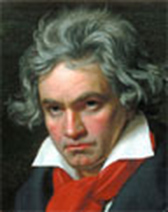
Ludwig van Beethoven
The Bridge Between Classical and Romantic Music
Born on December 16, 1770
Died on March 26, 1827
Age at death: 57
Profession: Composer, Pianist
Place of Birth: Bonn, Germany
Place of Death: Vienna, Austria
Ludwig van Beethoven was a German classical music composer and pianist, widely regarded as one of the most influential figures in the history of Western music. Born on 17 December 1770 in Bonn, Germany, he was of Dutch descent. He had seven siblings, all of whom were disabled. Beethoven received his first music lessons from his father Johann van Beethoven, an alcoholic musician. Experiencing an unhappy childhood, he began working at a young age by playing the piano in churches to help support his family.
In 1779, Beethoven began studying with Christian Gottlob Neefe. In 1783, with Neefe’s assistance, his first composition, Variations on a March by Dressler, was published. By the age of thirteen, he was playing the organ at court and contributing significantly to household expenses. Four years later, he traveled to Vienna.
In 1787, Beethoven went to Vienna hoping to study with Wolfgang Amadeus Mozart. He took lessons from Mozart for a short period, and Mozart became the first teacher to recognize Beethoven’s extraordinary talent. On one occasion, while Beethoven was playing the piano at Mozart’s home, Mozart drew the attention of his friends and said that the world would one day speak of this young man.
As Beethoven’s mother’s illness worsened—she was suffering from tuberculosis—he returned to Bonn. A few days later, she passed away in his arms. In 1792, at the age of twenty-two, Beethoven returned to Vienna, only to learn that Mozart had died. He then began studying with the famous classical composer Joseph Haydn, who quickly recognized Beethoven’s exceptional abilities and supported him in every way. Initially, Beethoven became known not as a composer but as a pianist. Later, through his compositions, he influenced virtually all musicians who lived until the late 19th century. From his arrival in Vienna in 1792 until his death, Beethoven lived there continuously.
His remarkable piano skills attracted the attention of Prince Carl Lichnowsky and his wife. Music-loving Austrian aristocrats welcomed Beethoven into their home and agreed to pay him an annual stipend of six hundred florins. They also helped him gain recognition within Viennese high society.
Until 1794, Beethoven performed for music-loving aristocrats at courts and private gatherings in Vienna. He did not appear before the general public until 1795. At first, he gained fame as a pianist and teacher rather than as a composer, but he soon achieved widespread recognition.
Beethoven completed his First Symphony in 1800. He dedicated his Third Symphony, Eroica Symphony, to Napoleon Bonaparte, but withdrew the dedication after Napoleon declared himself emperor. His Ninth Symphony is often regarded as one of the greatest symphonies ever composed.
In 1798, Beethoven began experiencing hearing problems. From that point on, he gradually withdrew from verbal communication, and by 1819 he communicated with others primarily through writing, having become completely deaf. The twenty-one years he spent in isolation caused him profound suffering. Remarkably, Beethoven composed all of his symphonies after the onset of his hearing loss.
Although Beethoven loved several women throughout his life, he never married. The woman he loved most, and came closest to marrying, was known as the “Immortal Beloved.” Although her identity remains uncertain, she is widely believed to have been Antonie Brentano, the wife of a Frankfurt merchant. Beethoven dedicated Diabelli Variations to his Immortal Beloved.
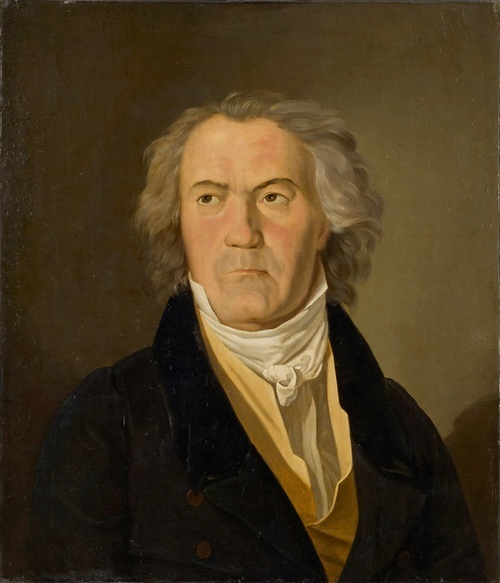
In 1823, Austrian painter Ferdinand Georg Waldmüller created a portrait of Ludwig van Beethoven.
Beethoven was a slow and meticulous composer who refined his works with extraordinary care. His sketches reveal that ideas initially appearing insignificant evolved into unique masterpieces, with a simple minuet transforming into a perfect scherzo. His music is exceptionally powerful in both expression and technique. To create more energetic and dynamic works, he deliberately avoided the elegance characteristic of Mozart’s music. Unlike Mozart, Beethoven frequently explored the subconscious world in his compositions. Although his works adhere to classical forms, especially with the Piano Sonata Op. 109, he significantly accelerated the transition to the Romantic period.
Beethoven composed only one opera. Originally titled Leonore, the opera Fidelio is considered one of the finest operas ever written.
Throughout his life, Beethoven produced nine symphonies, one violin concerto, five piano concertos, a triple concerto, the opera Fidelio, thirty-two piano sonatas, ten violin–piano sonatas, five cello sonatas, one horn sonata, numerous chamber music works, and many other compositions in various forms.
Ludwig van Beethoven died on 26 March 1827 in Vienna, Austria, at the age of fifty-seven, from cirrhosis of the liver.
Today, the final movement of Beethoven’s Ninth Symphony, composed in 1823 and known as Ode to Joy, is performed as the official anthem at formal occasions by the European Union and the Council of Europe.
Source: Biyografiler.com
Ludwig van Beethoven Movies
A Clockwork Orange
Release Date: December 19, 1971
Director: Stanley Kubrick
Writer: Stanley Kubrick, Anthony Burgess
Cast: Malcolm McDowell, Patrick Magee, Michael Bates, Warren Clarke, John Clive
Frequently asked questions about Ludwig van Beethoven
Who is Ludwig van Beethoven?, Ludwig van Beethoven biography, Ludwig van Beethoven life story, Ludwig van Beethoven age, Ludwig van Beethoven facts, Ludwig van Beethoven birthplace, Ludwig van Beethoven photos, Ludwig van Beethoven videos, Ludwig van Beethoven career
Related Biographies

Lamine Yamal
Professional footballer

Kylian Mbappe
Professional footballer

Erling Haaland
Professional footballer

Sam Altman
Entrepreneur, Investor, CEO

Bad Bunny
Rapper, Songwriter

Brad Pitt
Actor


Hongjoong
Singer, Rapper, Songwriter, Composer

Ludacris
Rapper, Actor

Kwon Eunbi
Singer

Sarah Wayne Callies
Actress, Screenwriter, Producer, Director

LaTavia Roberson
Singer, Actress, Entrepreneur
Brad Pitt
Actor

Sarah Jessica Parker
Actress, Producer

Stephen King
Novelist, Screenwriter
Lamine Yamal
Professional footballer

Quentin Tarantino
Film Director, Actor, Screenwriter

Zohran Mamdani
Politician, Musician