
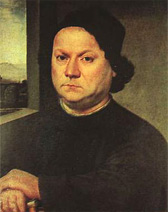
Andrea del Verrocchio
Italian Renaissance sculptor, painter, and goldsmith who worked under the patronage of the Medici family in Florence. He was the teacher of Leonardo da Vinci and created works including David, Christ and Saint Thomas, The Baptism of Christ, and the equestrian monument to Bartolomeo Colleoni.
Born on ?? ??, 1435
Died on October 10, 1488
Age at death: 53
Profession: Sculptor, Painter
Place of Birth: Florence, Republic of Florence (present-day Italy)
Place of Death: Venice, Republic of Venice (present-day Italy)
Andrea del Verrocchio, whose birth name was Andrea di Michele di Francesco de' Cioni, was born around 1435 in Florence, Italy. He was an Italian sculptor, painter, and goldsmith of the Early Renaissance. Working under the patronage of the Medici family, particularly Lorenzo de' Medici, he produced bronze sculptures, religious paintings, and funerary monuments. His workshop trained several Renaissance artists, including Leonardo da Vinci, Pietro Perugino, and Lorenzo di Credi. His principal works include the bronze David, Christ and Saint Thomas, and the equestrian monument to Bartolomeo Colleoni in Venice. He also worked with Leonardo on The Baptism of Christ, now displayed in the Uffizi Gallery. He died in Venice in 1488 while working on the Colleoni monument.
Early Life and Artistic Training
Andrea del Verrocchio was born around 1435 in Florence, then part of the Republic of Florence. His father, Michele di Francesco Cioni, initially worked in brick and tile production and later became a tax collector. His mother was named Gemma.
Verrocchio began his career as a goldsmith. His professional name is traditionally associated with the Florentine goldsmith Giuliano Verrocchi, although details of his apprenticeship remain uncertain.
He subsequently learned sculpture and painting. His artistic development has been associated with Donatello, Desiderio da Settignano, and Alesso Baldovinetti, although the precise nature of his training with these artists is not fully documented.
By the 1460s, he was working independently in Florence, producing sculptures, paintings, and decorative metalwork.
Workshop in Florence and Leonardo da Vinci
During the 1460s, Andrea del Verrocchio established a workshop in Florence that accepted commissions for sculpture, painting, and goldsmithing.
Among the artists who trained or worked in his workshop were Leonardo da Vinci, Pietro Perugino, Lorenzo di Credi, and Francesco di Simone Ferrucci. Sandro Botticelli, Domenico Ghirlandaio, Francesco Botticini, and Biagio d'Antonio have also been associated with his artistic circle or workshop.
Leonardo entered Verrocchio's workshop during the 1460s and remained connected with it into the early 1470s. By 1472, Leonardo had joined the Florentine painters' confraternity.
The workshop produced paintings, bronze and marble sculptures, architectural decoration, and designs for religious and civic commissions. Assistants frequently worked on different parts of the same project under Verrocchio's supervision.
Verrocchio's training included drawing, perspective, human anatomy, modeling, and the representation of movement. His workshop provided Leonardo with practical experience in several artistic techniques.
Patronage of the Medici Family
Andrea del Verrocchio received commissions from the Medici family, which exercised considerable political and economic influence in Florence during the fifteenth century.
His work for the family included the bronze statue David, generally dated to around 1465–1470. The sculpture depicts the biblical David standing over the severed head of Goliath.
The statue was later displayed at the Palazzo della Signoria and is now preserved in the Bargello National Museum in Florence.
Between approximately 1469 and 1473, Verrocchio created the funerary monument of Piero de' Medici and Giovanni de' Medici, sons of Cosimo de' Medici. The monument is located in the Basilica of San Lorenzo in Florence.
Its design combines marble, bronze, decorative metalwork, and architectural elements.
Christ and Saint Thomas
One of Andrea del Verrocchio's principal sculptural commissions was Christ and Saint Thomas, created for the exterior of the Orsanmichele church in Florence.
The commission was awarded in 1467 by the city's merchants' tribunal. Verrocchio worked on the bronze group for several years, completing it in 1483.
The sculpture depicts the resurrected Christ showing the wound in his side to the apostle Thomas the Apostle, who reaches forward to examine it.
The composition places the two figures within an architectural niche, using their gestures and expressions to represent the biblical encounter.
The original sculpture is preserved in the Orsanmichele museum, while a replica occupies its former exterior location.
The Baptism of Christ and Leonardo's Contribution
Between approximately 1470 and 1475, Andrea del Verrocchio and members of his workshop produced The Baptism of Christ, a painting originally commissioned for the church of San Salvi in Florence.
The painting depicts Jesus Christ being baptized by John the Baptist in the River Jordan. Two kneeling angels appear on the left, while the landscape extends into the background.
The work was created using tempera and oil on a wooden panel measuring approximately 177 × 151 centimeters.
Leonardo da Vinci, then a young artist in Verrocchio's workshop, painted the angel on the left. Modern studies also attribute portions of the landscape and other passages to Leonardo.
According to Renaissance biographer Giorgio Vasari, Verrocchio was so impressed by Leonardo's contribution that he decided to stop painting. This account is traditionally repeated in biographies of the artist, although there is no firm evidence that he abandoned painting for that reason.
The painting is currently displayed in the Uffizi Gallery in Florence.

Equestrian Monument to Bartolomeo Colleoni
During the final decade of his life, Andrea del Verrocchio worked on a large equestrian monument commemorating Bartolomeo Colleoni, a military commander who had served the Republic of Venice.
Colleoni had died in 1475, leaving money for a monument in his honor. Venetian authorities subsequently commissioned a bronze equestrian statue.
Verrocchio began preparing designs and models around 1479–1480. The monument depicts Colleoni mounted on a horse, wearing military armor and holding the reins.
In the early 1480s, Verrocchio increasingly concentrated on the Venetian commission. He entrusted the management of his Florentine workshop to his pupil Lorenzo di Credi.
Verrocchio died before the monument could be cast in bronze. After his death, Venetian sculptor Alessandro Leopardi was appointed to complete the casting and installation.
The finished monument was erected in 1495 at Campo Santi Giovanni e Paolo in Venice, where it remains today.
Artistic Style
Andrea del Verrocchio worked in bronze, marble, gold, and other materials. His sculptures show an interest in human anatomy, the movement of figures, and detailed surface treatment.
His painting workshop combined drawing, perspective, and the representation of light with collaborative production methods.
These techniques formed part of the artistic education received by Leonardo da Vinci and other painters who later developed independent careers.
Personal Life
Andrea del Verrocchio never married. He devoted much of his professional life to managing his workshop and fulfilling commissions in Florence and Venice.
Death
Andrea del Verrocchio died in 1488 in Venice, at approximately 53 years of age. His exact date of death is not securely established.
Following his death, Lorenzo di Credi inherited responsibility for much of the Florentine workshop, while Alessandro Leopardi completed the equestrian monument to Bartolomeo Colleoni.
Selected Works
Circa 1465–1470 – David – Bronze sculpture, Bargello National Museum, Florence
Circa 1469–1473 – Tomb of Piero and Giovanni de' Medici – Basilica of San Lorenzo, Florence
Circa 1470–1475 – The Baptism of Christ – With Leonardo da Vinci, Uffizi Gallery, Florence
Circa 1470–1475 – Tobias and the Angel – Workshop painting, National Gallery, London
Circa 1470–1475 – The Virgin and Child with Two Angels – National Gallery, London
1467–1483 – Christ and Saint Thomas – Bronze sculpture, Orsanmichele, Florence
Circa 1476 – Monument to Cardinal Niccolò Forteguerri – Pistoia
Circa 1479–1488 – Equestrian Monument to Bartolomeo Colleoni – Completed after his death by Alessandro Leopardi, Venice
Source: Biyografiler.com
Frequently asked questions about Andrea del Verrocchio
Who is Andrea del Verrocchio?, Andrea del Verrocchio biography, Andrea del Verrocchio life story, Andrea del Verrocchio age, Andrea del Verrocchio facts, Andrea del Verrocchio birthplace, Andrea del Verrocchio photos, Andrea del Verrocchio videos, Andrea del Verrocchio career
Related Biographies

Lamine Yamal
Professional footballer

Erling Haaland
Professional footballer

Keanu Reeves
Actor

Kylian Mbappe
Professional footballer

Bad Bunny
Rapper, Songwriter

Leonardo DiCaprio
Actor

Andre Gide
Novelist, Essayist

Andreas Papandreu
Former Prime Minister, Politician, Economist

Andrea Mantegna
Painter

Andrea del Verrocchio
Sculptor, Painter

Andrea del Sarto
Painter

Andrea Bargnani
Former Professional Basketball Player

Amy Ryan
Actress

Andy Garcia
Actor, Film Director

Ali Larter
Actress, Former Model

Andy Serkis
Actor, Film Director

Ursula von der Leyen
Politician, Physician

John Healey
Politician