
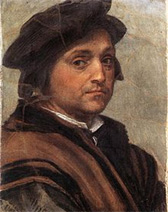
Andrea del Sarto
Italian Renaissance painter known for his frescoes in Florence and the 1517 altarpiece Madonna of the Harpies. He was associated with the High Renaissance and the early development of Mannerism.
Born on July 16, 1486
Died on January 21, 1531
Age at death: 45
Profession: Painter
Place of Birth: Florence, Republic of Florence (present-day Italy)
Place of Death: Florence, Republic of Florence (present-day Italy)
Andrea del Sarto, whose full name was Andrea d'Agnolo di Francesco di Luca, was born on July 16, 1486, in Florence, Italy. He was an Italian painter of the High Renaissance and an early influence on Mannerism. His works include frescoes at Santissima Annunziata, the life of Saint John the Baptist cycle at the Chiostro dello Scalzo, and The Last Supper at San Salvi. He is also known for the 1517 painting Madonna of the Harpies, now housed in the Uffizi Gallery. His paintings combine techniques associated with Leonardo da Vinci, Michelangelo Buonarroti, and Raphael. Art historian Giorgio Vasari described him as a painter *senza errori*, meaning "without errors," in reference to his technical abilities. Del Sarto died during a plague outbreak in Florence in September 1530, aged 44.
Early Life and Artistic Education
Andrea del Sarto was born on July 16, 1486, in Florence, then part of the Republic of Florence. He was the third son of Agnolo di Francesco, a tailor. His nickname, *del Sarto*, derives from his father's profession and means "of the tailor."
According to Giorgio Vasari's account, Andrea began his artistic training around 1494 as an apprentice to a goldsmith. He subsequently worked with a woodcarver and the painter Gian Barile.
In 1498, he entered the workshop of Piero di Cosimo, where he studied painting and drawing. He also encountered the work of Raffaellino del Garbo and other Florentine artists.
His early artistic development was influenced by the compositions of Raphael, Leonardo da Vinci's treatment of light and shadow, and Michelangelo's representation of the human figure.
Early Career and the Santissima Annunziata Frescoes
In 1508, Andrea del Sarto established a shared workshop with painter Franciabigio in Florence. On December 12 of that year, he was admitted to the Arte dei Medici e Speziali, the guild to which Florentine painters belonged.
Between 1509 and 1511, he painted a series of frescoes depicting scenes from the life of Saint Philip Benizi in the entrance courtyard of the Basilica della Santissima Annunziata.
His work at the basilica continued with compositions including The Journey of the Magi (1511) and The Birth of the Virgin (1513–1514).
These frescoes established his approach to large-scale religious compositions, using arrangements of figures, architectural settings, and changes in light to construct narrative scenes.
The Chiostro dello Scalzo Frescoes
Beginning around 1512, Andrea del Sarto worked on a series of frescoes illustrating the life of John the Baptist at the Chiostro dello Scalzo in Florence.
The paintings were executed in *grisaille*, a technique that uses variations of gray to imitate sculptural relief and create the appearance of three-dimensional forms.
The cycle includes scenes such as The Baptism of the People, The Sermon of John the Baptist, and The Birth of Saint John the Baptist.
Andrea continued working on the frescoes during the following decade, completing the principal cycle by 1526. The project also involved Franciabigio, who contributed to the decoration.
Madonna of the Harpies
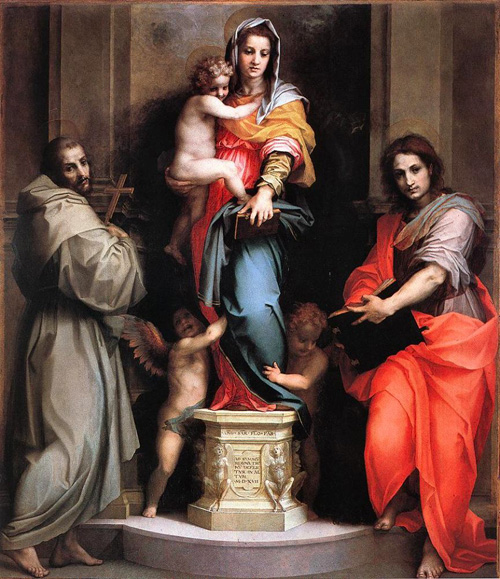
In 1517, Andrea del Sarto completed Madonna of the Harpies (*Madonna delle Arpie*), an oil painting commissioned for the convent of San Francesco dei Macci in Florence.
The painting depicts the Virgin Mary holding the infant Jesus while standing on a pedestal, accompanied by Francis of Assisi and John the Evangelist. Two small angels appear near the base of the composition.
The title derives from the figures depicted on the pedestal, which Vasari interpreted as harpies. Modern art historians have also identified them with the locusts described in the biblical Book of Revelation.
The composition combines a pyramidal arrangement associated with Raphael, the treatment of figures found in Michelangelo's works, and the softened colors associated with Leonardo da Vinci.
The painting is preserved in the Uffizi Gallery in Florence.
Marriage and Personal Life
Andrea del Sarto married Lucrezia di Bartolomeo del Fede, a widow who had previously modeled for some of his paintings, around 1517–1518.
Lucrezia continued appearing as a model in several works associated with Andrea's workshop. Her facial features have been identified in some of his depictions of the Virgin Mary and other female figures.
Contemporary accounts of their marriage, especially those written by Giorgio Vasari, influenced later descriptions of the painter's personal life. Some details in these accounts remain disputed by art historians.
Journey to France and the Court of Francis I
In May 1518, Andrea del Sarto traveled to France after receiving an invitation from King Francis I of France. He left his wife in Florence and entered the service of the French royal court.
During his stay, he produced paintings for the king, including Charity (*La Charité*), dated 1518 and now held by the Louvre Museum in Paris.
Andrea returned to Florence in 1519. According to Vasari, the king had entrusted him with money to purchase Italian artworks for the French court, but Andrea used the funds for other purposes and did not return to France. This account has been questioned by later historians.
Later Works in Florence
Following his return from France, Andrea del Sarto resumed work in Florence, producing religious paintings and frescoes for churches and private patrons.
In 1519, he received a commission for The Last Supper at the convent of San Salvi. The large fresco, completed around 1526–1527, depicts Jesus and the apostles gathered around a table.
In 1521, he worked on The Tribute to Caesar at the Villa Medicea di Poggio a Caiano, a Medici residence near Florence. The project was interrupted following the death of Pope Leo X.
During the plague outbreak of 1523, Andrea temporarily left Florence and traveled to the Mugello region. He produced religious works during this period, including an altarpiece for the church of San Pietro a Luco.
In 1525, he completed Madonna del Sacco (*Madonna of the Sack*), a fresco in the great cloister of Santissima Annunziata.
His later paintings included Four Saints and Sacra Conversazione, both dated 1528. The former is preserved in the Uffizi Gallery, while the latter is associated with the Berlin State Museums.
Andrea also worked with younger painters, including Jacopo Pontormo, Rosso Fiorentino, and Giorgio Vasari, who studied aspects of his painting techniques.
Painting Style
Andrea del Sarto worked primarily in fresco and oil painting. His compositions were characterized by carefully arranged figures, balanced proportions, and the use of color to create depth.
He adopted elements of Leonardo da Vinci's *sfumato* technique, using gradual transitions between light and shadow. His treatment of color also differed from the sharply defined outlines common in earlier Florentine painting.
His work influenced the development of Mannerism in Florence, particularly through the artists who trained in his workshop.
Connection with Madonna in a Fur Coat
The painting Madonna of the Harpies is mentioned in Madonna in a Fur Coat (*Kürk Mantolu Madonna*), the 1943 novel by Turkish writer Sabahattin Ali.
In the novel, the protagonist Raif Efendi encounters a self-portrait painted by Maria Puder. The portrait is compared with Andrea del Sarto's depiction of the Virgin Mary in Madonna of the Harpies.
The resemblance between the two paintings is described through their facial expressions and the positioning of the figures. The comparison becomes part of the explanation for the novel's title.
Death
Andrea del Sarto died in Florence in September 1530 during an outbreak of the plague. He was 44 years old.
He was buried at the Basilica della Santissima Annunziata in Florence.
Selected Paintings and Frescoes
1509–1511 – Life of Saint Philip Benizi – Fresco cycle, Santissima Annunziata, Florence
1511 – The Journey of the Magi – Santissima Annunziata, Florence
1512–1526 – Life of Saint John the Baptist – Fresco cycle, Chiostro dello Scalzo, Florence
1513–1514 – The Birth of the Virgin – Santissima Annunziata, Florence
1517 – Madonna of the Harpies – Uffizi Gallery, Florence
1518 – Charity (*La Charité*) – Louvre Museum, Paris
1520–1521 – The Tribute to Caesar – Villa Medicea di Poggio a Caiano
1522 – Madonna of the Steps – Museo del Prado, Madrid
1524 – Luco Pietà – Palazzo Pitti, Florence
1525 – Madonna del Sacco – Santissima Annunziata, Florence
1526–1527 – The Last Supper – San Salvi, Florence
1528 – Four Saints – Uffizi Gallery, Florence
1528 – Sacra Conversazione – Berlin
1528 – Sacrifice of Isaac – Cleveland Museum of Art
1529 – Medici Holy Family – Palazzo Pitti, Florence
Source: Biyografiler.com
Frequently asked questions about Andrea del Sarto
Who is Andrea del Sarto?, Andrea del Sarto biography, Andrea del Sarto life story, Andrea del Sarto age, Andrea del Sarto facts, Andrea del Sarto birthplace, Andrea del Sarto photos, Andrea del Sarto videos, Andrea del Sarto career
Related Biographies

Lamine Yamal
Professional footballer

Erling Haaland
Professional footballer

Keanu Reeves
Actor

Kylian Mbappe
Professional footballer

Bad Bunny
Rapper, Songwriter

Leonardo DiCaprio
Actor

Andre Gide
Novelist, Essayist

Andreas Papandreu
Former Prime Minister, Politician, Economist

Andrea Mantegna
Painter

Andrea del Verrocchio
Sculptor, Painter

Andrea del Sarto
Painter

Andrea Bargnani
Former Professional Basketball Player

Amy Ryan
Actress

Andy Garcia
Actor, Film Director

Ali Larter
Actress, Former Model

Andy Serkis
Actor, Film Director

Ursula von der Leyen
Politician, Physician

John Healey
Politician