
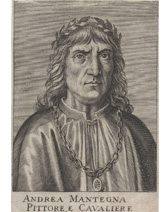
Andrea Mantegna
Italian Renaissance painter known for his use of perspective, foreshortening, and classical Roman imagery. His works include The Lamentation over the Dead Christ, the San Zeno Altarpiece, The Triumphs of Caesar, and the frescoes of the Camera degli Sposi.
Born on ?? ??, 1431
Died on September 13, 1506
Age at death: 75
Profession: Painter
Place of Birth: Isola di Carturo, Republic of Venice (present-day Italy)
Place of Death: Mantua, Italy
Andrea Mantegna was born in 1431 in Isola di Carturo, near Padua, in the Republic of Venice, present-day Italy. He was an Italian Renaissance painter and engraver associated with the artistic traditions of Padua and Mantua. His work is characterized by detailed architectural settings, figures influenced by ancient Roman sculpture, and the use of perspective and foreshortening. His painting The Lamentation over the Dead Christ is a frequently cited example of foreshortening in Renaissance art. He also painted frescoes for the Ovetari Chapel in Padua and the Camera degli Sposi in Mantua, created the San Zeno Altarpiece in Verona, and produced the series The Triumphs of Caesar. From 1460 until his death in 1506, he served the Gonzaga family, rulers of Mantua.
Early Life and Artistic Education
Andrea Mantegna was born in 1431 in Isola di Carturo, a village near Padua. His father, Biagio, was a carpenter. During childhood, Andrea entered the workshop of Francesco Squarcione, a painter and teacher with an interest in ancient Roman art.
Squarcione adopted Mantegna and trained him in drawing and painting. His workshop contained examples and reproductions of ancient sculptures, which influenced the young artist's treatment of human anatomy and architectural forms.
Mantegna remained in Squarcione's workshop for several years but ended their professional relationship in 1448. By that time, he had begun accepting independent commissions.
The artistic environment of Padua also exposed him to the works of Donatello, Paolo Uccello, and Andrea del Castagno.
Ovetari Chapel Frescoes
In 1448, Andrea Mantegna was commissioned to participate in the decoration of the Ovetari Chapel in the Church of the Eremitani in Padua.
The project included frescoes depicting episodes from the lives of Saint James the Greater and Saint Christopher. Mantegna initially worked alongside other painters, including Nicolò Pizolo.
He continued working on the chapel until approximately 1457. The compositions featured classical architectural settings, carefully constructed perspective, and figures modeled on ancient sculpture.
Much of the fresco cycle was destroyed during the bombing of Padua in March 1944, during the Second World War. Surviving fragments and photographic records document the original paintings.
Marriage and the Bellini Family
In 1453, Andrea Mantegna married Nicolosia Bellini, daughter of Venetian painter Jacopo Bellini.
Through the marriage, he became related to painters Giovanni Bellini and Gentile Bellini, Nicolosia's brothers.
Mantegna and Giovanni Bellini were active during the same period and developed artistic relationships that included shared interests in religious subjects, composition, and the representation of figures.
San Zeno Altarpiece
In 1457, Andrea Mantegna received a commission to create an altarpiece for the Basilica of San Zeno in Verona. Completed around 1459, the work depicts the Virgin Mary and Child surrounded by saints within an architectural setting.
The San Zeno Altarpiece originally included three smaller paintings beneath the central composition, collectively known as the predella.
These depicted The Agony in the Garden, The Crucifixion, and The Resurrection.
In 1797, French troops removed the altarpiece from Verona. The main panels were eventually returned to San Zeno, but the original predella paintings remained in France.
The Crucifixion is now housed in the Louvre Museum in Paris, while The Agony in the Garden and The Resurrection are preserved in the Musée des Beaux-Arts de Tours.
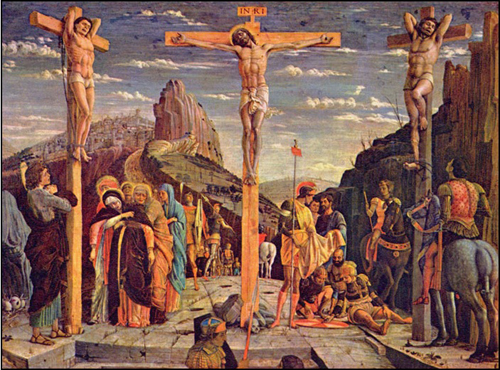
The Crucifixion, originally part of the San Zeno Altarpiece, is now displayed at the Louvre Museum in Paris.
Court Painter in Mantua
In 1460, Andrea Mantegna entered the service of Ludovico III Gonzaga, Marquis of Mantua.
He became the official painter of the Gonzaga court and spent most of the remainder of his life in Mantua. His responsibilities included producing portraits, religious paintings, and decorative works for the family's residences.
Between 1465 and 1474, he decorated the Camera degli Sposi (*Bridal Chamber*) in the Ducal Palace of Mantua.
The frescoes depict members of the Gonzaga family, courtiers, and scenes associated with the Mantuan court. The ceiling includes a painted circular opening, or *oculus*, surrounded by figures who appear to look down into the room.
Mantegna used perspective to create the illusion of architectural space extending beyond the actual walls and ceiling.
The Lamentation over the Dead Christ
Among Andrea Mantegna's paintings is The Lamentation over the Dead Christ, also known as The Dead Christ or *Cristo morto*.
The painting depicts the body of Jesus Christ lying on a stone slab after the Crucifixion. The figures of the Virgin Mary, John the Evangelist, and another mourner appear beside the body.
Its composition presents Christ from the direction of his feet, with the body extending away from the viewer. This technique, known as *foreshortening*, represents a three-dimensional figure within the limited space of a two-dimensional surface.
Mantegna adjusted the proportions of the body to maintain the visibility of Christ's face and torso while preserving the effect of depth.
The painting is executed in tempera on canvas and measures approximately 68 × 81 centimeters.
Its precise date remains uncertain, although the Pinacoteca di Brera in Milan, where the work is displayed, dates it to approximately 1483.
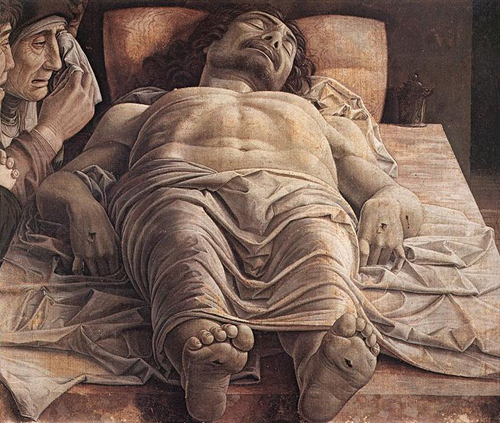
The Lamentation over the Dead Christ, also known as *The Dead Christ*, is housed in the Pinacoteca di Brera in Milan.
The Triumphs of Caesar
During the 1480s and 1490s, Andrea Mantegna worked on The Triumphs of Caesar, a series of nine paintings depicting a triumphal procession associated with the Roman general Julius Caesar.
The paintings present soldiers, musicians, captured weapons, ceremonial objects, animals, and prisoners participating in a Roman military procession.
Mantegna drew on his knowledge of ancient Roman sculpture, architecture, and historical sources to construct the scenes.
The series was created for the Gonzaga court and later entered the collections of the English monarchy. It is preserved at Hampton Court Palace in England.
Later Works and Isabella d'Este
During his later years, Andrea Mantegna received commissions from Isabella d'Este, who married Francesco II Gonzaga in 1490 and became Marchioness of Mantua.
Isabella commissioned paintings for her private study, known as the *studiolo*, in the Gonzaga residence.
In 1497, Mantegna completed Parnassus, an allegorical painting featuring figures from classical mythology, including Venus, Mars, Apollo, and the Muses.
In 1502, he completed Minerva Expelling the Vices from the Garden of Virtue, another mythological composition commissioned for Isabella's study.
Both works are preserved in the Louvre Museum in Paris.
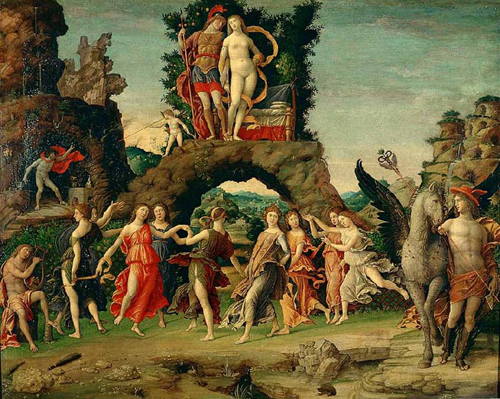
Parnassus (1497), painted for Isabella d'Este, is now in the Louvre Museum.
Artistic Style and Engraving
Andrea Mantegna worked primarily as a painter and engraver. His interest in classical antiquity influenced the architectural settings, costumes, and human figures in his compositions.
He frequently depicted figures with sharply defined outlines, sculptural forms, and carefully arranged spatial relationships.
His use of perspective and foreshortening was particularly evident in his religious paintings and illusionistic frescoes.
Mantegna also produced engravings based on religious and mythological subjects. These prints circulated beyond the cities in which he worked and helped make his compositions known to other artists.
He was associated with the development of Renaissance painting in northern Italy, particularly in Padua and Mantua.
Death
Andrea Mantegna died on September 13, 1506, in Mantua, Italy, at approximately 75 years of age.
He was buried in the Basilica of Sant'Andrea in Mantua, where he had been preparing a chapel for his burial.
Selected Works
1448–1457 – Ovetari Chapel Frescoes – Church of the Eremitani, Padua
1453–1454 – San Luca Altarpiece – Pinacoteca di Brera, Milan
1457–1459 – San Zeno Altarpiece – Basilica of San Zeno, Verona
1457–1459 – The Crucifixion – Louvre Museum, Paris
1457–1459 – The Agony in the Garden – Musée des Beaux-Arts de Tours
1457–1459 – The Resurrection – Musée des Beaux-Arts de Tours
1465–1474 – Camera degli Sposi Frescoes – Ducal Palace, Mantua
Circa 1483 – The Lamentation over the Dead Christ – Pinacoteca di Brera, Milan
1480s–1490s – The Triumphs of Caesar – Hampton Court Palace, England
1496 – Madonna della Vittoria – Louvre Museum, Paris
1497 – Parnassus – Louvre Museum, Paris
1502 – Minerva Expelling the Vices from the Garden of Virtue – Louvre Museum, Paris
Source: Biyografiler.com
Frequently asked questions about Andrea Mantegna
Who is Andrea Mantegna?, Andrea Mantegna biography, Andrea Mantegna life story, Andrea Mantegna age, Andrea Mantegna facts, Andrea Mantegna birthplace, Andrea Mantegna photos, Andrea Mantegna videos, Andrea Mantegna career
Related Biographies

Lamine Yamal
Professional footballer

Erling Haaland
Professional footballer

Keanu Reeves
Actor

Kylian Mbappe
Professional footballer

Bad Bunny
Rapper, Songwriter

Leonardo DiCaprio
Actor

Andre Gide
Novelist, Essayist

Andreas Papandreu
Former Prime Minister, Politician, Economist

Andrea Mantegna
Painter

Andrea del Verrocchio
Sculptor, Painter

Andrea del Sarto
Painter

Andrea Bargnani
Former Professional Basketball Player

Amy Ryan
Actress

Andy Garcia
Actor, Film Director

Ali Larter
Actress, Former Model

Andy Serkis
Actor, Film Director

Ursula von der Leyen
Politician, Physician

John Healey
Politician