
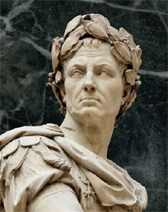
Julius Caesar
Born on -
Age: -
Profession: Statesman, Writer
Place of Birth: Rome, Italy
Julius Caesar was a Roman military and political leader, widely regarded as one of the greatest commanders and statesmen in history. He was also a celebrated author and played a decisive role in the transformation of the Roman Republic.
Julius Caesar was born in July 100 BC in Rome, Italy. His mother was Aurelia Cotta and his father was Gaius Julius. According to a popular legend, Caesar was delivered by cutting open his mother’s abdomen after her death, which allegedly gave rise to his name meaning “cut from.” This story later inspired the term used for the modern surgical procedure known as cesarean section.
A Roman general and statesman, Julius Caesar is considered one of the most brilliant military commanders and political figures of all time. In his political conduct, he generally sided with the common people and attempted to ease the pressure exerted by the Roman aristocracy on the populace.
In 80 BC, the young Julius Caesar served as an envoy at the court of Nicomedes IV of Bithynia. During this period, rumors spread claiming that Caesar and Nicomedes were lovers. These allegations later haunted Caesar’s political life, earning him the mocking nickname “Queen of Bithynia” from his rivals.
In 83 BC, Caesar married Cornelia Cinna minor, the daughter of Lucius Cornelius Cinna, a supporter of Gaius Marius. This marriage aligned him with the Marian faction and drew him into the conflict between Sulla and the Marians. As a result, Caesar was forced to leave Rome and was only able to return after Sulla’s death in 78 BC. He then traveled to Rhodes to study rhetoric under the renowned teacher Apollonius Molo, who had also taught Marcus Tullius Cicero. Five years later, Caesar returned to Rome, devoted himself fully to politics, supported Pompeius Magnus, and sought to win popular favor through generosity.
While traveling by ship to Rhodes, Julius Caesar was captured by pirates in the Aegean Sea. The pirates took him to Antalya and demanded a ransom of twenty talents. Offended, Caesar reportedly shouted that he was worth at least fifty talents and promised to have them crucified once he was free. During his captivity, he spent his time drinking, reciting poetry, and playing games with his captors. After thirty-eight days, the ransom was paid, and Caesar was released.
True to his word, Caesar immediately gathered ships in Miletus, pursued the pirates, captured them off the coast of Antalya, and brought them to Pergamon. Although the Roman governor intended to sell them into slavery, Caesar ordered their execution without waiting for official approval and had them crucified.
After the death of Cornelia in 68 BC, Caesar married Pompeia. In 66 BC, he was elected praetor, a high magistracy preceding the consulship. By suppressing a revolt in Western Hispania, he obtained sufficient spoils to pay off his debts. In 59 BC, Caesar was elected consul alongside the conservative Marcus Calpurnius Bibulus. That same year, he formed the “First Triumvirate” with Pompeius Magnus and Marcus Licinius Crassus.
As consul, Julius Caesar largely sidelined the Senate and ruled independently. He enacted laws distributing land to poor citizens and to Pompey’s discharged soldiers, forgave one-third of tax debts, and secured loyalty among officers. He later became governor of Dalmatia, Illyria, Northern Italy, and Southern Gaul. After removing rivals such as Marcus Tullius Cicero and Cato the Younger from Rome, Caesar launched his Gallic campaigns in 58 BC. Over eight years, he conquered territories stretching from the Rhine River to the Pyrenees, emerging as Rome’s most powerful figure.
Following the death of Marcus Licinius Crassus in 53 BC and the deterioration of relations with Pompeius Magnus, the First Triumvirate collapsed. In 49 BC, the Senate, under Pompey’s influence, demanded that Caesar disband his army. Enraged, Caesar crossed the Rubicon River with his troops, initiating civil war. After a sixty-day campaign, his forces took control of Italy.
Caesar pursued Pompey into Greece and defeated him decisively at the Battle of Pharsalus in 48 BC. Pompey fled to Egypt, where he was murdered in Alexandria by order of Egyptian officials seeking Caesar’s favor. Upon arriving in Egypt, Caesar intervened in the dynastic struggle between Cleopatra VII and her sister, securing Cleopatra’s throne. He later traveled to Anatolia, defeated Pharnaces II of Pontus in 47 BC, and famously reported his victory to the Senate with the words “I came, I saw, I conquered.”
Caesar’s victories continued relentlessly. In 46 BC, he crushed the remaining Pompeian forces in North Africa, and in 45 BC, he defeated Pompey’s sons in Spain. These successes left him the sole holder of power in Rome. He assumed the imperial title, extended his dictatorship for ten years, and had a statue erected in the Temple of Quirinus. The month of August was renamed “Julius” in his honor.
In February 45 BC, Caesar’s daughter Julia Caesaris died, a loss from which he never fully recovered.
Julius Caesar used his authority to implement far-reaching reforms. He reorganized the legal status of Italian cities, improved provincial administration, eased debt laws, granted citizenship and senatorial eligibility to provincial elites, and established colonies for the poor in Carthage and Corinth.
These reforms significantly weakened the Senate’s authority. When Caesar was declared dictator for life in 44 BC, fears arose that he intended to establish a monarchy. A group of aristocrats led by Marcus Junius Brutus and Gaius Cassius Longinus conspired against him. On March 15, 44 BC, during a Senate meeting, Julius Caesar was assassinated. Upon seeing his close friend Brutus among the attackers, he is said to have uttered his famous last words: “Et tu, Brute?” (“You too, Brutus?”).
Julius Caesar was murdered on March 15, 44 BC, in Rome, Italy, at the age of 56, while attending a session of the Senate.
Spouses:
Cornelia Cinna minor (84 BC – 68 BC)
Pompeia (68 BC – 63 BC)
Calpurnia Pisonis (59 BC – 44 BC)
Lovers:
Cleopatra VII
Servilia Caepionis, mother of Marcus Junius Brutus
Eunoë, Queen of Mauretania and wife of Bogudes
Children:
Julia Caesaris (83/82 BC – 54 BC)
Caesarion (47 BC – 30 BC), executed at age 17 by Caesar’s adopted heir Octavianus (Augustus)
Augustus Caesar (adopted son)
Source: Biyografiler.com
Frequently asked questions about Julius Caesar
Who is Julius Caesar?, Julius Caesar biography, Julius Caesar life story, Julius Caesar age, Julius Caesar facts, Julius Caesar birthplace, Julius Caesar photos, Julius Caesar videos, Julius Caesar career
Related Biographies

Lamine Yamal
Professional footballer

Kylian Mbappe
Professional footballer

Erling Haaland
Professional footballer

Sam Altman
Entrepreneur, Investor, CEO

Austin Abrams
Actor

Bad Bunny
Rapper, Songwriter


Hongjoong
Singer, Rapper, Songwriter, Composer

Ludacris
Rapper, Actor

Kwon Eunbi
Singer

Sarah Wayne Callies
Actress, Screenwriter, Producer, Director

LaTavia Roberson
Singer, Actress, Entrepreneur

Pedro Sanchez
Politician

Adam Sandler
Actor

Cillian Murphy
Actor
Lamine Yamal
Professional footballer
Austin Abrams
Actor

Brad Pitt
Actor