
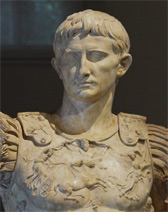
Augustus
First Emperor of the Roman Empire – Founder of the Principate
Born on -
Died on August 19, 0014
Age at death: -
Profession: Head of State
Place of Birth: Rome, Italy
Place of Death: Nola, Italy
Augustus, born as Gaius Octavius Thurinus, was the first Emperor of the Roman Empire and the architect of a new political order that transformed Rome from a republic into an imperial state. His reign marked the beginning of a long period of relative peace and stability known as the Pax Augusta.
Augustus was born on 23 September 63 BC in Rome. His full birth name was Gaius Octavius Thurinus. His mother was Atia, and his father, who bore the same name, died in 59 BC when Octavian was only four years old. He was raised by his mother and his stepfather Lucius Marcius Philippus. His great-uncle was Julius Caesar, a connection that would decisively shape his future. Augustus spent much of his childhood in Velletri, near Rome, under the care of his grandfather.
At the age of seventeen, in 46 BC, Augustus was assigned ceremonial duties during the Greek games organized by Julius Caesar for the Temple of Venus Genetrix. In 45 BC, Julius Caesar formally named him as his heir and adopted son, instantly placing him in direct rivalry with Mark Antony.
In 44 BC, while preparing to join Caesar’s eastern campaign in Illyria, Augustus learned of Caesar’s assassination on 15 March. He immediately returned to Rome and adopted the name Gaius Julius Caesar Octavianus. Following Caesar’s death, both Mark Antony and Augustus claimed political legitimacy. Antony seized Caesar’s papers and assets, prompting Augustus to rally Caesar’s veteran soldiers around himself.
By September 44 BC, the famed orator Marcus Tullius Cicero launched a series of speeches portraying Antony as the greatest threat to the Republic. As Antony attempted to secure control of Cisalpine Gaul, Augustus raised a private army in Italy and persuaded two of Antony’s legions to defect. Facing mounting opposition, Antony fled Rome on 1 January 43 BC.
With growing political support, Augustus entered the Senate on 1 January 43 BC. In April of that year, Antony’s forces were defeated at the Battles of Forum Gallorum and Mutina, forcing him to retreat into Transalpine Gaul. Later in November 43 BC, Augustus, Mark Antony, and Marcus Aemilius Lepidus met near Mutina and formed the Second Triumvirate.
In 42 BC, Augustus and Antony defeated Julius Caesar’s assassins Brutus and Cassius at the Battle of Philippi in Macedonia. By 40 BC, control of the Roman world was divided among the Triumvirs: Antony ruled the East, Augustus governed the West, and Lepidus controlled Africa. Antony’s military failures against the Parthians and his relationship with Cleopatra weakened his standing in Rome.
Augustus, by contrast, governed effectively and gained popular support. In 31 BC, tensions between Augustus and Antony erupted into war. Augustus won decisive naval and land victories at the Battle of Actium. After further defeat in Egypt, Antony died and Cleopatra committed suicide, leaving Augustus as the sole ruler of Rome.
Having ended decades of civil war, Augustus restored internal order and peace. His command over the Roman legions placed the Senate under implicit military pressure, preventing effective opposition. Between 28 and 18 BC, he reduced the number of senators from 1,000 to 600, canceled citizens’ debts, restored temples, and formally returned his powers to the Senate. In response, the Senate granted him the sacred title Augustus and bestowed upon him extraordinary authority in 27 BC, marking the beginning of the Principate.
During the Principate, Augustus reformed provincial administration. Provinces with standing armies were placed under imperial control, while peaceful provinces remained under the Senate. Governors received fixed salaries and lost financial authority, significantly reducing corruption. Tax collectors were restrained, protecting citizens from abuse.
In 12 BC, following the death of Lepidus, Augustus also assumed the title of Pontifex Maximus, gaining supreme religious authority. He invested heavily in public works throughout the empire, demobilized portions of the army, and expanded Roman territory, including Egypt (30 BC), Galatia (25 BC), and parts of Anatolia and Illyria.
The reign of Augustus inaugurated a prolonged era of peace known as the Pax Augusta. Apart from border conflicts and the brief civil war of the Year of the Four Emperors, the Mediterranean world experienced more than two centuries of relative stability. Augustus secured Rome’s borders through buffer states and achieved peace with the Parthians through diplomacy.
Believing that Rome’s previous turmoil stemmed from religious decay, Augustus revitalized traditional Roman paganism. Temples were restored, religious festivals revived, and monumental architecture flourished. One of the most famous projects was the Pantheon, commissioned by his close associate Marcus Agrippa, later rebuilt by Emperor Hadrian in AD 125.
Augustus reformed the Roman taxation system, introducing two lasting taxes: Tributum Capitis, a personal wealth tax on citizens, and Tributum Soli, a land tax on property owners. A state courier system and extensive road network were established, reinforcing the saying “All roads lead to Rome.” Major construction projects included the Forum of Augustus, the Temple of Apollo, the Temple of Caesar, triumphal arches, public baths, and temples dedicated to Mars and Pax.
He created a standing army, a small navy, the Praetorian Guard, an official police force, and a fire brigade. Rome was reorganized into fourteen districts, and Italy was divided into eleven regions governed by prefects. Infrastructure management, trade oversight, public supply, water systems, and fire control were systematically administered.
The historian Livy wrote his monumental history of Rome, Ab Urbe Condita, during Augustus’ reign. The poet Virgil composed Rome’s national epic, Aeneid. Roman literature reached one of its brightest periods under his patronage.
Augustus had no biological sons. He arranged the marriage of his daughter from his second wife to the son of his third wife and named Tiberius as his successor. Before his death, he composed an account of his achievements titled Res Gestae Divi Augusti. After his death, it was read in the Senate and inscribed on pillars across the empire. The most complete surviving text is preserved on the walls of the Temple of Augustus in Ankara, alongside versions in Antioch and Apollonia.
Augustus died on 19 August AD 14 in Nola, near Naples, at the age of 77, after ruling for more than forty years. He was succeeded by Tiberius. Following his death, the Senate declared him a god, and his name, along with Caesar, became a title adopted by all subsequent Roman emperors. The month of Sextilis was renamed August in his honor.
Marriages:
1st wife: Clodia Pulchra (m. 42–40 BC)
2nd wife: Scribonia (m. 40–38 BC)
3rd wife: Livia Drusilla (m. 38 BC – AD 14)
Source: Biyografiler.com
Frequently asked questions about Augustus
Who is Augustus?, Augustus biography, Augustus life story, Augustus age, Augustus facts, Augustus birthplace, Augustus photos, Augustus videos, Augustus career
Related Biographies


Lamine Yamal
Professional footballer

Kylian Mbappe
Professional footballer

Erling Haaland
Professional footballer

Sam Altman
Entrepreneur, Investor, CEO

Austin Abrams
Actor

Bad Bunny
Rapper, Songwriter


Hongjoong
Singer, Rapper, Songwriter, Composer

Ludacris
Rapper, Actor

Kwon Eunbi
Singer

Sarah Wayne Callies
Actress, Screenwriter, Producer, Director

LaTavia Roberson
Singer, Actress, Entrepreneur

Pedro Sanchez
Politician

Adam Sandler
Actor

Cillian Murphy
Actor
Austin Abrams
Actor
Lamine Yamal
Professional footballer

Brad Pitt
Actor