
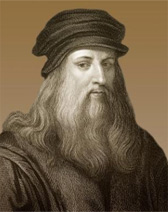
Leonardo da Vinci
Born on April 15, 1452
Died on May 2, 1519
Age at death: 67
Profession: Painter, Sculptor, Architect, Scientist
Place of Birth: Vinci, Republic of Florence (Italy)
Place of Death: Amboise, Indre-et-Loire, France
Leonardo da Vinci is regarded as the greatest representative of perfection and human intelligence in history. A universal genius, a multi-disciplinary artist, an inventor who shaped centuries, a sculptor, architect, engineer, and the greatest painter of the Italian Renaissance, he stands as one of the most extraordinary figures humanity has ever produced.
Leonardo da Vinci, one of the greatest forces of the Italian Renaissance and humanism, was born in 1452 in the town of Vinci, from which his family took its name. His father was the lawyer Ser Piero Antonio da Vinci. Because Leonardo’s mother was not from a noble family, his parents never married, and Leonardo was born out of wedlock. His mother, Caterina, later married another man, so Leonardo was raised in his father’s household.
From his earliest years of education, Leonardo progressed so rapidly in arithmetic and geometry that he astonished his teachers with the questions he asked. His sharp intelligence and talents were evident even at a very young age. He was also interested in music and played the lute extremely well. However, painting was his greatest passion during childhood. When his father recognized this talent, he placed him under the training of Andrea del Verrocchio, the head of one of Florence’s most important workshops and originally a master goldsmith. There, Leonardo received a remarkably comprehensive artistic education alongside Sandro Botticelli, Pietro Perugino, Lorenzo di Credi, Francesco di Simone, Francesco Botticini, and Biagio d’Antonio.
Between 1469 and 1476, Leonardo studied in what was essentially an unconventional “polytechnic laboratory,” where he gained foundational knowledge not only in drawing, architecture, and sculpture, but also in optics, botany, and music. Some of his early works, including the famous Arno Landscape, studies for the Adoration of the Magi, the sketch of Saint Jerome, and several paintings, date from this period. One of the angels in Andrea del Verrocchio’s painting The Baptism of Christ is believed to have been painted by Leonardo.
In June 1472, his name was entered into the register of the Florentine painters’ guild as an independent artist under the name Leonardo di Ser Piero da Vinci. Until 1482, he worked independently without the patronage of a famous or wealthy protector. He chose his own subjects for painting and sculpture and became the first painter to take nature itself as a direct model. Moving far beyond earlier approaches to form and color, he was the first artist to fully recognize the effects of light and shadow. He explored how color changes with perspective. His curiosity did not stop at observation; he studied the physical structure of the eye and worked on optics and wave motion. He also examined animal and human anatomy, researching the laws of muscular movement. By studying physiology and botany for the first time in such depth, he became a pioneer in these sciences as well, revealing the true scope of his multifaceted genius.
In 1482, Leonardo traveled to Milan, which was then ruled by Ludovico Sforza. He wrote an intriguing letter offering his services, proposing nine original ideas related to warfare and military engineering. He summarized his tenth idea as follows: “In times of peace, I believe I am equal to anyone in architecture, in the construction of buildings, and in the conduct of waterworks. I can execute sculpture in marble, bronze, or clay. As for painting, I can do as well as any man, whoever he may be. Furthermore, I can create a monument to immortalize the memory of your father.”
Leonardo brought with him a lute of unusual design, shaped like a horse’s head, and when he played before the Duke, he surpassed all other musicians. He was also the finest improvisational poet of his time. Ludovico Sforza was immediately captivated by the charm of this young Florentine and accepted his offer, enabling Leonardo to live and work in Milan for seventeen years.
During this period, Leonardo revealed his genius through countless projects. He directed court festivities, wrote satires, allegories, and songs, and fulfilled his official duties. He maintained an intense working rhythm through a unique sleep pattern, resting only about fifteen minutes at a time throughout the day. In 1485, a plague outbreak in Milan inspired him to design plans for rebuilding the city according to principles of public health, which he presented to the Duke. The following year, he prepared plans for Milan Cathedral. At the same time, he worked on geometry, astronomy, energy, and lute construction, while modeling the equestrian statue of Francesco Sforza. After years of labor, he completed an enormous 80-meter-high model, which was exhibited in Milan. However, it was never cast in bronze and was destroyed six years later during the French invasion.
The famous drawing made by Leonardo da Vinci in 1492, inspired by the proportions described by Marcus Vitruvius Pollio in his work De Architectura, became known as the Vitruvian Man.
In 1494, Leonardo prepared plans for a network of canals to cover the Lombardy plain and conducted observations on lightning and storms. That same year, he completed a painting of the Madonna and began his most famous work, The Last Supper, painted on the wall of the Santa Maria delle Grazie monastery. Due to experimental techniques, the painting soon began to deteriorate, yet despite its damaged condition, it remains one of the greatest works in the world. Considered the first masterpiece of the Renaissance to achieve absolute perfection, it is often described as the most perfect composition in the history of painting. During his Milan period, Leonardo also produced numerous decorative works and portraits, including The Virgin of the Rocks.
After Ludovico Sforza lost power, Leonardo left Milan at the end of 1499 and traveled to Venice, where he was warmly welcomed by Isabella Gonzaga. He drew her portrait in chalk and promised to later complete it as a painting, though science increasingly dominated his interests. He devoted most of his time to mathematics and engineering. His work as an architectural and military engineer shaped his travels, and he developed advanced designs for war machines, artillery, transport, and siege equipment. He improved upon the ideas of Filippo Brunelleschi, Taccola, Francesco di Giorgio, and Valturio, designing multi-barreled cannons, launching mechanisms, explosives, and even the modern form of scissors.
In April 1500, Leonardo returned to Florence, where he became interested in geography, studying tides in the Caspian Sea and preparing plans to canalize the Arno River. In 1502, he presented a bridge design for the Golden Horn to Bayezid II, which was not accepted, though it was later built in Norway in 2001. The marble block he declined to carve was later given to his contemporary Michelangelo Buonarroti for the creation of the David statue. It is said that Michelangelo Buonarroti disliked Leonardo and once mocked him in public.
In 1502, Leonardo entered the service of Cesare Borgia as chief engineer, traveling throughout central Italy and producing six extraordinarily detailed maps, now preserved in the Windsor Royal Library. After returning to Florence, he was commissioned to design a battle scene for a noble palace. Around this time, he worked on his most famous painting, Mona Lisa, completed in 1506, renowned for its enigmatic smile and profound mystery.
That same year, Leonardo returned once more to Milan and remained there until his fame spread throughout France. In 1514, he accepted the invitation of King Francis I of France and settled at the Château of Cloux near Amboise, where he lived until his death in 1519.
Beyond his extraordinary paintings and sculptures, Leonardo da Vinci earned his title as the greatest mind of the ages through his notebooks filled with writings and sketches. Centuries ahead of his time, he designed flying machines, studied the use of steam, sketched steam cannons, and developed paddle-wheel mechanisms for ships. He is considered the founder of hydraulic science and the inventor of the camera obscura in visual art. With extensive knowledge of water molecules, sound and light waves, and as the first to study plant structure and growth, Leonardo remains the supreme symbol of universal genius.
Source: Biyografiler.com
Frequently asked questions about Leonardo da Vinci
Who is Leonardo da Vinci?, Leonardo da Vinci biography, Leonardo da Vinci life story, Leonardo da Vinci age, Leonardo da Vinci facts, Leonardo da Vinci birthplace, Leonardo da Vinci photos, Leonardo da Vinci videos, Leonardo da Vinci career
Related Biographies

Lamine Yamal
Professional footballer

Kylian Mbappe
Professional footballer

Sam Altman
Entrepreneur, Investor, CEO

Erling Haaland
Professional footballer

Alice Weidel
Politician, Economist

Bad Bunny
Rapper, Songwriter


Hongjoong
Singer, Rapper, Songwriter, Composer

Ludacris
Rapper, Actor

Kwon Eunbi
Singer

Sarah Wayne Callies
Actress, Screenwriter, Producer, Director

LaTavia Roberson
Singer, Actress, Entrepreneur
Lamine Yamal
Professional footballer

Alfred Molina
Actor

Brad Pitt
Actor

Leonardo DiCaprio
Actor
Bad Bunny
Rapper, Songwriter

Keanu Reeves
Actor