
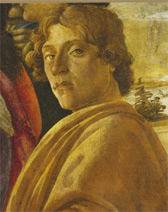
Sandro Botticelli
Renaissance Poet of Line and Grace
Born on March 1, 1445
Died on May 17, 1510
Age at death: 65
Profession: Painter
Place of Birth: Florence, Italy
Place of Death: Florence, Italy
Sandro Botticelli was a painter who played a crucial role in the development of Renaissance art. Born as Alessandro di Mariano di Vanni Filipepi on March 1, 1445, in Florence, Italy, he became one of the most distinctive masters of the Florentine Early Renaissance. His father, Mariano Filipepi, deliberately educated his son at home, teaching him foundational skills before placing him with a master craftsman. After receiving solid early training, Sandro was apprenticed to a goldsmith and artisan known as Botticelli, a close friend of his father. The artist later took his name from this master. At the time, goldsmiths and painters worked in close contact, which led Sandro to focus intensely on drawing. His fascination with design gradually evolved into a deep devotion to painting.
Following this decision, Sandro Botticelli became a student of Filippo Lippi. Although his early works show the influence of Lippi, later paintings reveal the impact of Andrea del Verrocchio. Botticelli’s talent developed rapidly, and while still young, he contributed a figure to works displayed alongside paintings by Antonio Pollaiuolo and Piero Pollaiuolo at the Mercanzia. From his earliest works onward, Botticelli earned widespread admiration. He skillfully achieved monumentality by selecting subjects from both religious narratives and classical mythology. His compositions often featured numerous figures, through which he developed a highly personal and recognizable style.
Botticelli favored flowing, oscillating lines, using dynamic contours that give his figures a sense of movement. Billowing fabrics and animated hair lend his paintings a refined and decorative elegance. In contrast to the strong and vivid color palettes popular in the early Renaissance, his own palette remained restrained and subdued. Italian artist and historian Giorgio Vasari described Botticelli as the first to devise a method for weaving banners and fabrics so that colors would appear clearly on both sides without bleeding.
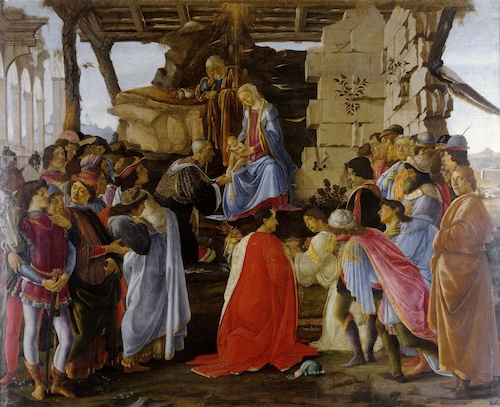
The painting that first brought Sandro Botticelli widespread fame was Adoration of the Magi (1475). This work ensured his recognition not only in Florence but beyond. Upon hearing of his reputation, Pope Sixtus IV commissioned Botticelli to decorate the chapel of the Vatican Palace, later known as the Sistine Chapel. In 1481, Botticelli traveled to Rome, where he worked alongside Cosimo Rosselli, Domenico Ghirlandaio, and Pietro Perugino on the Sistine Chapel frescoes. There, he painted three scenes from the life of Moses as well as The Temptation of Christ, all distinguished by rich detail and narrative complexity.
Between 1480 and 1490, during his mature period, Botticelli continued his artistic production in Florence under the patronage of Lorenzo de’ Medici. His work during this time solidified his importance in the evolution of Renaissance painting. A persistent inner anxiety, which pushed him to the edge of emotional intensity, shaped his artistic vision. He depicted ethereal and passionate figures, imbuing his paintings with a poetic and almost fragile elegance. His elongated bodies, long necks, and serious expressions—especially in his female figures—create a refined and textured visual language. Although he painted religious subjects, Botticelli was not a devotional painter in spirit; rather, he was a painter devoted to beauty itself.
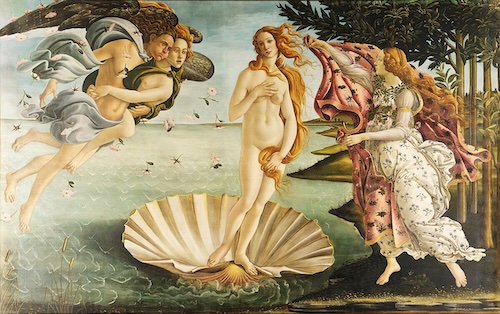
Among Sandro Botticelli’s most famous works are The Birth of Venus and La Primavera. Many of his paintings are housed today in the Uffizi Gallery in Florence. Dated to 1486, The Birth of Venus is one of the most concrete expressions of Florentine Early Renaissance culture and reflects the influence of classical ideals. Commissioned by Lorenzo de’ Medici, the painting depicts Venus, the goddess of beauty and love, standing at the center of the composition within a giant seashell.
After the year 1500, Botticelli produced very few paintings. Nevertheless, his works exerted a profound influence on artists of subsequent generations. His oeuvre can be divided into religious compositions and scenes depicting the daily life of Florence. Whether sacred or pagan, his paintings prioritize linear arabesque over sculptural volume. Grace and delicacy dominate his lines rather than force or power. While he drew inspiration from Greek mythology in accordance with the ideals of his time, he did not treat mythological subjects with sculptural rigidity. In this respect, Botticelli closed the first Florentine phase of the Renaissance and opened the path toward artistic individualism.
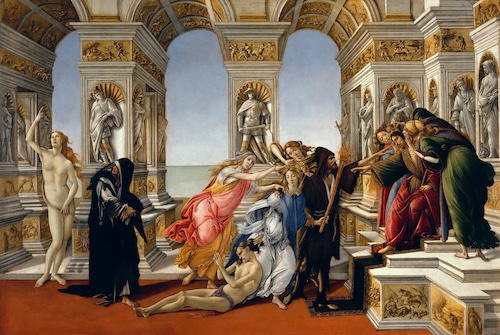
Sandro Botticelli died on May 17, 1510, in Florence, Italy, at the age of sixty-five. One of his remarkable Renaissance works, Calumny of Apelles, can still be seen today at the Uffizi Gallery in Florence.
Selected Works
- The Birth of Venus, 1486, Original Size: 175 x 278 cm, Location: Galleria degli Uffizi, Florence
- La Primavera, 1482, Original Size: 203 x 314 cm, Location: Galleria degli Uffizi, Florence
- Scenes from the Life of Saint Zenobius, 1500, Original Size: 66 x 182 cm, Location: Gemäldegalerie, Dresden
- Calumny of Apelles, 1495, Original Size: 62 x 91 cm, Location: Galleria degli Uffizi, Florence
- The Annunciation, 1490, Original Size: 150 x 156 cm, Location: Galleria degli Uffizi, Florence
- Venus and Mars, 1483, Original Size: 69 x 173 cm, Location: National Gallery, London
- Portrait of a Young Woman, 1476, Original Size: 47.5 x 35 cm, Location: Gemäldegalerie, Berlin
- Return of Judith, Location: Galleria degli Uffizi, Florence
- Pallas and the Centaur, Location: Galleria degli Uffizi, Florence
- Madonna and Child with Two Angels, 1470, Original Size: 100 x 71 cm, Location: Galleria Nazionale, Naples
- Madonna of San Barnaba, 1487, Original Size: 340 x 270 cm, Location: Galleria degli Uffizi, Florence
- Portrait of Giuliano de’ Medici, 1478, Original Size: 54 x 36 cm, Location: Gemäldegalerie, Berlin
- Mystic Nativity, 1500, Original Size: 109 x 75 cm, Location: National Gallery, London
- Story of Nastagio degli Onesti, 1487, Original Size: 138 x 83 cm, Location: Museo del Prado, Madrid
- Lamentation over the Dead Christ, 1500, Original Size: 140 x 207 cm, Location: Alte Pinakothek, Munich
- Madonna of the Pomegranate, 1487, Original Size: 143.5 x 143.5 cm, Location: Galleria degli Uffizi, Florence
- Adoration of the Magi, 1475, Original Size: 107.5 x 173 cm, Location: Galleria degli Uffizi, Florence
- Idealized Portrait of a Woman, 1480, Original Size: 81.8 x 54 cm, Location: Städelsches Kunstinstitut, Frankfurt
- Madonna with Saints, 1485, Original Size: 185 x 180 cm, Location: Gemäldegalerie, Berlin
- Madonna and Child with Singing Angels, 1477, Location: Gemäldegalerie, Berlin
- Adoration of the Magi, 1482, Original Size: 70 x 104.2 cm, Location: National Gallery of Art, Washington, D.C.
- Portrait of a Young Man, 1485, Original Size: 37.5 x 28.3 cm, Location: National Gallery, London
- Madonna Reading, 1480, Original Size: 59 x 39.5 cm, Location: Museo Poldi Pezzoli, Milan
- Three Miracles of Saint Zenobius, 1500, Original Size: 64.8 x 139.7 cm, Location: National Gallery, London
- Venus and the Three Graces Presenting Gifts to a Young Woman, 1486, Original Size: 211 x 283 cm, Location: Musée du Louvre, Paris
La Primavera (1478) was commissioned for the wedding of Lorenzo di Pierfrancesco de’ Medici. In this painting, Botticelli unites two different mythological narratives within a single open composition. At the center stands Venus, the goddess of love and beauty, whose halo-like presence formed by tree branches evokes a Christianized association with the Virgin Mary. With the coming of Venus—and symbolically with the arrival of Christ—nature awakens and spring begins.
To the right appears Zephyrus, god of the west wind, abducting Chloris, who transforms into Flora, the goddess of flowers, shown serenely scattering roses. On the left stand the Three Graces—Aglaia, Euphrosyne, and Thalia—symbols of brightness, joy, and elegance. At the far left, Mercury clears the clouds, while above Venus, Cupid aims his arrow toward the central Grace. Botticelli depicts nine mythological figures and over five hundred plant species representing more than one hundred seventy varieties, creating one of the most intricate and poetic visual narratives of the Renaissance.
Source: Biyografiler.com
Frequently asked questions about Sandro Botticelli
Who is Sandro Botticelli?, Sandro Botticelli biography, Sandro Botticelli life story, Sandro Botticelli age, Sandro Botticelli facts, Sandro Botticelli birthplace, Sandro Botticelli photos, Sandro Botticelli videos, Sandro Botticelli career

Lamine Yamal
Professional footballer

Kylian Mbappe
Professional footballer

Sam Altman
Entrepreneur, Investor, CEO

Erling Haaland
Professional footballer

Alice Weidel
Politician, Economist

Bad Bunny
Rapper, Songwriter


Hongjoong
Singer, Rapper, Songwriter, Composer

Ludacris
Rapper, Actor

Kwon Eunbi
Singer

Sarah Wayne Callies
Actress, Screenwriter, Producer, Director

LaTavia Roberson
Singer, Actress, Entrepreneur

Alfred Molina
Actor
Lamine Yamal
Professional footballer

Brad Pitt
Actor
Bad Bunny
Rapper, Songwriter

Leonardo DiCaprio
Actor

Keanu Reeves
Actor