
Rembrandt
The Master of Light and Shadow
Born on June 15, 1606
Died on November 4, 1669
Age at death: 63
Profession: Painter
Place of Birth: Leiden, Dutch Republic
Place of Death: Amsterdam, Dutch Republic
Rembrandt Harmenszoon van Rijn was born on July 15, 1606, in Leiden, a culturally vibrant city of the Dutch Republic. He was the eighth son of a mill owner who lived near the banks of the Rhine River, which gave rise to the family name “van Rijn.” Originally Catholic, the family later adopted Calvinism. Despite belonging to the working class, they were financially secure enough to provide Rembrandt with a strong education, enrolling him in Leiden’s prestigious Latin School.
During Rembrandt’s youth, Leiden was an important intellectual and artistic center, renowned for its university and its advanced infrastructure in science and the arts. One of the most influential artistic movements of the late 16th century, the Leiden School, emerged here. Its leading figure, Lucas van Leyden, was celebrated for his meticulous engravings and refined visual language. His emphasis on detail, precision, and narrative clarity laid the groundwork for the “fine painting” tradition that would later shape Rembrandt’s early style.
Seeking further artistic development, Rembrandt moved to Amsterdam to study under Pieter Lastman, a painter known for his historical, religious, and mythological scenes. He completed his training in 1624 after six months. Lastman’s carefully structured compositions and narrative-driven approach left a deep and lasting impression. Rembrandt studied his teacher’s works with extraordinary patience, copying them in detail and gradually mastering complex spatial arrangements, dramatic storytelling, and references to classical and biblical sources. He eventually surpassed his mentor by expanding compositional space and intensifying emotional impact.
At the age of nineteen, Rembrandt returned to Leiden with strong professional ambitions. Together with fellow Lastman pupil Jan Lievens, he established a shared workshop. The two young artists worked in closely related styles, reflecting both their shared education and their admiration for Utrecht painters. Although their early success remained largely local, their reputations soon began to spread beyond Leiden.
In February 1628, Rembrandt accepted his first student, the fifteen-year-old Gerrit Dou. Dou remained with him until Rembrandt’s move to Amsterdam in 1632 and later became one of the most important representatives of the refined painting tradition. His success further solidified Rembrandt’s reputation as a master teacher.
A major turning point in Rembrandt’s career occurred in 1628 when the influential diplomat Constantijn Huygens visited the studios of Rembrandt and Lievens. Deeply impressed by their talent, Huygens commissioned portraits from both artists and became their patron. He promoted their work among international collectors, facilitated Lievens’ move to England, and secured court commissions for Rembrandt. Huygens also encouraged Rembrandt to focus more extensively on religious and mythological themes, broadening the scope of his artistic ambition.
After his father’s death in 1630, Rembrandt decided to leave Leiden permanently. In 1632, he moved to Amsterdam, the leading commercial and artistic center of the Dutch Republic. Through his friend and art dealer Hendrick van Uylenburch, he gained access to wealthy patrons and elite social circles. To establish himself quickly, he focused primarily on portrait commissions. On July 22, 1634, he married Saskia van Uylenburgh, a woman from a distinguished and affluent family. This marriage marked a significant rise in his social status, and Saskia became a frequent model in his paintings. Their first child, Rombertus, born in 1635, survived only two months.
Thanks to his successful marriage and lucrative commissions, Rembrandt rose to wealth with remarkable speed. By 1635, at just twenty-nine years old, he moved into a fashionable house along the Amstel River and established a large workshop capable of hosting many students. Maintaining ties with Constantijn Huygens, he also became well known in court circles in The Hague. His religious neutrality allowed him to receive commissions from Catholics, Mennonites, and Jewish patrons alike. The luxury and confidence of this period are clearly reflected in the grandeur and richness of his paintings.
Renowned as one of the greatest printmakers in history, Rembrandt produced groundbreaking engravings distinguished by their dramatic use of black-and-white contrast and innovative manipulation of light and shadow. Although printmaking provided a significant portion of his income, it ultimately failed to protect him from financial ruin. Among his greatest masterpieces are The Anatomy Lesson of Dr. Nicolaes Tulp (1632) and The Night Watch (1642). The latter, housed today in the Amsterdam Museum, is his largest and most famous painting and one of the most important works of 17th-century European art.
Despite his success, Rembrandt’s life soon entered a period of personal tragedy. After the deaths of three infants, Saskia gave birth to their son Titus in 1641. Weakened by repeated childbirth and illness, she died shortly thereafter from tuberculosis. Rembrandt was left alone with a young child. Soon after, he became involved in an illicit relationship with Titus’s nurse, which led to social and religious condemnation. His isolation deepened, commissions declined, and many friends and students gradually abandoned him.
His later relationship with Hendrickje Stoffels brought temporary companionship but also legal and financial difficulties. Accused by his former partner Geertje of breaking a promise of marriage, Rembrandt faced court proceedings. Although found innocent, he was ordered to pay an annual allowance of 200 guilders. His financial situation worsened further as he spent excessively on collecting rare and exotic objects.
As local patrons turned away and clients rejected completed works, Rembrandt’s economic collapse became inevitable. In 1658, his house and extensive art collection were seized and sold to satisfy his debts, marking the lowest point of his material fortunes.
Rembrandt adored his son Titus and expressed his deep affection through numerous portraits. Although he later had a daughter with Hendrickje Stoffels, Titus remained the living memory of his beloved Saskia. After Hendrickje’s death in 1663, Rembrandt’s emotional state deteriorated further. Five years later, he lost Titus as well. Titus was buried on March 22, 1668, at a very young age. That same year, Rembrandt dedicated one of his most moving works, The Return of the Prodigal Son, to his son.
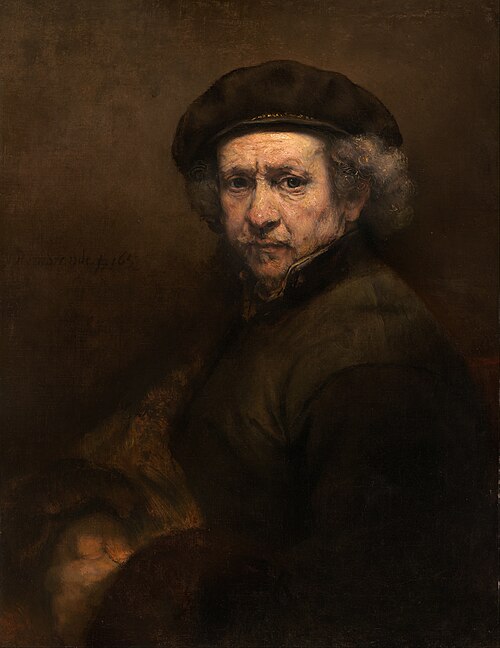
In his final years, Rembrandt turned inward, creating a powerful series of self-portraits that function as a visual diary of loss, aging, and introspection. Stylistically, his work increasingly approached that of Titian, characterized by expressive brushwork and profound psychological intensity. On October 4, 1669, after a modest evening meal of bread, cheese, and wine, Rembrandt went to bed and died peacefully in his sleep. He was buried four days later in a simple ceremony.
From the beginning of his career, Rembrandt favored historical painting, drawing on religious, mythological, and literary narratives comparable in ambition to the Italian Renaissance. Although he was an exceptional portraitist, he consistently pursued grand themes. Through his revolutionary use of light and shadow and his expansive approach to space, he elevated Flemish painting to its highest level and became a lasting source of inspiration for later movements, including 20th-century Impressionism.
Source: Biyografiler.com
Frequently asked questions about Rembrandt
Who is Rembrandt?, Rembrandt biography, Rembrandt life story, Rembrandt age, Rembrandt facts, Rembrandt birthplace, Rembrandt photos, Rembrandt videos, Rembrandt career

Lamine Yamal
Professional footballer

Erling Haaland
Professional footballer

Kylian Mbappe
Professional footballer

Keanu Reeves
Actor

Austin Abrams
Actor

Bad Bunny
Rapper, Songwriter


Hongjoong
Singer, Rapper, Songwriter, Composer

Ludacris
Rapper, Actor

Kwon Eunbi
Singer

Sarah Wayne Callies
Actress, Screenwriter, Producer, Director

LaTavia Roberson
Singer, Actress, Entrepreneur

Kristalina Georgieva
Economist
Lamine Yamal
Professional footballer
Austin Abrams
Actor

Guillermo del Toro
Film Director, Screenwriter
Keanu Reeves
Actor

Ludwig van Beethoven
Composer, Pianist