
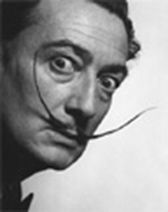
Salvador Dalí
The Architect of Surreal Madness
Born on May 11, 1904
Died on January 23, 1989
Age at death: 85
Profession: Painter
Place of Birth: Figueres, Catalonia, Spain
Place of Death: Figueres, Spain
Salvador Dalí, born as Salvador Domingo Felipe Jacinto Dalí y Domènech, was a Spanish painter and one of the most influential artists of the 20th century. Dalí was the artist who played the greatest role in the recognition and popularization of Surrealism within society. By breaking away from classical artistic conventions, he reflected his genius in works that relentlessly pushed the limits of creativity. Deeply influenced by the writings of Sigmund Freud, Dalí grounded his art in Surrealism and developed the method he called “Critical Paranoia,” through which he became the most successful surrealist painter in the world. His most famous and groundbreaking work in art history is The Persistence of Memory, completed in 1931.
Salvador Dalí was born on May 11, 1904, in Figueres, Catalonia, Spain. Nine months before his birth, his older brother—also named Salvador—had died of meningitis. Dalí’s parents believed that he was the reincarnation of this deceased child, a belief that profoundly shaped his psychological development. Dalí later reflected on this experience as follows:
“From the moment I was born, I began walking in the footsteps of a dead man who was worshipped. While loving me, they were still loving him. Perhaps they loved him more than me. The limits of my father’s affection became a deep wound for me from the very first days of my life.”
Struggling to live with this awareness, Dalí’s behavior increasingly focused on drawing his family’s attention. The birth of his sister Ana María Dalí did not change this situation, and over time his urge to express his uniqueness became unbearable. During his childhood, Dalí was close friends with Emili Sagi-Barba and Josep Samitier, both of whom would later become FC Barcelona football players. Dalí greatly enjoyed playing football with them during summer holidays in Cadaqués.
In 1916, Dalí enrolled in an art school, and the charcoal drawings he produced over the course of a year were exhibited in his family home with his father’s support. His first official exhibition opened in 1919 at the Municipal Theater in Figueres. His teacher was the accomplished painter Juan Núñez. After becoming familiar with Catalan Impressionists and Realists, Dalí discovered Cubism and the work of Juan Gris.
In 1921, when Dalí was only sixteen, his mother died of breast cancer. Although deeply traumatized, Dalí did not resent his father’s subsequent marriage to his late wife’s sister, as he was fond of his aunt. During his education at the Figueres Municipal School of Fine Arts, Dalí contributed to the magazine *Studium*, which featured articles on artists he admired, including Michelangelo Buonarroti, El Greco, Diego Velazquez, Leonardo da Vinci, and Francisco Goya.
In 1922, Dalí moved to Madrid and enrolled at the San Fernando School of Fine Arts, where his Cubist works attracted significant attention. During this period, he encountered the Dadaist movement, which would influence him throughout his life. He formed close friendships with poet Federico García Lorca and filmmaker Luis Buñuel. Dalí was expelled shortly before his final exams after declaring that no one at the institution was qualified to examine him. That same year, he demonstrated his genius in his painting Basket of Bread. On his first visit to Paris, he met Pablo Picasso, whose work deeply impressed him and influenced Dalí’s artistic direction.
Dalí’s talent was validated through exhibitions that drew great interest, particularly in Barcelona. He freely combined various artistic movements in his work, sometimes individually and sometimes simultaneously. Although his style was largely avant-garde and experimental, he remained deeply engaged with the foundations of classical painting. His flamboyant mustache became one of his defining features, inspired by his admiration for Diego Velazquez. While his daily life revolved around intellectual discourse and luxury, Dalí initially showed little interest in women—though this would soon change.
In 1929, Dalí collaborated with his filmmaker friend Luis Buñuel on the surrealist short film Un Chien Andalou. That same year, he met Gala Dalí, the former wife of surrealist poet Paul Éluard. A passionate love affair began, and from that moment on, Gala became Dalí’s lover, companion, muse, and primary model.
During this period, Dalí held numerous important professional exhibitions and was widely praised for his creativity. He completed The Persistence of Memory in 1931. Dalí married Gala in 1934, after living together since 1929. Around the same time, he befriended historian Alexandre Deulofeu. Although he had participated in the Paris Surrealist movement in the early 1930s, Dalí was soon excluded due to his defiant and rebellious personality. During this time, he produced works that would cement his status as one of Surrealism’s greatest figures, including *The Great Masturbator*, *Sex Appeal Phantom*, and *The Lugubrious Game*.
Also in 1934, art dealer Julien Levy introduced Dalí to the American art scene, leading to an exhibition in New York. Dalí supported Francisco Franco following the Spanish Civil War, which led to accusations from his surrealist peers that he had become bourgeois. Dalí responded with the following statement:
“Marxism did not interest me in the slightest. Politics was like cancer.”
He had earlier expressed his political stance with these words:
“I have always been an anarchist and at the same time a monarchist. I have always been against the bourgeoisie and still am. A true cultural revolution is only possible through the restoration of monarchist principles.”
In 1936, Stefan Zweig introduced Dalí to Sigmund Freud in London. That same year, Dalí participated in the exhibition Fantastic Art, Dada and Surrealism at the New York Museum of Modern Art. His appearance at the exhibition wearing a deep-sea diving suit while holding two leashed hounds symbolized his belief that humans must consciously suspend reason to create a true dream world. Dalí later appeared on the cover of Time.
At the outbreak of World War II, Dalí and Gala moved to the United States, where they lived for eight years. In 1942, Dalí published his autobiography The Secret Life of Salvador Dalí. After spending time in Virginia, Pebble Beach, California, and New York’s St. Regis Hotel, the couple returned to Spain in 1949.
Dalí participated in Homage to Surrealism, organized by André Breton for the fortieth anniversary of Surrealism, alongside Joan Miró, Enrique Tábara, and Eugenio Granell. During the 1940s, Dalí produced major works such as *Soft Self-Portrait with Fried Bacon*, *The Basket of Bread*, *Atomic Leda*, and *The Madonna of Port Lligat*. In 1946, he designed dream sequences for Alfred Hitchcock’s film Spellbound. Andy Warhol later stated that Dalí had a major influence on the emergence of Pop Art. Dalí also showed strong interest in mathematics and physics, incorporating geometric elements into his work.
In the 1950s, Dalí developed his “Paranoiac–Critical Method of Reflection and Deepening.” Many of his works from this period explored themes of religion, history, and science. Among his most notable paintings from these years were *Christ of Saint John of the Cross*, *Galatea of the Spheres*, *Corpus Hypercubus*, *The Discovery of America by Christopher Columbus*, and *The Last Supper*.
In 1960, Dalí began work on his largest project, the Dalí Theatre-Museum in Figueres, which he completed in 1974. He also designed the logo for the famous lollipop brand Chupa Chups. In 1969, Dalí was responsible for the promotional visuals and stage design of the Eurovision Song Contest. He purchased Púbol Castle in Girona and began renovating it.
From the 1960s onward, Dalí held major retrospective exhibitions at institutions including Los Angeles (1964), the New York Museum of Modern Art (1966), Rotterdam (1974), the Dalí Cleveland Museum (1971), the Centre Georges Pompidou in Paris (1979), London’s Tate Gallery (1980), the Spanish Museum of Contemporary Art in Madrid (1983), and the Pedralbes Palace in Barcelona (1983).
Dalí’s creativity extended beyond painting into numerous fields of fine art. He created the *Aphrodisiac Jacket*, a tuxedo covered with liqueur glasses fitted with filters, and invented the *Lobster Telephone*. In *Venus de Milo with Drawers*, he transformed the classical sculpture into a surreal piece of furniture, a concept later applied to luxury design and jewelry. Criticized by André Breton with the anagram “Avida Dollars,” Dalí sought to dismantle the idea of “art for art’s sake,” aiming instead to show that art was a way of life affecting every aspect of existence.
Together with Robert Descharnes, Dalí directed *The Incredible Story of the Lace-Maker and the Rhinoceros*, and in 1978 he made the experimental film Impressions de Haute Mongolie.
After the death of his lifelong love Gala in 1982, Dalí suffered a severe emotional collapse, and his health deteriorated rapidly. Following a fire at his castle in 1984, his condition worsened further. He spent his final years in seclusion, partly at Púbol Castle and partly in a private room at the Torre Galatea, adjacent to the museum he founded. Salvador Dalí died on January 23, 1989, at the age of eighty-four in Figueres Hospital and was buried beneath the great dome of the Dalí Theatre-Museum.
Dalí bequeathed his entire estate and collection to the Spanish state.
Source: Biyografiler.com
Frequently asked questions about Salvador Dalí
Who is Salvador Dalí?, Salvador Dalí biography, Salvador Dalí life story, Salvador Dalí age, Salvador Dalí facts, Salvador Dalí birthplace, Salvador Dalí photos, Salvador Dalí videos, Salvador Dalí career
Related Biographies

Lamine Yamal
Professional footballer

Sam Altman
Entrepreneur, Investor, CEO

Erling Haaland
Professional footballer

Kylian Mbappe
Professional footballer

Alice Weidel
Politician, Economist

Giorgia Meloni
Politician, Journalist


Hongjoong
Singer, Rapper, Songwriter, Composer

Ludacris
Rapper, Actor

Kwon Eunbi
Singer

Sarah Wayne Callies
Actress, Screenwriter, Producer, Director

LaTavia Roberson
Singer, Actress, Entrepreneur
Lamine Yamal
Professional footballer

Sydney Sweeney
Actress

Kevin Warsh
Economist

Ursula von der Leyen
Politician, Physician

Mustafa Suleyman
Business Leader, Entrepreneur
Kylian Mbappe
Professional footballer