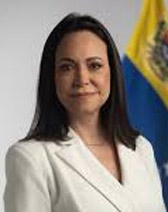
Maria Corina Machado
The Relentless Face of Venezuela’s Democratic Resistance
Born on October 7, 1967
Age: 59
Profession: Politician, Political Activist
Place of Birth: Caracas, Venezuela
María Corina Machado Parisca is a Venezuelan politician and civil rights activist internationally recognized for her uncompromising, nonviolent struggle against authoritarian rule in Venezuela. She has become one of the most prominent symbols of democratic resistance in Latin America through her sustained efforts to restore democratic institutions, defend civil liberties, and achieve a peaceful transition from dictatorship to democracy. In recognition of this long-running and principled struggle, she was awarded the Nobel Peace Prize in 2025.
Early Life and Family Background
María Corina Machado Parisca was born on October 7, 1967, in Caracas, Venezuela, into a conservative Catholic family. She is the eldest of four sisters. Her mother, Corina Parisca Pérez, worked as a psychologist, while her father, Henrique Machado Zuloaga, was a businessman active in the steel industry.
Her family history is deeply intertwined with Venezuela’s intellectual and democratic tradition. Her great-great-uncle Eduardo Blanco was the author of Venezuela Heroica, a foundational work in Venezuelan historical literature. Another relative, Armando Zuloaga Blanco, became a symbol of democratic resistance after being killed in 1929 during a failed uprising against dictator Juan Vicente Gómez. This legacy of opposition to authoritarianism would later shape Machado’s political identity.
Education and Early Professional Career
Machado earned a degree in industrial engineering from Andrés Bello Catholic University and later completed a master’s degree in finance at the Instituto de Estudios Superiores de Administración (IESA) in Caracas. After completing her studies, she worked in the automotive sector in Valencia, gaining experience in private enterprise and management.
Her early career soon expanded beyond business into social engagement. In 1992, she founded Fundación Atenea, an organization dedicated to supporting orphaned and at-risk children in Caracas. She later served as president of the Oportunitas Foundation, reinforcing her commitment to social responsibility and civic engagement. In 2009, she was selected as a fellow of Yale University’s prestigious Yale World Fellows program.
Entry into Politics and Civil Society Activism
María Corina Machado entered public life through civil society activism rather than party politics. In 2001, she became one of the founders of Súmate, an election-monitoring organization created to promote transparent and fair elections in Venezuela. She famously summarized the organization’s mission with the phrase “ballots instead of bullets,” emphasizing peaceful democratic participation over violence.
Súmate played a key role during the 2004 recall referendum against President Hugo Chavez. Although the referendum resulted in Chávez remaining in power, the organization’s activities led to Machado and other members being accused of receiving foreign funding and conspiracy. These charges were widely condemned by international human rights organizations and were later suspended.
Parliamentary Career and Confrontation with Power
In 2010, Machado resigned from Súmate and ran for office. She was elected to the National Assembly representing Miranda state, receiving one of the highest vote shares nationwide. During the 2011–2014 legislative period, she emerged as one of the most outspoken critics of the Chávez government and, after Chávez’s death, of President Nicolas Maduro.
In January 2012, her interruption of Chávez’s annual address in the National Assembly—where she accused the government of corruption, shortages, and democratic regression—drew widespread international attention. As a legislator, she focused on crime, inflation, power outages, and the politicization of state institutions, framing her electoral success as a popular rejection of authoritarian and militarized governance.
Presidential Ambitions and Political Exclusion
Machado announced her candidacy for the 2012 presidential election, competing in opposition primaries. Although she lost to Henrique Capriles, she immediately accepted the result and pledged her support, reinforcing her reputation as a principled democratic actor.
Her parliamentary career ended abruptly in March 2014 after she addressed the Organization of American States at Panama’s request to denounce human rights violations in Venezuela. Pro-government legislators expelled her from the National Assembly, a move she described as unconstitutional and evidence that Venezuela had entered a de facto dictatorship.
Protests, Repression, and International Profile
During the nationwide protests against the Maduro government in 2014, María Corina Machado became one of the opposition’s most visible leaders. She faced multiple investigations, arrest warrants, and physical attacks. Years of harassment and violence led supporters and media outlets to refer to her as the “Iron Lady” or “Steel Lady” of Venezuelan politics.
Despite these risks, she remained at the center of opposition politics. During the 2019 presidential crisis, she declared her willingness to run in free and fair elections. In 2023, she won the opposition’s presidential primary by a landslide, becoming the unity candidate for the 2024 election.
Ban, Proxy Candidacy, and the 2024 Election
Shortly after her primary victory, the Maduro government imposed a 15-year political ban on Machado, a decision condemned by the United Nations, the European Union, and numerous governments. After being barred from running, she endorsed Corina Yoris as a replacement candidate. When that effort was also blocked, the opposition ultimately rallied behind Edmundo González Urrutia.
Although not formally on the ballot, Machado remained the de facto leader of the opposition campaign. After the government controversially declared Maduro the winner, the opposition released its own vote tallies. Facing repeated threats to her life, Machado was forced into hiding, and in January 2025 authorities again attempted to detain her.
Political Ideology and Foreign Policy Positions
Ideologically, María Corina Machado is commonly described as a liberal conservative. She is openly opposed to socialism and Chavismo, advocating free-market economics, privatization of state-owned enterprises, the rule of law, and democratic capitalism.
On social issues, she has expressed support for same-sex marriage, the legalization of medical cannabis, and national debate on abortion in cases of rape or when the mother’s life is at risk. In foreign policy, she is firmly anti-communist and strongly favors close relations with Western democracies, particularly the United States. She is a signatory of the Madrid Charter and is known for her vocal support for Israel and her pledge to restore diplomatic relations severed during the Chávez era.
International Recognition and the Nobel Peace Prize
Over the course of her career, Machado has received numerous international honors, including being named to the BBC’s list of the 100 Most Influential Women in the World. She has also received the Liberal International Freedom Prize, the Václav Havel Human Rights Prize, and the Andrei Sakharov Prize for Freedom of Thought.
In October 2025, María Corina Machado was awarded the Nobel Peace Prize “for her tireless struggle to defend the democratic rights of the Venezuelan people and to achieve a just and peaceful transition from dictatorship to democracy.” Due to security concerns, she was unable to attend the Nobel ceremony in person, and the prize was accepted on her behalf by her daughter. Machado dedicated the award to the people of Venezuela and reaffirmed her determination to return to her country despite the risks.
On January 15, 2026, Venezuelan opposition leader María Corina Machado presented her Nobel Peace Prize to United States President Donald Trump during a meeting in Washington, D.C. The gesture sparked international debate, with The New York Times reporting that members of the Norwegian Nobel establishment were surprised by what they viewed as the use of the prize as an instrument of “soft power.”
Source: Biyografiler.com
News about Maria Corina Machado
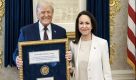
Venezuelan Opposition Leader Machado’s Nobel Gesture Toward Trump
Venezuelan opposition leader Maria Corina Machado presented her Nobel Peace Prize medal to Donald Trump during a meeting at the White House, describin...
Frequently asked questions about Maria Corina Machado
Who is Maria Corina Machado?, Maria Corina Machado biography, Maria Corina Machado life story, Maria Corina Machado age, Maria Corina Machado facts, Maria Corina Machado birthplace, Maria Corina Machado photos, Maria Corina Machado videos, Maria Corina Machado career
Related Biographies

Lamine Yamal
Professional footballer

Sam Altman
Entrepreneur, Investor, CEO

Kylian Mbappe
Professional footballer

Alice Weidel
Politician, Economist

Erling Haaland
Professional footballer

Giorgia Meloni
Politician, Journalist


Hongjoong
Singer, Rapper, Songwriter, Composer

Ludacris
Rapper, Actor

Kwon Eunbi
Singer

Sarah Wayne Callies
Actress, Screenwriter, Producer, Director

LaTavia Roberson
Singer, Actress, Entrepreneur

Lady Gaga
Singer, Musician, Songwriter, Actress, Producer

Taylor Swift
Singer, Musician, Songwriter

Amanda Seyfried
Actress, Model, Singer

Delcy Rodriguez
Politician, Lawyer, Diplomat

Austin Abrams
Actor

Fatih Akin
Film Director, Screenwriter