
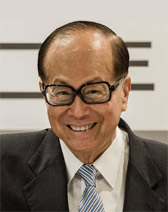
Li Ka-shing
Born on July 29, 1928
Age: 98
Profession: Businessperson, Investor
Place of Birth: Chao’an (Chaozhou), Guangdong, China
Li Ka-shing is a Hong Kong–based billionaire entrepreneur, global investor, and philanthropist widely regarded as one of the most influential business figures in modern Asian history. Nicknamed “Superman” by local media for his investment foresight and disciplined capital allocation, he built a diversified corporate empire spanning ports, infrastructure, retail, telecommunications, utilities, energy, real estate, and technology. Through strategic timing, cross-border expansion, and structural reorganizations, Li Ka-shing transformed a small plastics business into a multinational conglomerate operating in more than 50 countries.
Early Life and Background
Li Ka-shing was born on July 29, 1928, in Chao’an (Chaozhou), Guangdong Province, China. His early life was shaped by war and displacement. In 1940, during the Second Sino-Japanese War, his family fled to Hong Kong to escape Japanese occupation. Shortly after their relocation, his father died of tuberculosis, forcing Li Ka-shing to leave school at a young age in order to support his family.
He began working as an apprentice in a factory, enduring long hours under difficult conditions. Those formative years cultivated the discipline and resilience that would later define his business philosophy. By his early twenties, he had saved enough capital to establish his own manufacturing venture.
Entrepreneurial Beginnings
In 1950, at the age of 22, Li Ka-shing founded Cheung Kong Plastics, producing plastic flowers that quickly became popular in export markets. His early success in manufacturing provided the financial base for his entry into property development.
During the 1967 riots in Hong Kong, influenced by China’s Cultural Revolution, property prices fell sharply. While others retreated, Li Ka-shing aggressively acquired undervalued real estate assets. He applied a similar contrarian strategy after the 1989 Tiananmen Square protests, purchasing properties during market uncertainty. Within twelve years, it was reported that one in every seven private residential units in Hong Kong had been developed by his flagship company.
Acquisition of Hutchison and Global Expansion
A pivotal turning point came in 1979 when Li Ka-shing acquired a 22% stake in Hutchison Whampoa from Hongkong and Shanghai Banking Corporation, gaining control at a price reportedly below half of book value. At the time, Hutchison owned docks, shipyards, retail stores, and property assets across Hong Kong and Guangdong.
Over the next decade, Li Ka-shing expanded Hutchison’s core businesses beyond Hong Kong, transforming it into one of the world’s largest private port operators. The group’s retail operations eventually grew to more than 12,000 stores worldwide, while its telecommunications networks served roughly 90 million customers globally. His strategy combined disciplined capital management with geographic diversification, reducing exposure to any single market.
Energy and International Investments
In 1987, when oil prices dropped below $10 per barrel, Li Ka-shing acquired a controlling stake in Canadian oil and gas producer Husky Energy. The move demonstrated his preference for counter-cyclical investments. Husky was later acquired by Cenovus Energy in 2020, further reshaping his energy holdings.
His international portfolio also expanded into infrastructure assets in Europe, Australia, and North America. In 2017, his group acquired Australia-based Duet Group for $5.5 billion, strengthening its global utilities footprint.
Corporate Restructuring and CK Group Formation
In 2015, Li Ka-shing completed the most significant restructuring of his corporate empire. He separated property assets into CK Asset Holdings and consolidated ports, retail, telecommunications, and infrastructure businesses under CK Hutchison Holdings. The restructuring simplified a previously complex web of cross-shareholdings and clarified investor positioning.
By 2024, CK Hutchison reported revenues of HK$476.7 billion (US$61.4 billion). Li Ka-shing retained significant ownership stakes—approximately 30% of CK Hutchison and 38% of CK Asset—held through various holding companies and trusts registered in Hong Kong, the British Virgin Islands, the Cayman Islands, and Panama.
In May 2018, at age 89, he stepped down as chairman of both companies, passing leadership to his eldest son Victor Li. However, Li Ka-shing remained involved as senior advisor.
Investment Acumen and Market Timing
Li Ka-shing earned the nickname “Superman” largely because of his market timing. He reportedly anticipated the bursting of China’s stock market bubble in 2007 and forecast a major rebound in Hong Kong property prices in early 2009. Housing values subsequently rose nearly 70% by mid-2011.
In February 2023, disclosures showed that he held a 6.7% stake in Zoom Video Communications. In 2020, he transferred 1.6% of Zoom shares to others, including his younger son Richard Li. His investment portfolio has also included technology ventures, telecommunications infrastructure, and diversified cash holdings adjusted for dividends, insider transactions, taxes, charitable donations, and family transfers.
Personal Life
Li Ka-shing married his cousin Chong Yuet-ming in 1962. She passed away on January 1, 1990. The couple had two sons: Victor Li, chairman of CK Hutchison and CK Asset, and Richard Li, chairman of PCCW. Both sons hold Canadian citizenship.
In 1996, Victor Li was kidnapped by gangster Cheung Tze-keung. Li Ka-shing reportedly paid HK$1 billion in ransom directly to the kidnapper without notifying Hong Kong police. The case was later handled by mainland authorities, and Cheung Tze-keung was executed in 1998. The incident fueled speculation about political arrangements between Hong Kong business elites and mainland officials.
Philanthropy and the Li Ka Shing Foundation
In 1980, Li Ka-shing established the Li Ka Shing Foundation, which he once described as his “third son.” In 2006, he pledged to donate one-third of his wealth to the foundation. By 2015, he had transferred approximately one-third of his assets to it.
The foundation focuses on education, medical research, healthcare services, and social innovation. It has committed more than HK$30 billion to philanthropic initiatives, with approximately 80% allocated to projects in mainland China and Hong Kong. Major contributions include the development of Shantou University and its medical school, the Li Ka Shing Centre at the University of Cambridge, and support for research initiatives at University of Oxford.
In 2024, two medical faculties in Hong Kong acquired advanced histotripsy systems with support from the foundation. The organization has also funded global disaster relief efforts and partnered with numerous international universities and hospitals, reinforcing Li Ka-shing’s reputation as one of Asia’s most significant philanthropic financiers.
Source: Biyografiler.com
Frequently asked questions about Li Ka-shing
Who is Li Ka-shing?, Li Ka-shing biography, Li Ka-shing life story, Li Ka-shing age, Li Ka-shing facts, Li Ka-shing birthplace, Li Ka-shing photos, Li Ka-shing videos, Li Ka-shing career

Lamine Yamal
Professional footballer

Kylian Mbappe
Professional footballer

Erling Haaland
Professional footballer

Sam Altman
Entrepreneur, Investor, CEO

Bad Bunny
Rapper, Songwriter

Brad Pitt
Actor


Hongjoong
Singer, Rapper, Songwriter, Composer

Ludacris
Rapper, Actor

Kwon Eunbi
Singer

Sarah Wayne Callies
Actress, Screenwriter, Producer, Director

LaTavia Roberson
Singer, Actress, Entrepreneur
Brad Pitt
Actor
Lamine Yamal
Professional footballer

Sarah Jessica Parker
Actress, Producer

Stephen King
Novelist, Screenwriter

Quentin Tarantino
Film Director, Actor, Screenwriter

Zohran Mamdani
Politician, Musician