
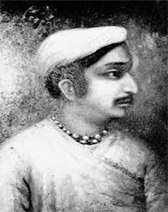
Mian Tansen
Mian Tānsen (“The Learned One”), Sangeet Samrāt (“Emperor of Hindustani Music”)
Born on ?? ??, 1493
Died on April 26, 1589
Age at death: 96
Profession: Musician, Composer
Place of Birth: Gwalior, Tomar Kingdom (present-day Madhya Pradesh, India)
Place of Death: Gwalior, Mughal Empire (India)
Mian Tansen, born Rāmtanu Pandey (also known as Rāmtanu Mukund Gaud), stands as one of the most foundational and transformative figures in Hindustani classical music. Revered as “Sangeet Samrāt,” meaning the Emperor of Music, he played a decisive role in shaping the North Indian classical tradition during the 16th century. His mastery of the Dhrupad style, his attributed creation of numerous ragas, and the legendary accounts of his extraordinary vocal abilities established Mian Tansen as both a historical icon and a near-mythical cultural figure. He is widely regarded as the spiritual fountainhead of the Senia gharana and an architect of what later evolved into the Gwalior Gharana tradition.
Early Life and Musical Formation
Mian Tansen was born in Gwalior, then part of the Tomar Kingdom, into a Hindu Gaur Brahmin family. His father, Mukund Ram (also referred to as Mukund Gaud or Mukund Chand), was a respected poet and accomplished musician who is believed to have served as a temple priest in Varanasi. The exact year of Mian Tansen’s birth remains debated; most scholars place it around 1493, while some sources suggest a later date closer to 1506.
Legends surround his childhood. One popular narrative claims that he did not speak until the age of five, and that his early vocalizations mimicked animal sounds with uncanny precision—an anecdote often cited to emphasize his innate musical genius. While such stories belong more to folklore than verifiable history, they reflect the deep cultural reverence attached to his name.
His formal musical education took place in Gwalior under the tutelage of the renowned Dhrupad master Swami Haridas. Under Haridas’s guidance, Mian Tansen absorbed not only the technical rigors of Dhrupad but also a devotional philosophy rooted in the Bhakti movement. Importantly, he adopted the practice of composing in vernacular languages such as Brajbhasha and early Hindi, rather than exclusively in Sanskrit. This linguistic shift aligned with the Bhakti movement’s emphasis on accessibility and spiritual intimacy.
Some biographical traditions suggest that he was influenced by the Sufi mystic Muhammad Ghaus Gwaliori. While scholars debate the depth of this influence, it is generally agreed that Mian Tansen’s music transcended rigid religious categorization. Throughout his life, he composed devotional works honoring Hindu deities such as Krishna and Shiva, even as he maintained connections within the Sufi spiritual milieu.
Service in Royal Courts
Mian Tansen began his professional career in the court of the Gwalior kingdom before entering the service of Raja Ramchandra Singh Baghel of Rewa, where he remained for many years. Under the patronage of Ramchandra Singh, his reputation flourished, and he became celebrated across North India for his vocal depth and compositional brilliance.
His growing fame eventually reached the Mughal Emperor Akbar. In 1562, at approximately sixty years of age, Mian Tansen joined Akbar’s imperial court. Though some accounts suggest initial reluctance, he ultimately accepted the emperor’s invitation and became one of the most distinguished members of the Mughal cultural establishment.
Akbar included him among the legendary Navaratnas, or Nine Jewels of his court, and conferred upon him the honorific “Mian,” a title denoting respect and mastery. Contemporary chronicles describe how Akbar held his performances in extraordinary esteem, often rewarding him lavishly. The emperor’s admiration elevated Mian Tansen to an unparalleled status within the artistic hierarchy of the Mughal Empire.
Musical Innovations and Ragas
Mian Tansen is most closely associated with the Dhrupad tradition, which he refined and expanded. Several major ragas bear his name, including Mian ki Todi, Mian ki Malhar, and Darbari Kanada. These ragas are still foundational within the Hindustani repertoire and are frequently performed by classical vocalists and instrumentalists.
His compositions drew heavily from Hindu Puranic literature, praising deities such as Ganesha, Saraswati, Surya, Shiva, and Vishnu (particularly in his Krishna avatar). At the same time, he composed works honoring royal patrons, including Emperor Akbar. His attributed treatises, including Sangita Sara and Sri Ganesh Stotra, are cited in traditional accounts as part of his scholarly contribution to classical music, though their authorship is debated among historians.
Legend credits Mian Tansen with supernatural musical powers—stories claim he could light lamps by singing Raga Deepak or bring rain with Raga Malhar. While such accounts are symbolic rather than historical, they illustrate the cultural magnitude of his influence and the near-mystical aura surrounding his artistry.
Senia Lineage and Gharana Influence
Mian Tansen is regarded as the progenitor of the Senia gharana, a lineage that traces its stylistic authority to his teachings. The term “Senia” itself derives from his name, “Tansen.” Over centuries, multiple North Indian gharanas have claimed descent from his musical tradition, underscoring his central role in shaping the architecture of Hindustani classical performance.
His influence was particularly significant in the formation of the Gwalior Gharana, which later became one of the most important khayal traditions in North Indian music. Though Dhrupad was his principal form, the aesthetic principles he established informed later stylistic evolutions.
Personal Life
Mian Tansen married Hussaini of Gwalior and fathered several children: Surat Sen, Sarat Sen, Tarang Khan, Bilas Khan, and Saraswati. All of his children were recognized as accomplished musicians. His daughter Saraswati married the noted veena player and composer Misri Singh, further strengthening the musical lineage.
Some narratives claim that Mian Tansen married a daughter of Emperor Akbar named Mehrunissa and converted religions as a result. However, many historians question the reliability of these claims, emphasizing the absence of firm documentary evidence.
Death and Commemoration
The year of Mian Tansen’s death is sometimes cited as 1586 in Delhi, but the more widely accepted date is April 26, 1589, in Gwalior. Accounts of his funeral vary; some describe Islamic rites, while others refer to Hindu ceremonies. His tomb is located within the mausoleum complex of Muhammad Ghaus Gwaliori in Gwalior, symbolizing the syncretic cultural world in which he lived.
Each December, the Tansen Samaroh music festival is held in Gwalior to honor his life and enduring legacy. The festival attracts leading classical musicians from across India, reinforcing his status as a foundational pillar of Hindustani music.
Portrayal in Indian Cinema
The life of Mian Tansen has inspired numerous Indian films, including Tansen (1943), Tansen (1958), Sangeet Samrat Tansen (1962), and Baiju Bawra (1952). These cinematic portrayals often emphasize the legendary and romanticized dimensions of his life, blending documented history with folklore.
Source: Biyografiler.com
Frequently asked questions about Mian Tansen
Who is Mian Tansen?, Mian Tansen biography, Mian Tansen life story, Mian Tansen age, Mian Tansen facts, Mian Tansen birthplace, Mian Tansen photos, Mian Tansen videos, Mian Tansen career

Lamine Yamal
Professional footballer

Erling Haaland
Professional footballer

Kylian Mbappe
Professional footballer

Bad Bunny
Rapper, Songwriter

Austin Abrams
Actor

Keanu Reeves
Actor


Hongjoong
Singer, Rapper, Songwriter, Composer

Ludacris
Rapper, Actor

Kwon Eunbi
Singer

Sarah Wayne Callies
Actress, Screenwriter, Producer, Director

LaTavia Roberson
Singer, Actress, Entrepreneur

Lee Jae Myung
, Human Rights Activist, Politician, Lawyer, President

Catherine Zeta-Jones
Actress

Salvador Allende
Physician, Politician, Former President

Steven Soderbergh
Film Director, Screenwriter, Producer

Alan Turing
Mathematician, Cryptologist, Computer Scientist

Rita Ora
Singer, Songwriter