
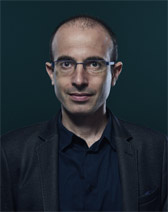
Yuval Noah Harari
Historian of Humanity, Technology, and the Future
Born on February 24, 1976
Age: 50
Profession: Academic, Historian
Place of Birth: Kiryat Ata, Israel
Yuval Noah Harari is an Israeli historian, author, public intellectual, and academic known for his broad, accessible interpretations of human history, technology, power, artificial intelligence, and the future of civilization. Through works such as Sapiens: A Brief History of Humankind, Homo Deus: A Brief History of Tomorrow, 21 Lessons for the 21st Century, and Nexus: A Brief History of Information Networks from the Stone Age to AI, Yuval Noah Harari has become one of the most widely read contemporary thinkers in the world. His books have been translated into dozens of languages and have reached tens of millions of readers across different cultures.
Early Life and Family Background
Yuval Noah Harari was born on February 24, 1976, in Kiryat Ata, Israel, to Shlomo Harari and Pnina Harari. He was one of three children in a Jewish family with roots in Eastern Europe and Lebanon. His father worked as an arms engineer for the state, while his mother worked as an office administrator.
A gifted child, Yuval Noah Harari reportedly taught himself to read at the age of three. From the age of eight, he studied in a class for intellectually gifted children at the Leo Baeck Education Center in Haifa. This early intellectual development shaped his later ability to move between history, philosophy, biology, economics, politics, and technology in a single analytical framework.
Education and Academic Formation
Yuval Noah Harari began studying history and international relations at the Hebrew University of Jerusalem in 1993, when he was 17 years old. As part of the Atuda academic program, he postponed his compulsory service in the Israel Defense Forces, but was later exempted from military service for health reasons after completing his studies.
Between 1993 and 1998, Yuval Noah Harari specialized in medieval history and military history at the Hebrew University. These early fields of study helped him develop a long historical perspective on violence, empire, technology, and the organization of human societies.
He completed his doctorate in 2002 at Jesus College, Oxford, under the supervision of Steven J. Gunn. His doctoral work focused on military memoirs and the experience of war in early modern Europe. Between 2003 and 2005, he continued postdoctoral research as a Yad Hanadiv Fellow.
Intellectual Influences
During his time at Oxford, Yuval Noah Harari encountered the work of Jared Diamond, especially Guns, Germs, and Steel. He later described Diamond’s book as a major intellectual turning point, because it showed him that large-scale historical questions could be written for a broad public without abandoning analytical ambition.
This influence helped shape Harari’s own method: combining history with evolutionary biology, anthropology, economics, cognitive science, and political theory. Like Jared Diamond, he became interested in why societies develop differently, but Harari extended the question toward consciousness, capitalism, religion, technology, and artificial intelligence.
Academic Career
Yuval Noah Harari became a professor in the Department of History at the Hebrew University of Jerusalem. His early academic publications focused on military history, war culture, and the experience of combat.
Over time, his work moved from specialist military history toward global history and the future of humanity. This transition allowed him to reach audiences far beyond university departments and academic journals.
Sapiens and Global Recognition
Yuval Noah Harari achieved international fame with Sapiens: A Brief History of Humankind. The book examines the history of Homo sapiens from the cognitive revolution and agricultural revolution to capitalism, empire, science, and modern technology.
Sapiens became a global bestseller and spent 96 consecutive weeks in the top three of The New York Times bestseller list. The book was praised by figures including Barack Obama, Bill Gates, and Mark Zuckerberg, helping Harari become one of the most visible public intellectuals of the 21st century.
The book’s central argument is that humans became dominant not only because of biological ability, but because they can cooperate flexibly in large numbers through shared stories, myths, institutions, religions, nations, corporations, and money.
Homo Deus and the Future of Humanity
In Homo Deus: A Brief History of Tomorrow, Yuval Noah Harari shifted from the past to the future. The book explores how biotechnology, data science, artificial intelligence, and algorithmic systems may transform human life.
Harari argues that once humanity gains greater power over disease, famine, and war, new ambitions may emerge: immortality, happiness, and enhanced intelligence. The book also examines the possibility that data-driven systems could challenge human freedom, identity, and political authority.
In 2017, Homo Deus received the German Economic Book Award from Handelsblatt, recognizing its influence in debates over economics, technology, and society.
21 Lessons and Contemporary Politics
In 21 Lessons for the 21st Century, Yuval Noah Harari turned directly to contemporary issues. The book addresses artificial intelligence, nationalism, religion, liberalism, fake news, work, education, terrorism, meditation, and global cooperation.
Unlike Sapiens and Homo Deus, which move across vast historical timelines, this work focuses on the immediate challenges facing modern societies. It reflects Harari’s growing role as a commentator on public policy, digital technology, ecological crisis, and global governance.
Nexus and Information Networks
In 2024, Yuval Noah Harari published Nexus: A Brief History of Information Networks from the Stone Age to AI. The book examines how information networks shape power, institutions, myth, bureaucracy, democracy, totalitarianism, and artificial intelligence.
Nexus continues Harari’s long-running concern with the relationship between stories, data, social cooperation, and control. It places artificial intelligence within a deep historical context rather than treating it only as a recent technological issue.
Sapienship and Public Work
In 2019, following the international success of his books, Yuval Noah Harari and his husband Itzik Yahav co-founded Sapienship. The organization works on education, storytelling, and social-impact projects centered on shared human challenges.
During the COVID-19 Pandemic, after United States President Donald Trump announced cuts to funding for the World Health Organization, Yuval Noah Harari and Itzik Yahav donated 1 million dollars to the organization through Sapienship.
Global Conversations and Public Influence
Yuval Noah Harari has regularly spoken with political and business leaders about the future of humanity, technology, democracy, and global cooperation. He has held public conversations with figures such as Sebastian Kurz, Mark Rutte, and Kyriakos Mitsotakis, and has met leaders including Emmanuel Macron, Angela Merkel, Mauricio Macri, Frank-Walter Steinmeier, and Ying Yong.
He has also appeared in discussions with technology leaders such as Mark Zuckerberg, with whom he spoke in 2019 about technology and society. In 2018, Harari delivered a TED Talk through a digital avatar, one of the first such presentations of its kind.
Harari spoke at the World Economic Forum in Davos in 2018 and 2020, addressing the future of humanity, artificial intelligence, and global risks from the main Congress Hall stage.
Meditation and Personal Life
Yuval Noah Harari is openly gay. He met Itzik Yahav in 2002, and the couple later married in a formal ceremony in Toronto, Canada. Itzik Yahav also serves as Harari’s personal manager and professional partner.
Harari has said that Vipassana meditation, which he began practicing in Oxford in 2000, changed his life. Meditation became an important part of his intellectual and personal discipline. He lives with Itzik Yahav in Karmei Yosef, a community settlement in central Israel.
Awards and Recognition
Yuval Noah Harari has received several awards and honors. In 2009 and 2012, he won the Polonsky Prize for Creativity and Originality. In 2011, he received the Moncado Award from the Society for Military History for distinguished articles in military history. In 2012, he was elected to the Young Israeli Academy of Sciences.
In 2015, Sapiens won China’s Wenjin Book Award. His books have been translated into 65 languages and have sold around 50 million copies worldwide, making him one of the most influential nonfiction authors of the modern era.
Graphic and Young Reader Projects
In 2020, Yuval Noah Harari collaborated with writer David Vandermeulen and illustrator Daniel Casanave on Sapiens: A Graphic History, a graphic adaptation of Sapiens. The project translated his large historical arguments into a witty, colorful, and accessible visual narrative.
He also expanded his work for younger audiences with Unstoppable Us, a children’s history series explaining how humans came to dominate the world and why human societies became unequal.
Major Books
2004 – Renaissance Military Memoirs: War, History and Identity, 1450–1600
2007 – Special Operations in the Age of Chivalry, 1100–1550
2008 – The Ultimate Experience: Battlefield Revelations and the Making of Modern War Culture, 1450–2000
2014 – Sapiens: A Brief History of Humankind
2014 – From Animals into Gods: Sapiens
2016 – Homo Deus: A Brief History of Tomorrow
2018 – 21 Lessons for the 21st Century
2018 – Money: Vintage Minis
2020 – Sapiens: A Graphic History
2022 – Unstoppable Us, Volume 1: How Humans Took Over the World
2024 – Unstoppable Us, Volume 2: Why the World Isn’t Fair
2024 – Nexus: A Brief History of Information Networks from the Stone Age to AI
Source: Biyografiler.com
Frequently asked questions about Yuval Noah Harari
Who is Yuval Noah Harari?, Yuval Noah Harari biography, Yuval Noah Harari life story, Yuval Noah Harari age, Yuval Noah Harari facts, Yuval Noah Harari birthplace, Yuval Noah Harari photos, Yuval Noah Harari videos, Yuval Noah Harari career
Related Biographies




Lamine Yamal
Professional footballer

Sam Altman
Entrepreneur, Investor, CEO

Kylian Mbappe
Professional footballer

Alice Weidel
Politician, Economist

Erling Haaland
Professional footballer

Giorgia Meloni
Politician, Journalist


Hongjoong
Singer, Rapper, Songwriter, Composer

Ludacris
Rapper, Actor

Kwon Eunbi
Singer

Sarah Wayne Callies
Actress, Screenwriter, Producer, Director

LaTavia Roberson
Singer, Actress, Entrepreneur
Lamine Yamal
Professional footballer

Austin Abrams
Actor

Xi Jinping
Politician, Statesman, Head of State

Claudia Sheinbaum
President, Politician, Scientist, Academic

Colman Domingo
Actor, Director, Producer

Kaia Gerber
Model, Actress