
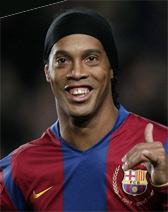
Ronaldinho
Brazil’s Joyful Football Genius and One of the Most Entertaining Players in History
Born on March 21, 1980
Age: 46
Profession: Professional footballer
Place of Birth: Porto Alegre, Rio Grande do Sul, Brazil
Ronaldinho, whose real name is Ronaldo de Assis Moreira, is a Brazilian former professional footballer widely regarded as one of the most gifted, entertaining and creative players in football history. Known as Ronaldinho Gaúcho, he became famous for his dribbling, no-look passes, free kicks, elasticos, joyful style and extraordinary technical imagination. During his career with Grêmio, Paris Saint-Germain, Barcelona, AC Milan, Flamengo and the Brazil National Football Team, Ronaldinho turned football into a form of art and inspired a generation of players including Lionel Messi, Neymar, Kylian Mbappe and Vinícius Júnior.
Early Life and Family Background
Ronaldinho was born on March 21, 1980, in Porto Alegre, Rio Grande do Sul, Brazil. His mother, Dona Miguelina Elói Assis dos Santos, worked as a nurse, while his father, João de Assis Moreira, worked as a shipyard employee. His older brother, Roberto Assis, was also a footballer and later became his manager. His sister, Deisi Assis, worked as his press coordinator.
When Ronaldinho was only eight years old, he lost his father after a fatal heart attack in a swimming pool. This tragedy deeply affected the family. During a period when much of Brazil was struggling economically, football became both an emotional escape and a possible route to a better life.
The family’s financial situation improved when Roberto Assis signed with Grêmio, and the club provided the family with a house in the Guarujá district of Porto Alegre. For Ronaldinho, his brother became both his first idol and first football model.
Early Talent and Grêmio Breakthrough
Ronaldinho first attracted media attention at the age of 13, when he scored all 23 goals in a local match that ended 23–0. This remarkable performance became one of the earliest stories attached to his legend.
He joined the youth academy of Grêmio and quickly became one of Brazil’s most exciting young talents. In 1997, he gained international recognition at the FIFA Under-17 World Championship in Egypt, where he finished as top scorer and helped Brazil win the tournament.
In 1998, Ronaldinho signed his first professional contract with Grêmio. Because Brazil already had the legendary striker Ronaldo Nazário, he became widely known as “Ronaldinho,” meaning “Little Ronaldo” in Portuguese.
Paris Saint-Germain
In 2001, Ronaldinho signed a five-year contract with Paris Saint-Germain. The move brought him to European football, although the transfer was complicated by a dispute between Grêmio and PSG over the fee. After legal issues and a period away from the pitch, he resumed playing in France.
His first season in Paris was inconsistent, and reports about his nightlife caused tension with the coaching staff. However, in his second season, Ronaldinho showed much more of his quality. His dribbling, creativity and flair attracted attention from major European clubs, including Manchester United and Barcelona.
Barcelona and the Peak of His Career
In 2003, Ronaldinho transferred to Barcelona for 27 million euros. The move became one of the most important signings in modern Barcelona history. At the time, the club was searching for a new identity, and Ronaldinho quickly became the player who restored excitement, creativity and belief at Camp Nou.
He made his Barcelona debut on July 27, 2003. During the 2004–2005 season, he helped the club win the Spanish league title. Alongside players such as Xavi Hernández, Carles Puyol, Samuel Eto’o, Deco and a young Lionel Messi, Ronaldinho became the symbol of Barcelona’s revival.
His performances under Frank Rijkaard made him the best player in the world. In 2004 and 2005, Ronaldinho won the FIFA World Player of the Year award. His magic at Barcelona included unforgettable goals, impossible passes and the rare honor of receiving applause from Real Madrid supporters at the Santiago Bernabéu.
AC Milan and Return to Brazil
Between 2008 and 2011, Ronaldinho played for AC Milan. His form was inconsistent, but he still produced moments of brilliance. In his first season, he scored 9 goals in 33 matches. In his second season, he improved significantly, scoring 15 goals in 43 matches.
In 2011, Ronaldinho signed with Flamengo. He scored 16 goals in 33 matches during his first season, but financial problems and unpaid wages led him to terminate his contract.
In 2012, he joined Atlético Mineiro, where he revived his career and reminded the world of his genius. With Atlético Mineiro, he helped the club win the Copa Libertadores, one of the most important achievements of his later career.
Querétaro, Fluminense and Retirement
After his success with Atlético Mineiro, Ronaldinho played for Querétaro in Mexico and later joined Fluminense in Brazil. Although these later years did not match the heights of his Barcelona peak, his presence still drew enormous attention wherever he played.
On February 3, 2017, Ronaldinho officially announced his retirement from professional football. His retirement marked the end of one of the most joyful and technically dazzling careers in modern football.
Brazil National Team Career
Ronaldinho represented Brazil at youth and senior levels. He won the FIFA Under-17 World Championship in 1997 and later became a key member of the senior Brazil National Football Team.
In 1999, he helped Brazil win the Copa América. His biggest international success came at the 2002 FIFA World Cup, where he played alongside Ronaldo Nazário and Rivaldo in one of the most iconic attacking trios in World Cup history.
One of his most famous moments came in the 2002 World Cup quarter-final against England, when he scored a long-range free kick over David Seaman. Brazil went on to win the tournament, and Ronaldinho became a world champion.
Playing Style
Ronaldinho was an attacking midfielder and forward whose game was built on imagination, rhythm, balance and improvisation. He could beat defenders with tricks, change direction instantly, shoot from distance, create goals with disguised passes and dominate matches without playing in a rigid tactical structure.
His style was shaped by Brazilian street football, futsal and the joyful attacking tradition associated with players such as Pele, Garrincha, Zico, Romário, Ronaldo Nazário and Rivaldo. Yet Ronaldinho developed a personality entirely his own: smiling, unpredictable and technically outrageous.
Personal Life and Later Issues
Ronaldinho has a son, João de Assis Moreira, born on February 25, 2005, from his relationship with Brazilian dancer Janaína Mendes. In 2007, he acquired Spanish citizenship.
After retirement, Ronaldinho remained a global football celebrity, but he also faced legal and financial problems. In 2019, Brazilian authorities confiscated several properties and his Brazilian and Spanish passports due to unpaid taxes and fines.
In March 2020, Ronaldinho and his brother Roberto Assis were detained in Paraguay after allegedly entering the country with fake passports. After spending time in prison, they were released on bail and placed under house arrest.
Achievements
Club Honors:
2004–2005 – Spanish League Champion – Barcelona
2005–2006 – Spanish League Champion – Barcelona
2005–2006 – UEFA Champions League Winner – Barcelona
2013 – Copa Libertadores Winner – Atlético Mineiro
National Team Honors:
1997 – FIFA Under-17 World Championship Winner – Brazil
1999 – Copa América Winner – Brazil
2002 – FIFA World Cup Winner – Brazil
Individual Honors:
1997 – FIFA Under-17 World Championship Top Scorer
2004 – FIFA World Player of the Year
2005 – FIFA World Player of the Year
2005 – Ballon d’Or
Career Overview
Source: Biyografiler.com
Frequently asked questions about Ronaldinho
Who is Ronaldinho?, Ronaldinho biography, Ronaldinho life story, Ronaldinho age, Ronaldinho facts, Ronaldinho birthplace, Ronaldinho photos, Ronaldinho videos, Ronaldinho career
Related Biographies

Lamine Yamal
Professional footballer

Erling Haaland
Professional footballer

Kylian Mbappe
Professional footballer

Austin Abrams
Actor

Bad Bunny
Rapper, Songwriter

Sam Altman
Entrepreneur, Investor, CEO


Hongjoong
Singer, Rapper, Songwriter, Composer

Ludacris
Rapper, Actor

Kwon Eunbi
Singer

Sarah Wayne Callies
Actress, Screenwriter, Producer, Director

LaTavia Roberson
Singer, Actress, Entrepreneur

Pedro Sanchez
Politician

Ronaldinho
Professional footballer
Bad Bunny
Rapper, Songwriter

Margot Robbie
Actress

Antonio Conte
Football Manager, Professional footballer

Greta Thunberg
Activist