
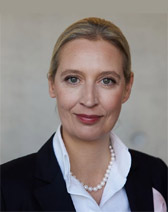
Alice Weidel
Co-Leader of Alternative for Germany and One of the Most Prominent Figures in Contemporary German Politics
Born on February 6, 1979
Age: 47
Profession: Politician, Economist
Place of Birth: Gütersloh, North Rhine-Westphalia, Germany
Alice Weidel is a German politician and economist known as one of the leading figures of Alternative for Germany (AfD), the right-wing populist party that has become a major force in contemporary German politics. Since June 18, 2022, Alice Weidel has served as co-leader of the party alongside Tino Chrupalla. She has also been one of the parliamentary leaders of the AfD group in the Bundestag since 2017. With her background in economics, finance, and international business, Alice Weidel has become one of the most visible and polarizing politicians in Germany.
Early Life and Education
Alice Weidel was born on February 6, 1979, in Gütersloh, North Rhine-Westphalia, Germany. She is the daughter of Gerhard Weidel and Margitta Weidel and spent much of her childhood in Harsewinkel. Her early life was shaped by a middle-class German environment before she moved into academic and professional fields connected to economics, finance, and international markets.
Alice Weidel studied economics and business administration at University of Bayreuth. Her academic focus later turned toward China, pension systems, and international economic structures. In 2011, she completed her doctoral dissertation on the Chinese pension system, a subject that reflected her interest in demographic change, welfare models, and global economic development.
Professional Career Before Politics
Before entering politics, Alice Weidel worked in the financial sector. She served as an analyst at Goldman Sachs Asset Management, gaining experience in investment structures and international finance.
She later worked in consulting and business roles connected to China. Her experience in China, combined with her doctoral research, helped shape her profile as a politician with an economic and international background. This professional identity became one of the ways she distinguished herself inside AfD, especially on issues such as fiscal policy, taxation, globalization, and Germany’s economic competitiveness.
Entry into Alternative for Germany
Alice Weidel joined Alternative for Germany in 2013, the year the party was founded. At that time, AfD was strongly associated with criticism of eurozone rescue policies and skepticism toward the direction of the European Union. Over time, the party shifted toward a broader nationalist, anti-immigration, and right-wing populist platform.
Inside the party, Alice Weidel rose quickly. In 2015, she became a member of the AfD federal executive board. Her polished public speaking style, economic background, and ability to present party positions in a more technocratic language helped her become one of the party’s national figures.
Bundestag Leadership
In the 2017 federal election, Alice Weidel became one of the AfD’s lead candidates together with Alexander Gauland. After the election, she entered the Bundestag and became co-leader of the AfD parliamentary group.
This role placed her at the center of German parliamentary debates. She frequently spoke on migration, taxation, public spending, internal security, energy policy, the European Union, and criticism of the governments led by Angela Merkel and later Olaf Scholz. Her speeches often combined economic critique with broader cultural and political arguments associated with AfD’s opposition identity.
Party Co-Leadership with Tino Chrupalla
On June 18, 2022, Alice Weidel was elected co-chair of Alternative for Germany alongside Tino Chrupalla. Their leadership came during a period when the party was increasing its influence in polls, regional elections, and national political debate.
While Tino Chrupalla often represented the party’s working-class and eastern German electoral base, Alice Weidel projected a more business-oriented and internationally experienced image. This combination helped AfD broaden its public presentation, even as the party remained highly controversial within Germany’s political system.
Political Positions and Public Debate
Alice Weidel is associated with strict criticism of immigration policy, skepticism toward deeper European Union integration, tax reduction, economic liberalism, and a more nationalist interpretation of German sovereignty. She has frequently criticized mainstream parties including the Christian Democratic Union (CDU), the Social Democratic Party of Germany (SPD), the Alliance 90/The Greens, and the Free Democratic Party (FDP).
Her rise has also been closely tied to broader debates around AfD’s place in German democracy. Supporters view her as a sharp critic of the political establishment and a defender of national interests. Critics describe her and her party as part of a right-wing populist movement that challenges Germany’s postwar liberal consensus.
Because of this tension, Alice Weidel has frequently been compared with other European right-wing figures such as Marine Le Pen, Giorgia Meloni, and Geert Wilders, although Germany’s historical and constitutional context makes AfD’s position especially sensitive.
2025 Federal Election Profile
During the 2025 federal election cycle, Alice Weidel was presented by AfD as a candidate for chancellor. This move made her one of the most discussed political figures in Germany and increased her visibility in national and international media.
However, her path to executive power remained limited by Germany’s political “firewall” against AfD, as major parties such as the CDU, SPD, Greens, and FDP maintained distance from formal coalition cooperation with the party. This political isolation became one of the central themes surrounding her candidacy.
Personal Life
Alice Weidel has been in a relationship with Sarah Bossard since 2009. Sarah Bossard is a Swiss-based film producer who was born in Sri Lanka and adopted as an infant by a Swiss pastor couple. The couple has two sons, whose biological mother is Sarah Bossard.
Alice Weidel primarily lives in Berlin but also spends part of her time in Einsiedeln, Switzerland, where Sarah Bossard resides. She has described herself as lesbian, while rejecting the label “queer.” Religiously, Alice Weidel identifies as agnostic.
Contemporary Significance
Alice Weidel is one of the most influential and controversial politicians in contemporary Germany. Her career combines a background in economics and finance with leadership in one of the country’s most debated political parties.
As co-leader of Alternative for Germany and a major figure in the Bundestag, Alice Weidel remains central to debates over migration, national identity, European integration, democratic norms, and the changing structure of German party politics.
Source: Biyografiler.com
Frequently asked questions about Alice Weidel
Who is Alice Weidel?, Alice Weidel biography, Alice Weidel life story, Alice Weidel age, Alice Weidel facts, Alice Weidel birthplace, Alice Weidel photos, Alice Weidel videos, Alice Weidel career
Related Biographies


Lamine Yamal
Professional footballer

Sam Altman
Entrepreneur, Investor, CEO

Kylian Mbappe
Professional footballer

Alice Weidel
Politician, Economist

Erling Haaland
Professional footballer

Giorgia Meloni
Politician, Journalist


Hongjoong
Singer, Rapper, Songwriter, Composer

Ludacris
Rapper, Actor

Kwon Eunbi
Singer

Sarah Wayne Callies
Actress, Screenwriter, Producer, Director

LaTavia Roberson
Singer, Actress, Entrepreneur
Lamine Yamal
Professional footballer

Lady Gaga
Singer, Musician, Songwriter, Actress, Producer

Delcy Rodriguez
Politician, Lawyer, Diplomat


Bad Bunny
Rapper, Songwriter

Austin Abrams
Actor