
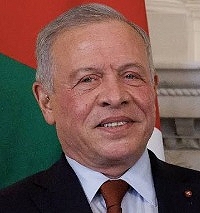
King Abdullah II
King of Jordan since February 7, 1999. The eldest son of King Hussein, he previously served as commander of Jordan's Special Forces and attained the rank of major general. His reign has included economic and political reform programs, regional diplomacy, and efforts to address the Israeli–Palestinian conflict.
Born on -
Age: -
Profession: King
Place of Birth: Amman, Jordan
King Abdullah II, whose full name is Abdullah bin Hussein bin Talal, was born on January 30, 1962, in Amman, Jordan. He has been King of the Hashemite Kingdom of Jordan since February 7, 1999. The eldest son of King Hussein and Princess Muna Al-Hussein, he received his education in Jordan, Britain, and the United States before pursuing a military career. He served in the Jordanian Armed Forces, commanded the country's Special Forces, and attained the rank of major general. Shortly before his death in 1999, King Hussein appointed Abdullah Crown Prince. Following his accession to the throne, King Abdullah II pursued economic reforms, maintained Jordan's relations with Western and Arab countries, and participated in diplomatic efforts concerning the Israeli–Palestinian conflict.
Early Life and Family
King Abdullah II was born on January 30, 1962, in Amman, the capital of Jordan. His father was King Hussein bin Talal, who ruled Jordan from 1952 to 1999. His mother was Princess Muna Al-Hussein, born Antoinette Avril Gardiner, a British woman who married King Hussein in 1961.
His parents divorced in 1972 after approximately eleven years of marriage. Abdullah has three full siblings: Prince Faisal bin Hussein, Princess Aisha bint Hussein, and Princess Zein bint Hussein. He also has several half-siblings from his father's other marriages.
He belongs to the Hashemite dynasty, which has ruled Jordan since the establishment of the Emirate of Transjordan in 1921.
Education and Military Training
King Abdullah II began his education at the Islamic Educational College in Amman. He subsequently attended St Edmund's School in Surrey, England, before continuing his secondary education at Eaglebrook School and Deerfield Academy in the United States.
In 1980, he entered the Royal Military Academy Sandhurst in Britain. After completing his military training in 1981, he was commissioned as a second lieutenant and served with the British Army's Royal Hussars.
In 1982, he attended Oxford University, completing a one-year course in Middle Eastern affairs. He later returned to Jordan and joined the Jordanian Armed Forces as a first lieutenant, serving in the 40th Armoured Brigade.
In 1985, he received advanced armoured officer training at Fort Knox in the United States. He also trained with the Royal Jordanian Air Force and qualified as a pilot of Cobra attack helicopters.
In 1987, he attended the School of Foreign Service at Georgetown University in Washington, D.C., through a fellowship and advanced study program in international affairs.
Military Career
After completing his education, King Abdullah II continued serving in the Jordanian military. He held command positions in armoured and mechanized units and completed further military training in Britain.
During the early 1990s, he served in the 17th Royal Tank Battalion and other armoured formations. In 1993, he was promoted to colonel and became involved in the command of Jordan's Special Forces.
He subsequently became commander of the Jordanian Special Forces. In 1996, he participated in reorganizing these forces into a unified Special Operations Command.
By 1998, he had attained the rank of major general. His military duties included the development of special operations capabilities and counterterrorism units.
Becoming King of Jordan
Following the birth of King Abdullah II in 1962, he was initially designated Crown Prince. In April 1965, his father appointed his brother, Prince Hassan bin Talal, as Crown Prince instead.
Prince Hassan retained the position for more than three decades. On January 24, 1999, shortly before his death, King Hussein removed Hassan from the succession position and appointed his eldest son Abdullah as Crown Prince.
King Hussein died on February 7, 1999. Abdullah succeeded him on the same day, becoming King Abdullah II of Jordan.
Following his accession, he appointed his half-brother Prince Hamzah bin Hussein as Crown Prince. In November 2004, he removed Hamzah from that position without immediately naming a replacement.
On July 2, 2009, Abdullah officially appointed his eldest son, Prince Hussein bin Abdullah, as Crown Prince of Jordan.
Reign and Foreign Policy
Since becoming king in 1999, King Abdullah II has maintained Jordan's diplomatic and security relationships with the United States, European countries, and other Arab states.
Jordan has continued its participation in regional diplomacy concerning the Israeli–Palestinian conflict. Abdullah has supported negotiations based on a two-state solution and has called for the establishment of an independent Palestinian state alongside Israel.
His government has maintained the peace treaty signed between Jordan and Israel in 1994 under King Hussein. At the same time, relations between the two countries have periodically been strained by developments in the Palestinian territories and Jerusalem.
Jordan's historical custodianship of Islamic and Christian holy sites in Jerusalem has remained a subject of the king's diplomatic activities.
Abdullah has also participated in international discussions concerning regional security, counterterrorism, and humanitarian assistance for refugees displaced by conflicts in neighboring countries.
Economic and Political Reforms
King Abdullah II introduced economic policies aimed at attracting foreign investment, expanding private-sector activity, and reducing Jordan's dependence on external financial assistance.
During his reign, Jordan implemented privatization programs and regulatory changes intended to encourage investment and economic growth. The country also pursued international trade agreements and expanded cooperation with foreign investors.
However, Jordan continued to face economic difficulties, including unemployment, public debt, limited natural resources, and dependence on imported energy.
Abdullah also supported several programs intended to modernize the country's political institutions. Following the protests associated with the Arab Spring in 2011, constitutional amendments and electoral reforms were introduced.
Further changes were pursued through a royal committee established in 2021 to examine the modernization of Jordan's political system. Nevertheless, the monarchy retained extensive executive powers, including the authority to appoint the prime minister.
Relations with Turkey
On March 5, 2013, King Abdullah II visited Turkey at the official invitation of Turkish President Abdullah Gül.
During the visit, the two leaders discussed bilateral relations, regional developments, and economic cooperation. President Gül hosted a state dinner in honor of Abdullah and his wife, Queen Rania.
On March 6, 2013, Abdullah and President Gül visited the facilities of Turkish Aerospace Industries (TUSAŞ) in Ankara, where they examined the Turkish-developed T129 ATAK helicopter.
Marriage and Children
King Abdullah II married Rania Al-Yassin, who is of Palestinian descent, on June 10, 1993, in Amman. Following Abdullah's accession to the throne in 1999, she received the title Queen Rania.
The couple have four children. Their eldest son, Crown Prince Hussein bin Abdullah, was born on June 28, 1994. Their daughter Princess Iman bint Abdullah was born on September 27, 1996, followed by Princess Salma bint Abdullah on September 26, 2000, and Prince Hashem bin Abdullah on January 30, 2005.
Crown Prince Hussein was officially designated heir to the throne in July 2009.
Family
Father: King Hussein bin Talal (1935–1999)Mother: Princess Muna Al-Hussein (Born 1941)
Wife: Queen Rania Al Abdullah (Married June 10, 1993)
Son: Crown Prince Hussein bin Abdullah (Born 1994)
Daughter: Princess Iman bint Abdullah (Born 1996)
Daughter: Princess Salma bint Abdullah (Born 2000)
Son: Prince Hashem bin Abdullah (Born 2005)
Royal and Military Career
1980–1981 - Military Training at Royal Military Academy Sandhurst1982 - Studies at Oxford University
1980s - Military Service in the Jordanian Armoured Forces
1985 - Advanced Military Training at Fort Knox, United States
1987 - International Affairs Studies at Georgetown University
1993 - Command Positions in the Jordanian Special Forces
1996 - Reorganization of the Special Operations Command
1998 - Promotion to Major General
January 24, 1999 - Appointed Crown Prince of Jordan
February 7, 1999 – Present - King of Jordan
July 2, 2009 - Appointed Prince Hussein bin Abdullah Crown Prince
Source: Biyografiler.com
Frequently asked questions about King Abdullah II
Who is King Abdullah II?, King Abdullah II biography, King Abdullah II life story, King Abdullah II age, King Abdullah II facts, King Abdullah II birthplace, King Abdullah II photos, King Abdullah II videos, King Abdullah II career

Lamine Yamal
Professional footballer

Kylian Mbappe
Professional footballer

Brad Pitt
Actor

Keanu Reeves
Actor

Erling Haaland
Professional footballer

Leonardo DiCaprio
Actor

Kyle Polzin
Painter

Kyle MacLachlan
Actor

Lakshmi Mittal
Businessperson, Investor

King Abdullah II
King

King Hussein
King

Queen Rania
Queen

Jensen Huang
Entrepreneur, CEO, Engineer

Jackie Chan
Actor

Scott Bessent
Politician, Investor

Bruno Rodriguez Parrilla
Diplomat, Lawyer, Politician

Gadi Eisenkot
Politician, Military Commander

Ronaldinho
Professional footballer