
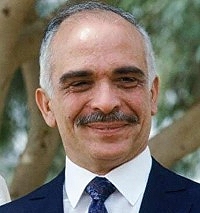
King Hussein
King of Jordan from August 11, 1952, to February 7, 1999. A member of the Hashemite dynasty, he ruled during the 1967 Arab–Israeli War, the Black September conflict of 1970–1971, and the 1994 peace agreement between Jordan and Israel. He was succeeded by his eldest son, King Abdullah II.
Born on November 14, 1935
Died on February 7, 1999
Age at death: 64
Profession: King
Place of Birth: Amman, Jordan
Place of Death: Amman, Jordan
King Hussein, whose full name was Hussein bin Talal, was born on November 14, 1935, in Amman, Jordan. He was King of Jordan from August 11, 1952, until his death on February 7, 1999, exercising full constitutional powers from May 2, 1953. A member of the Hashemite dynasty, he succeeded his father, King Talal, at the age of 16. During his reign, Jordan experienced the Six-Day War of 1967, the conflict between the Jordanian army and Palestinian armed organizations known as Black September, the Gulf War, and negotiations that resulted in the 1994 Jordan–Israel peace treaty. He ruled for nearly 47 years and was succeeded by his eldest son, King Abdullah II.
Early Life and Education
King Hussein was born on November 14, 1935, in Amman. His father was King Talal, the son of Jordan's founding monarch King Abdullah I, and his mother was Queen Zein Al-Sharaf.
He received his early education in Amman before attending Victoria College in Alexandria, Egypt. He subsequently continued his studies at Harrow School in the United Kingdom and received military training at the Royal Military Academy Sandhurst.
Hussein spent considerable time with his grandfather, King Abdullah I, who had ruled Transjordan as emir before the country's independence in 1946 and subsequently became its first king.
After the establishment of Israel in May 1948, Jordan participated in the first Arab–Israeli war. By the end of the conflict, Jordanian forces controlled the West Bank and East Jerusalem, including the Old City of Jerusalem. Israel controlled West Jerusalem. Jordan formally annexed the West Bank in 1950, a decision recognized by only a limited number of countries.
The young prince accompanied his grandfather during official meetings and learned about the political affairs of Jordan and neighboring countries. He occasionally assisted him in communicating with foreign visitors.
Assassination of King Abdullah I
On July 20, 1951, King Hussein accompanied his grandfather King Abdullah I to the Al-Aqsa Mosque compound in Jerusalem for Friday prayers.
During the visit, Abdullah I was shot and killed by an assassin. Hussein was standing nearby and was also targeted. According to accounts of the incident, a bullet struck a medal on his uniform and was deflected, allowing him to survive.
Following his grandfather's assassination, Hussein's father, King Talal, became King of Jordan in September 1951. Hussein was named Crown Prince.
He subsequently returned to the United Kingdom to continue his military education at Sandhurst.
Becoming King of Jordan
King Talal developed serious health problems that prevented him from continuing his royal duties. On August 11, 1952, the Jordanian Parliament removed him from the throne on medical grounds and proclaimed King Hussein the new monarch.
Hussein was 16 years old and had not reached the age required to exercise his constitutional powers. A Regency Council was therefore established to administer the kingdom until he came of age.
He learned of his accession while abroad with his mother. During the regency, he continued his military training in the United Kingdom.
On May 2, 1953, he formally assumed his constitutional powers as King of Jordan, having reached the required age under the Islamic calendar. His cousin King Faisal II of Iraq also assumed full royal powers on the same date.
The young king inherited a country facing political and economic challenges, including the settlement of Palestinian refugees displaced by the 1948 Arab–Israeli War and tensions involving neighboring Arab states.
Political Challenges and Arab Nationalism
During the 1950s, King Hussein faced growing pressure from Arab nationalist movements, particularly those associated with Egyptian President Gamal Abdel Nasser.
The overthrow of the Egyptian monarchy in 1952 and the rise of Nasser's pan-Arab policies influenced political movements across the Middle East, including Jordan.
In 1956, Hussein dismissed British General John Bagot Glubb, commander of the Arab Legion, and placed the Jordanian armed forces under Jordanian command.
In 1957, tensions between the monarchy and sections of the military and political opposition led to a domestic crisis. Hussein dismissed the government of Suleiman Nabulsi, declared martial law, and introduced restrictions on political party activities.
His relations with Egypt, Syria, Iraq, and Saudi Arabia were shaped by competing approaches to Arab nationalism, regional alliances, and relations with Western powers.
The Arab Federation and the 1958 Iraqi Revolution
In February 1958, King Hussein and his cousin King Faisal II established the Arab Federation between Jordan and Iraq.
The federation was formed shortly after Egypt and Syria announced their union as the United Arab Republic under Gamal Abdel Nasser. The arrangement was intended to strengthen cooperation between the two Hashemite monarchies.
However, the federation survived for only a few months.
On July 14, 1958, Iraqi military officers overthrew the Hashemite monarchy in Baghdad. King Faisal II and several members of the Iraqi royal family were killed.
The revolution ended the Iraqi monarchy, and the Arab Federation was dissolved later that year.
Following the overthrow of his cousin, Hussein continued to govern Jordan amid regional political instability and concerns about the security of his own monarchy.
The Six-Day War of 1967
In the 1960s, relations between Israel and neighboring Arab states became increasingly tense. On May 30, 1967, King Hussein traveled to Cairo and signed a defense agreement with Egyptian President Gamal Abdel Nasser.
On June 5, 1967, Israel launched air strikes against Egyptian airfields, beginning the Six-Day War. Jordan entered the conflict alongside Egypt and Syria.
During the six-day conflict, Israeli forces captured the West Bank and East Jerusalem from Jordan. The captured territory included the Old City of Jerusalem and the Al-Aqsa Mosque compound.
The defeat resulted in another movement of Palestinian refugees toward the East Bank of Jordan and significantly changed the kingdom's territorial and political position.
The loss of East Jerusalem and the West Bank remained central issues in Hussein's subsequent negotiations over the Arab–Israeli conflict.
Black September and the Conflict with Palestinian Organizations
Following the 1967 war, Palestinian armed organizations expanded their presence in Jordan. Groups operating under the Palestine Liberation Organization (PLO) conducted attacks against Israel from Jordanian territory and established armed positions in and around Jordanian cities.
Relations between the Jordanian government and Palestinian organizations deteriorated as the armed groups increasingly challenged the authority of the monarchy.
On September 6, 1970, members of the Popular Front for the Liberation of Palestine began a series of international aircraft hijackings. Several aircraft were diverted to Jordan, including a remote airstrip near Zarqa known as Dawson's Field.
The hijackings intensified the confrontation between the Jordanian government and Palestinian armed groups. In September 1970, King Hussein ordered the Jordanian armed forces to reassert government control.
Fighting broke out in Amman and other parts of the country. Jordanian troops used tanks and artillery against Palestinian armed positions, while a Syrian armored force entered northern Jordan during the conflict.
On September 27, 1970, Hussein and PLO leader Yasser Arafat reached a ceasefire agreement in Cairo through the mediation of Egyptian President Gamal Abdel Nasser. However, fighting continued intermittently.
Jordan received military assistance and advice from Pakistan. Among the Pakistani officers serving in the country was Brigadier Muhammad Zia-ul-Haq, who later became President of Pakistan. His precise operational role during the fighting has been described differently in historical accounts.
By July 1971, Jordanian forces had defeated the remaining Palestinian armed formations operating independently of the government. The PLO subsequently relocated much of its leadership and military infrastructure to Lebanon.
The events became known as Black September. Thousands of people, including Palestinian combatants and civilians, were killed. Estimates of the death toll differ considerably. Some Palestinian accounts claimed as many as 25,000 deaths, while other historical estimates are substantially lower. There is no universally accepted final figure.
The 1973 Arab–Israeli War
In October 1973, Egypt and Syria launched military operations against Israel, beginning the Yom Kippur War, also known as the October War.
King Hussein had maintained discreet contacts with Israeli officials, including Prime Minister Golda Meir, during the period preceding the conflict.
Jordan did not immediately enter the war on the same scale as Egypt and Syria. Hussein later sent Jordanian armored forces to support Syrian operations on the Golan Heights.
After the war, Hussein continued diplomatic contacts with Arab governments and Western countries while seeking financial support for Jordan's economy.
Saudi Arabia and other Arab states provided economic assistance, while relations with Western governments remained an element of Jordan's foreign policy.
Relations with the Palestinians and the West Bank
At the 1974 Arab League summit in Rabat, the Palestine Liberation Organization was recognized as the sole legitimate representative of the Palestinian people.
This decision reduced Jordan's role in representing Palestinians living in the West Bank, although Jordan continued to maintain administrative and financial ties with the territory.
In December 1987, the First Intifada began in the Israeli-occupied Palestinian territories.
On July 31, 1988, King Hussein announced that Jordan would sever its legal and administrative ties with the West Bank, relinquishing its claim to govern the territory.
The decision was intended to leave the question of Palestinian political representation and statehood to the Palestinians and their recognized leadership.
Political Reforms in Jordan
During the late 1980s, King Hussein also faced economic difficulties and domestic political protests.
In 1989, Jordan held parliamentary elections, beginning a new period of political participation after years of restrictions on parliamentary and party activity.
The government subsequently introduced measures intended to expand political pluralism, and political parties were legalized again in 1992.
Further parliamentary elections took place in 1993 and 1997.
The Gulf War and Relations with Iraq
When Iraqi President Saddam Hussein ordered the invasion of Kuwait in August 1990, King Hussein attempted to mediate between Iraq and other regional governments.
Jordan did not join the United States-led military coalition formed against Iraq during the Gulf War of 1990–1991.
Hussein called for a negotiated resolution and maintained diplomatic contacts with Baghdad. His position caused tensions with Saudi Arabia, Kuwait, and several Western governments.
Following the war, Jordan faced economic difficulties and a deterioration in relations with some of its traditional financial supporters.
The 1994 Peace Treaty with Israel
During the early 1990s, King Hussein became directly involved in negotiations aimed at ending the state of conflict between Jordan and Israel.
On July 25, 1994, Hussein and Israeli Prime Minister Yitzhak Rabin met at the White House in Washington, D.C., in the presence of United States President Bill Clinton.
The meeting resulted in the signing of the Washington Declaration, which formally ended the state of belligerency between Jordan and Israel.
Negotiations continued over territorial boundaries, water resources, security arrangements, and diplomatic relations.
On October 26, 1994, Jordan and Israel signed the Jordan–Israel Peace Treaty at a ceremony near their shared border. The agreement formally established peace and diplomatic relations between the two countries.
The treaty also recognized Jordan's historical role in Muslim holy sites in Jerusalem and established arrangements concerning borders and shared water resources.
Illness and Final Years
In 1998, King Hussein was diagnosed with non-Hodgkin lymphoma, a form of cancer affecting the lymphatic system.
He traveled to the United States for medical treatment at the Mayo Clinic in Minnesota, where he underwent chemotherapy and further treatment.
After several months of treatment, he returned to Jordan in January 1999.
On January 24, 1999, Hussein removed his brother Prince Hassan bin Talal, who had served as Crown Prince since 1965, from the line of immediate succession.
He appointed his eldest son, Prince Abdullah bin Hussein, as Crown Prince shortly before his death.
Death
King Hussein died on February 7, 1999, in Amman, Jordan, following complications from cancer. He was 63 years old.
His funeral was attended by numerous foreign heads of state, monarchs, and political leaders.
He was buried at the Royal Cemetery near Raghadan Palace in Amman, where other members of Jordan's Hashemite royal family are also buried.
His eldest son succeeded him on the same day as King Abdullah II.
Marriages and Personal Life
King Hussein married four times and had eleven biological children.
His first wife was Sharifa Dina bint Abdul-Hamid, whom he married on April 19, 1955. Their daughter, Princess Alia bint Hussein, was born in 1956. The marriage ended in divorce in June 1957.
On May 25, 1961, Hussein married British-born Antoinette Avril Gardiner, who became known as Princess Muna Al-Hussein. They had four children: King Abdullah II, Prince Faisal bin Hussein, Princess Aisha bint Hussein, and Princess Zein bint Hussein. Their marriage ended in December 1972.
On December 24, 1972, Hussein married Alia Bahauddin Toukan, who became Queen Alia. They had two children, Princess Haya bint Hussein and Prince Ali bin Hussein. Queen Alia died in a helicopter crash on February 9, 1977.
On June 15, 1978, Hussein married American-born Lisa Najeeb Halaby, who became known as Queen Noor Al-Hussein. Her father was of Arab descent and her mother was of Swedish ancestry.
The couple had four children: Prince Hamzah bin Hussein, Prince Hashim bin Hussein, Princess Iman bint Hussein, and Princess Raiyah bint Hussein. Their marriage continued until Hussein's death in 1999.
Wives
Sharifa Dina bint Abdul-Hamid (1955–1957)Princess Muna Al-Hussein – Antoinette Avril Gardiner (1961–1972)
Queen Alia – Alia Bahauddin Toukan (1972–1977)
Queen Noor Al-Hussein – Lisa Najeeb Halaby (1978–1999)
Children
Princess Alia bint Hussein (Born 1956)King Abdullah II (Born 1962)
Prince Faisal bin Hussein (Born 1963)
Princess Aisha bint Hussein (Born 1968)
Princess Zein bint Hussein (Born 1968)
Princess Haya bint Hussein (Born 1974)
Prince Ali bin Hussein (Born 1975)
Prince Hamzah bin Hussein (Born 1980)
Prince Hashim bin Hussein (Born 1981)
Princess Iman bint Hussein (Born 1983)
Princess Raiyah bint Hussein (Born 1986)
Royal Reign and Major Events
1951–1952 - Crown Prince of JordanAugust 11, 1952 – February 7, 1999 - King of Jordan
May 2, 1953 - Assumed Full Constitutional Powers
1956 - Dismissal of British Commander John Bagot Glubb
1958 - Establishment of the Arab Federation with Iraq
1967 - Six-Day War and Loss of the West Bank and East Jerusalem
1970–1971 - Black September Conflict
1973 - Jordanian Military Participation in the October War
1988 - Legal and Administrative Disengagement from the West Bank
1989 - Resumption of Parliamentary Elections
1990–1991 - Gulf War and Diplomatic Mediation Efforts
July 25, 1994 - Washington Declaration with Israel
October 26, 1994 - Jordan–Israel Peace Treaty
February 7, 1999 - Death and Accession of King Abdullah II
Source: Biyografiler.com
Frequently asked questions about King Hussein
Who is King Hussein?, King Hussein biography, King Hussein life story, King Hussein age, King Hussein facts, King Hussein birthplace, King Hussein photos, King Hussein videos, King Hussein career

Lamine Yamal
Professional footballer

Kylian Mbappe
Professional footballer

Brad Pitt
Actor

Keanu Reeves
Actor

Erling Haaland
Professional footballer

Leonardo DiCaprio
Actor

Kyle Polzin
Painter

Kyle MacLachlan
Actor

Lakshmi Mittal
Businessperson, Investor

King Abdullah II
King

King Hussein
King

Queen Rania
Queen

Jensen Huang
Entrepreneur, CEO, Engineer

Jackie Chan
Actor

Scott Bessent
Politician, Investor

Bruno Rodriguez Parrilla
Diplomat, Lawyer, Politician

Gadi Eisenkot
Politician, Military Commander

Ronaldinho
Professional footballer