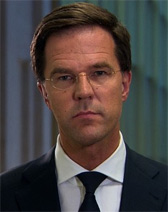
Mark Rutte
Prime Minister of the Netherlands
Born on February 14, 1967
Age: 59
Profession: Politician, Historian
Place of Birth: The Hague, Netherlands
Mark Rutte was born on February 14, 1967, in The Hague, Netherlands, as the son of Hermina Cornelia Rutte and Izaak Rutte. He graduated from Gymnasium high school in 1984. Between 1984 and 1992, he studied history at Leiden University, earning a master’s degree. He also received education at the International Institute for Management Development in Lausanne, Switzerland.
Until 1997, Mark Rutte worked in the human resources departments of private companies such as Unilever and Calvé. He entered politics during the 1990s. Between 1997 and 2000, he served as personnel manager at Van den Bergh Nederland, a subsidiary of Unilever. In 2000, he joined Unilever’s Corporate Human Resources Group, and in 2002 he became human resources director of another Unilever subsidiary, the IgloMora Group.
Mark Rutte was a board member of the Liberal Youth Organization (JOVD) from 1988 to 1991 and later served on the executive board of the People’s Party for Freedom and Democracy (VVD) between 1993 and 1997. In 2003, he was elected as a Member of Parliament.
Since May 31, 2006, Mark Rutte has served as leader of the People’s Party for Freedom and Democracy (VVD). From 2006 to 2010, he was parliamentary group leader in the House of Representatives.
Between July 22, 2002, and June 17, 2004, Mark Rutte served as State Secretary for Social Affairs and Employment. From June 17, 2004, to June 27, 2006, he was appointed Secretary-General at the Ministry of Education, Culture, and Science, with responsibility for vocational and higher education.
A member of the Calvinist Reformed Protestant Church, Mark Rutte is unmarried.
After winning the general elections held in October 2010, Mark Rutte was appointed the 50th Prime Minister of the Netherlands on October 14, 2010, by Queen Beatrix of the Netherlands. His party held only one more seat than the Labour Party, making a coalition government necessary. For the first time since World War II, a minority government was formed with external support from the far-right Party for Freedom (PVV), led by Geert Wilders, in coalition with the VVD and the Christian Democratic Appeal (CDA).
Following disagreements over European Union and budgetary issues, the PVV withdrew its support from the government on April 21, 2012. As a result, Mark Rutte submitted his resignation to Queen Beatrix on April 23, 2012, leading to early elections after an 18-month term.
In the early election held on September 12, 2012, the VVD received 26.6 percent of the vote, while the Labour Party (PvdA) received 24.9 percent. A coalition government led by Mark Rutte was formed on November 5, 2012.
During the period leading up to the March 15, 2017, general elections, Mark Rutte faced strong competition from the far-right Party for Freedom. In March 2017, tensions escalated after Turkish ministers Mevlüt Çavuşoğlu and Fatma Betül Sayan Kaya were denied permission to campaign in the Netherlands. Rutte rejected accusations made by Turkish President Recep Tayyip Erdogan and stated that such remarks were unacceptable. He also held multiple phone calls with then Turkish Prime Minister Binali Yıldırım during the crisis.
On January 15, 2021, Mark Rutte and his cabinet resigned due to the child benefits scandal but continued as a caretaker government until the general election held on March 17, 2021. After 299 days of coalition negotiations, a new four-party coalition government led by Rutte took office on January 10, 2022.
Mark Rutte handed over the office of Prime Minister to Dick Schoof on July 2, 2024.
Mark Rutte was appointed Secretary General of NATO to succeed Jens Stoltenberg, with his term scheduled to begin on October 1, 2024.
Political Party:
People’s Party for Freedom and Democracy (VVD)
Source: Biyografiler.com
News about Mark Rutte
NATO Announces New Support Package for Ukraine: Air Defense, Missiles and Drone Deliveries to Increase
NATO allies have announced a new and comprehensive military support package for Ukraine. The package, unveiled after the Defense Ministers’ Meeting ...
Record Gathering at Davos: World Leaders and Global Business to Converge in Switzerland
Record Gathering at Davos: World Leaders and Global Business to Converge in Switzerland. The 56th Annual Meeting of the World Economic Forum (WEF) ...
Frequently asked questions about Mark Rutte
Who is Mark Rutte?, Mark Rutte biography, Mark Rutte life story, Mark Rutte age, Mark Rutte facts, Mark Rutte birthplace, Mark Rutte photos, Mark Rutte videos, Mark Rutte career
Related Biographies

Lamine Yamal
Professional footballer

Erling Haaland
Professional footballer

Kylian Mbappe
Professional footballer

Sam Altman
Entrepreneur, Investor, CEO

Giorgia Meloni
Politician, Journalist

Khabib Nurmagomedov
Professional Boxer

Hoyt Richards
Model, Actor

Dieter Schwarz
Businessperson, Entrepreneur

Giovanni Ferrero
Businessperson

Cynthia Erivo
Singer, Actress, Songwriter, Producer

Mike Markkula
Businessperson, Entrepreneur

Carol Burnett
Actress, Singer
Lamine Yamal
Professional footballer


Ilya Sutskever
Computer Scientist, Researcher

Daniil Medvedev
Professional Tennis Player

Salma Hayek
Actress

William Shakespeare
Poet