
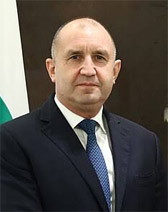
Rumen Radev
Former Air Force commander who moved from the presidency to the premiership and reshaped Bulgarian politics
Born on June 13, 1963
Age: 63
Profession: Military Officer, Politician
Place of Birth: Dimitrovgrad, Bulgaria
Rumen Radev was born on June 18, 1963, in Dimitrovgrad, Bulgaria. His full name is Rumen Georgiev Radev. A Bulgarian politician, retired major general and former fighter pilot, Rumen Radev has served as Prime Minister of Bulgaria since May 8, 2026. He previously served as President of Bulgaria from January 22, 2017, until his resignation took effect on January 23, 2026. After leaving the presidency, he founded the Progressive Bulgaria political movement, won an absolute parliamentary majority and completed one of the most remarkable transitions from a largely ceremonial head of state to the leader of the executive government in post-communist Bulgarian history.
Early Life and Education
Rumen Radev grew up in southern Bulgaria and demonstrated a strong aptitude for mathematics and technical subjects. In 1982, he graduated from the mathematics high school in Haskovo with a gold medal. His academic success led him toward military aviation, one of the most selective and technically demanding branches of the Bulgarian armed forces.
Rumen Radev subsequently entered the Bulgarian Air Force Academy in Dolna Mitropolia. He graduated as the leading student in his class and began his professional career as a military pilot. His training combined aeronautical engineering, navigation, combat tactics, flight safety and military leadership.
In 1992, Rumen Radev completed the Squadron Officer School at Maxwell Air Force Base in the United States. From 1994 to 1996, he attended the Command and Staff College of the G. S. Rakovski National Defence Academy in Bulgaria, again graduating at the top of his class.
Rumen Radev received a doctorate in military science in 2000. His research focused on improving the tactical training of aircrews and the simulation of aerial combat. In 2003, he returned to Maxwell Air Force Base and graduated with distinction from the Air War College, earning a master’s degree in strategic studies. His name was placed on the institution’s Glory Alley in recognition of his academic performance.
Career as a Fighter Pilot
Rumen Radev began his military career as a junior pilot in a fighter aviation regiment based at Ravnets. He later became a deputy unit commander, unit commander and squadron commander, steadily advancing through the operational and leadership structure of the Bulgarian Air Force.
He became particularly associated with the Soviet-designed MiG-29 fighter aircraft. Rumen Radev qualified as a first-class pilot, flight instructor and demonstration pilot, accumulating more than 1,400 hours of flying experience. His public image as a politician would later continue to draw heavily on his experience as a combat aviator and senior military commander.
During the early stages of his career, Rumen Radev served at a time when Bulgaria was transforming from a member of the Soviet-led Warsaw Pact into a country seeking integration with Western political and military institutions. This transition required the armed forces to adapt their command procedures, operational doctrine and technical standards.
From 2005 to 2009, Rumen Radev commanded the Third Fighter Air Base at Graf Ignatievo, one of Bulgaria’s most important military aviation facilities. He subsequently served as deputy commander of the Bulgarian Air Force from 2009 to 2014.
Commander of the Bulgarian Air Force
In 2014, Rumen Radev was appointed commander of the Bulgarian Air Force and promoted to the rank of major general. The position placed him in charge of a military branch facing serious financial and technical challenges, including an ageing aircraft fleet, limited flight hours and delays in the acquisition of modern fighter jets.
Rumen Radev publicly emphasized the need to maintain the operational independence of Bulgarian military aviation. He argued that the country required adequately trained pilots, reliable maintenance capacity and modern aircraft rather than long-term dependence on foreign forces for the protection of Bulgarian airspace.
His disagreements with the government over defence planning and the modernization of the fighter fleet contributed to his decision to leave active military service in 2016. By that time, Rumen Radev had developed a reputation as a technically knowledgeable officer who was willing to challenge civilian authorities over military readiness.
Entry into Politics
Rumen Radev entered national politics in 2016 when he became an independent candidate for president. Although he was not formally a member of the Bulgarian Socialist Party, his candidacy was supported by the party and its electoral organization.
His military background, outsider status and criticism of the political establishment distinguished him from conventional party candidates. His campaign emphasized national sovereignty, social justice, the modernization of the armed forces and a foreign policy based on what he described as Bulgaria’s own national interests.
In the presidential runoff held on November 13, 2016, Rumen Radev defeated Tsetska Tsacheva, the candidate supported by the governing Citizens for European Development of Bulgaria party. He won almost 60 percent of the vote, and the defeat prompted Prime Minister Boyko Borisov to submit his government’s resignation.
First Presidential Term
Rumen Radev took office as President of Bulgaria on January 22, 2017, with Iliana Iotova serving as vice president. Although the Bulgarian presidency has limited executive powers, the president plays an important constitutional role in defence, foreign affairs, the appointment of caretaker governments and the representation of the state.
During his first term, Rumen Radev frequently clashed with Prime Minister Boyko Borisov and the GERB government. He criticized corruption, the concentration of economic influence, weaknesses in the judicial system and what he regarded as the political capture of state institutions.
Rumen Radev used the presidential veto against legislation he considered constitutionally questionable or contrary to the public interest. Although parliament could override these vetoes, the decisions allowed him to maintain a visible position in national political debates.
He also called for greater transparency in public procurement, stronger institutional oversight and a more independent prosecution service. His supporters viewed him as a constitutional counterweight to the government, while his opponents accused him of behaving like an opposition party leader rather than a politically neutral president.
The 2020 Anti-Corruption Protests
The political influence of Rumen Radev increased considerably during the anti-government protests of 2020. Tensions intensified after prosecutors and police entered offices within the presidential administration as part of investigations involving presidential advisers.
Many Bulgarians interpreted the operation as an attempt to intimidate the presidency. The incident helped trigger the largest sustained anti-government demonstrations since Bulgaria joined the European Union in 2007. Protesters demanded the resignation of Boyko Borisov, stronger judicial accountability and an end to entrenched corruption.
Rumen Radev publicly supported the demonstrators and became one of the most visible political figures associated with their demands. His raised-fist appearance before protesters became an important symbol of the movement and strengthened his position among voters dissatisfied with the country’s traditional political parties.
Reelection and Political Instability
In November 2021, Rumen Radev was elected to a second presidential term alongside Iliana Iotova. He received approximately 66.7 percent of the vote in the second round, confirming his status as one of the most popular national political figures.
His second term coincided with one of the most unstable periods in modern Bulgarian politics. Repeated parliamentary elections produced fragmented legislatures, short-lived coalitions and governments that were unable to maintain durable parliamentary support.
Because political parties repeatedly failed to form regular governments, Rumen Radev appointed several caretaker cabinets. These administrations were intended to manage the state and organize elections, but their frequency substantially increased the political influence of the presidency.
Critics argued that Rumen Radev had gained excessive indirect authority through the repeated appointment of interim ministers. Supporters countered that he had been forced to act because established parties were incapable of forming stable governments or carrying out institutional reforms.
Relations with the European Union and NATO
Rumen Radev has consistently stated that Bulgaria should remain a member of the European Union and NATO. As a military officer trained in both Bulgaria and the United States, he has also supported the modernization of the Bulgarian armed forces and the country’s participation in collective defence.
At the same time, Rumen Radev has argued that membership in international alliances should not prevent Bulgaria from defending its own economic, energy and security interests. He has criticized European energy policies, certain climate regulations and decisions he believes impose disproportionate costs on smaller or less wealthy member states.
His political approach has often combined formal support for Euro-Atlantic membership with opposition to what he considers automatic alignment with the policies of more powerful allies. This balancing strategy has made him popular among voters who favor continued European integration but want a more independent Bulgarian foreign policy.
Russia, Crimea and the War in Ukraine
The foreign-policy positions of Rumen Radev have generated continuing controversy. He has condemned Russia’s invasion of Ukraine, but he has also opposed extensive Bulgarian military involvement and repeatedly argued that the conflict cannot be resolved solely through weapons and battlefield escalation.
During the 2021 presidential campaign, Rumen Radev caused an international dispute by describing Crimea as being under Russian control in terms that were interpreted as recognizing the result of the 2014 annexation. The United States expressed concern, and Ukraine summoned the Bulgarian ambassador. Rumen Radev later emphasized that the annexation was a violation of international law.
After Russia launched its full-scale invasion in 2022, Rumen Radev opposed sending Bulgarian weapons directly to Ukraine and warned that increasing military assistance could prolong the war. This brought him into conflict with pro-Ukrainian Bulgarian governments and with President Volodymyr Zelenskyy, who publicly challenged his position during a meeting in Sofia in 2023.
Critics have described Rumen Radev as sympathetic to the Kremlin or too willing to repeat Russian political narratives. He has rejected the description, presenting his position as a policy of military caution, national interest and support for negotiations rather than unconditional alignment with Moscow.
Resignation from the Presidency
On January 19, 2026, Rumen Radev announced that he would resign from the presidency before the scheduled end of his second term. The decision followed the collapse of another government and widespread public frustration over corruption, rising costs and prolonged political instability.
The Constitutional Court of Bulgaria formally terminated his presidential powers on January 23, 2026. Vice President Iliana Iotova succeeded him as president, becoming the first woman to hold the Bulgarian head-of-state position.
Rumen Radev became the first Bulgarian president of the post-communist era to resign from office. His departure confirmed long-standing expectations that he intended to abandon the constitutional limitations of the presidency and compete directly for executive power through parliament.
Foundation of Progressive Bulgaria
In March 2026, Rumen Radev launched the Progressive Bulgaria coalition as a center-left, populist and anti-establishment political movement. It brought together figures from social-democratic, nationalist, military and technocratic backgrounds.
The movement promised to dismantle what Rumen Radev called the oligarchic model of government. Its campaign focused on corruption, alleged political influence over prosecutors, public procurement abuses, vote buying, declining trust in state institutions and the rising cost of living.
Rumen Radev also promised stronger social protection, support for Bulgarian agriculture and industry, improved healthcare and education, and more effective use of European development funds. His military background and two presidential terms enabled him to present himself as both an outsider to parliamentary politics and an experienced national leader.
The campaign attracted voters from several political traditions. It received support from former socialist voters, citizens disappointed with Boyko Borisov and GERB, nationalist voters concerned about sovereignty, and younger Bulgarians frustrated by corruption and repeated inconclusive elections.
2026 Parliamentary Election Victory
The parliamentary election was held on April 19, 2026. Progressive Bulgaria won approximately 44.6 percent of the vote, finishing far ahead of GERB and the pro-European We Continue the Change–Democratic Bulgaria alliance.
The movement secured an absolute majority in the 240-seat National Assembly, winning approximately 131 seats. It was the first time since 1997 that a single Bulgarian political formation had obtained a parliamentary majority of this scale.
The result reflected dissatisfaction with years of unstable coalition governments, corruption allegations and repeated elections. It also demonstrated the ability of Rumen Radev to transform the personal popularity he had accumulated as president into a nationwide parliamentary organization.
European Council President António Costa and European Commission President Ursula von der Leyen congratulated Rumen Radev after the result. Russian officials also welcomed his stated preference for pragmatic dialogue, illustrating the competing expectations surrounding the direction of his future government.
Prime Minister of Bulgaria
On May 8, 2026, the Bulgarian National Assembly elected Rumen Radev Prime Minister. He received parliamentary approval after Progressive Bulgaria obtained the authority to form a majority government.
His appointment completed an extraordinary political transformation. Within less than four months, Rumen Radev had resigned as president, established a new political movement, won a parliamentary majority and assumed direct responsibility for the executive government.
The government identified judicial reform and the fight against corruption as its central objectives. Rumen Radev called for a new Supreme Judicial Council, an independent prosecutor’s office, transparent public procurement and a broader restructuring of the justice system.
He also ordered ministers to examine the financial condition of their departments, identify hidden liabilities, review controversial contracts and investigate possible overstaffing or misuse of public resources. The findings were intended to influence the preparation of the national budget.
Economic and Social Priorities
The first government program of Rumen Radev emphasized healthcare, education, transport infrastructure, digitalization, energy security and the business environment. His administration promised to accelerate European-funded projects and prevent Bulgaria from losing money available through the European Recovery and Resilience Plan.
In healthcare, Rumen Radev prioritized the completion of a national pediatric hospital and promised action against abuses involving pharmaceutical sales and medical procurement. In education, the government identified functional literacy and the quality of professional preparation as major concerns.
The government also pledged to reduce administrative regulation, expand electronic public services and improve conditions for domestic and foreign investment. Transport policy focused on roads, regional connections and the possible use of public-private partnerships.
Rumen Radev placed social payments and assistance for vulnerable households among his immediate priorities. This emphasis reflected the center-left character of Progressive Bulgaria and the economic concerns that had helped bring the movement to power.
In the energy sector, the administration promised greater use of domestic resources and policies intended to provide more affordable electricity for households and businesses. It also promoted food security, domestic agricultural production and stronger protection for Bulgarian producers.
Defence and Ukraine Policy as Prime Minister
After becoming prime minister, Rumen Radev stated that Bulgaria would retain its position within the European and Atlantic institutional system. His government also identified the modernization of the Bulgarian armed forces as an important national priority.
However, his administration adopted a more restrictive approach toward military assistance for Ukraine. In June 2026, Defence Minister Dimitar Stoyanov announced that Bulgaria did not plan to provide additional weapons to the Ukrainian army and called for negotiations between Moscow and Kyiv.
The decision represented a significant change from policies pursued in 2024 and 2025, when Bulgaria supplied Ukraine with anti-tank weapons, armored vehicles, artillery and other military equipment. The government nevertheless maintained an existing bilateral security framework covering defence production, intelligence cooperation and energy infrastructure.
This approach reflected the broader foreign-policy strategy of Rumen Radev: preserving formal membership in the European Union and NATO while seeking greater freedom to oppose particular military, economic or energy policies.
Political Style and Public Image
Rumen Radev is known for a serious, restrained and disciplined public manner shaped by his military career. Unlike politicians who rely heavily on humor, entertainment or constant media appearances, he generally presents himself as a commander-like figure concerned with state authority, constitutional order and national sovereignty.
His supporters describe him as an independent leader who challenged corruption, resisted oligarchic influence and remained outside the networks of Bulgaria’s established political parties. They credit him with providing a sense of stability after years of fragmented parliaments and short-lived governments.
Critics argue that the political influence accumulated by Rumen Radev during his presidency, followed by his parliamentary majority, creates a risk of excessive centralization. They also question whether his foreign-policy positions could weaken Bulgaria’s relations with European allies or increase Russian influence in the country.
His career has sometimes been compared with those of Viktor Orban and Robert Fico, particularly because of his criticism of European institutions, opposition to military aid for Ukraine and emphasis on national sovereignty. The comparison remains incomplete, as Rumen Radev has continued to affirm Bulgaria’s European membership and has also promoted judicial reform and institutional modernization.
Personal Life
Rumen Radev married Ginka Radeva in 1996. They had two children, Darina Radeva, born in 2001, and Georgi Radev Jr., born in 2003. The marriage ended in divorce in 2014.
In 2016, Rumen Radev married Desislava Gencheva, who became publicly known as Desislava Radeva. She accompanied him during presidential campaigns and official international visits and served as Bulgaria’s first lady during his time as head of state.
In addition to Bulgarian, Rumen Radev speaks English, German and Russian. His command of these languages, military training in the United States and familiarity with Russian-designed aviation technology have all influenced his ability to communicate across the competing political and strategic environments surrounding Bulgaria.
Position in Contemporary Bulgarian Politics
The career of Rumen Radev extends from combat aviation and military command to the presidency and the leadership of a parliamentary majority. Few Bulgarian politicians have combined such extensive experience in defence, constitutional office and executive government.
As president, Rumen Radev transformed a constitutionally limited office into an influential center of political opposition and public debate. Repeated political crises, caretaker governments and anti-corruption protests allowed him to develop a national political identity that extended beyond the traditional left-right division.
As prime minister, he faces a different standard of responsibility. He is now directly accountable for economic policy, public services, judicial reform, European funding and the consequences of Bulgaria’s foreign-policy choices.
Whether Rumen Radev will be remembered primarily as a successful reformer, a stabilizing leader or a politician who concentrated excessive power will depend on the results of his government. His transition from fighter pilot to Air Force commander, president and prime minister has already made him one of the most consequential figures in modern Bulgarian political history.
Selected Offices and Positions
- 1987–1989 – Junior Pilot in the 15th Fighter Aviation Regiment at Ravnets
- 1989–1997 – Deputy Unit Commander and Unit Commander
- 1997–1999 – MiG-29 Squadron Commander at Ravnets
- 2000–2005 – Senior Command and Staff Positions at Graf Ignatievo Air Base
- 2005–2009 – Commander of the Third Fighter Air Base at Graf Ignatievo
- 2009–2014 – Deputy Commander of the Bulgarian Air Force
- 2014–2016 – Commander of the Bulgarian Air Force
- 2017–2026 – President of the Republic of Bulgaria
- 2026–Present – Founder and Leader of Progressive Bulgaria
- 2026–Present – Prime Minister of the Republic of Bulgaria
Source: Biyografiler.com
Frequently asked questions about Rumen Radev
Who is Rumen Radev?, Rumen Radev biography, Rumen Radev life story, Rumen Radev age, Rumen Radev facts, Rumen Radev birthplace, Rumen Radev photos, Rumen Radev videos, Rumen Radev career
Related Biographies

Lamine Yamal
Professional footballer

Sam Altman
Entrepreneur, Investor, CEO

Kylian Mbappe
Professional footballer

Alice Weidel
Politician, Economist

Erling Haaland
Professional footballer

Giorgia Meloni
Politician, Journalist


Hongjoong
Singer, Rapper, Songwriter, Composer

Ludacris
Rapper, Actor

Kwon Eunbi
Singer

Sarah Wayne Callies
Actress, Screenwriter, Producer, Director

LaTavia Roberson
Singer, Actress, Entrepreneur
Lamine Yamal
Professional footballer

Austin Abrams
Actor

Xi Jinping
Politician, Statesman, Head of State

Claudia Sheinbaum
President, Politician, Scientist, Academic

Colman Domingo
Actor, Director, Producer

Kaia Gerber
Model, Actress