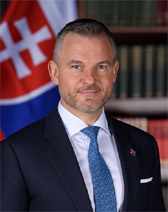
Peter Pellegrini
Social-democratic Slovak politician who reached the offices of prime minister, parliamentary speaker and president
Born on October 6, 1975
Age: 51
Profession: Politician, Economist, President
Place of Birth: Banská Bystrica, Czechoslovakia — now Slovakia
Peter Pellegrini was born on October 6, 1975, in Banská Bystrica, then part of Czechoslovakia and now located in Slovakia. A Slovak politician and economist, Peter Pellegrini has served as President of the Slovak Republic since June 15, 2024. He previously served as prime minister, deputy prime minister, education minister and, during two separate periods, Speaker of the National Council of the Slovak Republic. By reaching the presidency after leading both the government and parliament, Peter Pellegrini became the first Slovak politician to hold all three of the country’s highest constitutional offices.
Early Life and Education
Peter Pellegrini grew up in Banská Bystrica, one of the principal administrative, cultural and economic centers of central Slovakia. His childhood and early education took place during the final decades of socialist Czechoslovakia, while his university years coincided with the political and economic transformation that followed the fall of communist rule and the establishment of an independent Slovak state.
Peter Pellegrini studied at Matej Bel University in Banská Bystrica and at the Technical University of Košice. His academic education focused on finance, banking and investment, providing him with a professional foundation in economics before he entered national politics.
The economic background of Peter Pellegrini later influenced his political interest in public finance, state investment, transport infrastructure, European development funds and digital public services. In addition to Slovak, he has knowledge of English, German and Russian.
Early Professional Career
Before becoming a full-time political figure, Peter Pellegrini worked as a self-employed businessman between 1998 and 2002. Although this period was relatively brief, it gave him practical experience outside the institutions of government and parliament.
From 2002 to 2006, Peter Pellegrini worked as a parliamentary assistant to Ľubomír Vážny, a member of the National Council of the Slovak Republic. His work included economic policy, privatization, transport and infrastructure. This position introduced him to legislative procedures, parliamentary negotiations and the practical organization of political work.
Peter Pellegrini joined Direction–Social Democracy, generally known by its Slovak abbreviation Smer-SD, after the party was founded by Robert Fico. The movement positioned itself as a social-democratic alternative to both the post-communist left and the economically liberal center-right parties that had influenced Slovakia’s transition to a market economy.
Entry into Parliament
Peter Pellegrini was elected to the National Council of the Slovak Republic for the first time in the 2006 parliamentary election. During his first term, he served on the Economic Policy Committee and chaired a parliamentary commission responsible for transport, postal services, telecommunications and the development of the information society.
He also worked on parliamentary bodies dealing with mandates, immunity and decisions involving the National Security Authority. These responsibilities allowed Peter Pellegrini to combine economic legislation with questions concerning the institutional and administrative functioning of the Slovak state.
After being reelected in 2010, Peter Pellegrini became a member of the Finance and Budget Committee. His economic education and growing parliamentary experience helped establish him as one of the younger financial and administrative specialists within Smer-SD.
State Secretary at the Ministry of Finance
Following the return of Robert Fico to the premiership in 2012, Peter Pellegrini was appointed State Secretary at the Ministry of Finance of the Slovak Republic. He held the position until 2014.
As state secretary, Peter Pellegrini worked on the state budget, taxation, public finances and the management of European funds. The appointment moved him from parliamentary committee work into the executive administration of national economic policy.
This period strengthened his reputation as a technically oriented politician who was comfortable working with budgets, investment programs and complex administrative systems. His political profile depended less on ideological confrontation than on presenting himself as a competent manager of public institutions.
Minister of Education
In July 2014, Peter Pellegrini became Minister of Education, Science, Research and Sport. His term in the ministry was brief because he was elected parliamentary speaker later in the same year.
During his time as minister, Peter Pellegrini dealt with school financing, vocational education, scientific research and the use of European funding within the education system. Although his short tenure did not allow him to establish an extensive independent reform program, the appointment demonstrated the growing confidence placed in him by the leadership of Smer-SD.
First Term as Parliamentary Speaker
On November 25, 2014, Peter Pellegrini was elected Speaker of the National Council of the Slovak Republic, succeeding Pavol Paška. The appointment made him one of the three highest constitutional officials in Slovakia.
As parliamentary speaker, Peter Pellegrini managed legislative sessions, interpreted procedural rules, represented parliament at official events and maintained relations with foreign legislatures. He was also responsible for moderating disputes among governing and opposition parties during increasingly polarized parliamentary debates.
The position significantly increased the national visibility of Peter Pellegrini. His controlled manner and preference for procedural language contrasted with the more combative public style associated with several senior Slovak politicians. He remained parliamentary speaker until the formation of a new government following the 2016 election.
Deputy Prime Minister for Investment and Digitalization
In March 2016, Peter Pellegrini became Deputy Prime Minister for Investment and Informatisation in the third government led by Robert Fico. The position placed him in charge of major public investment, regional development, digital government and the coordination of European structural funds.
Peter Pellegrini promoted the expansion of electronic public services and argued that citizens and businesses should be able to complete more administrative procedures online. His responsibilities included the modernization of state databases, digital communication between public institutions and more effective use of European development resources.
The office became an important element of his political identity. While other prominent figures within Smer-SD were more closely associated with social welfare, internal security or traditional party organization, Peter Pellegrini became identified with technology, infrastructure, investment and the modernization of the state administration.
The Murder of Ján Kuciak and the Government Crisis
In February 2018, investigative journalist Ján Kuciak and his fiancée, Martina Kušnírová, were murdered in their home. Ján Kuciak had been investigating allegations involving corruption, tax fraud, organized crime and links between business interests and political circles.
The killings caused a profound national crisis and triggered some of the largest demonstrations in Slovakia since the end of communist rule. Protesters demanded an independent investigation, political accountability and stronger measures against corruption.
Interior Minister Robert Kaliňák resigned under public pressure. Prime Minister Robert Fico subsequently announced that he would also leave office, provided that the existing governing coalition was allowed to nominate his successor and avoid an immediate parliamentary election.
The coalition selected Peter Pellegrini as a figure capable of preserving its parliamentary majority while presenting a calmer and less confrontational image. His experience in parliament, economic administration and the deputy premiership made him an acceptable candidate to the governing parties.
Prime Minister of Slovakia
Peter Pellegrini became Prime Minister of the Slovak Republic on March 22, 2018. His government continued to rely on the coalition formed by Smer-SD, the Slovak National Party and Most–Híd.
Although Robert Fico remained chairman of Smer-SD and continued to exercise considerable political influence, Peter Pellegrini attempted to establish a more moderate and technocratic style of government. He emphasized stability, economic management and the restoration of public confidence in state institutions.
His administration operated during a period of economic growth and comparatively low unemployment. It continued social policies associated with the governing party while supporting infrastructure investment, wage increases, pensions and regional development.
Peter Pellegrini continued to promote digital public services and the modernization of public administration. His government also attempted to improve Slovakia’s capacity to use European funds, particularly for transport, regional projects and technological development.
The administration nevertheless remained under intense pressure over corruption, the independence of law-enforcement institutions and the political environment exposed by investigations connected with the murders of Ján Kuciak and Martina Kušnírová. Critics argued that replacing the prime minister had changed the public presentation of the government without fundamentally altering the networks of political influence surrounding it.
Compared with Robert Fico, Peter Pellegrini generally presented a more conventionally pro-European image. During his premiership, Slovakia remained firmly within the European Union and NATO, and he maintained working relationships with European institutions and neighboring governments.
In the final months of his government, Peter Pellegrini also temporarily assumed responsibility for the health ministry. This period coincided with the first stage of the COVID-19 crisis, requiring the outgoing administration to introduce initial emergency health measures and prepare institutions for a rapidly developing international pandemic.
2020 Election and Departure from Government
In the February 2020 parliamentary election, Smer-SD lost power after a prolonged period in which it had led or participated in most Slovak governments. The anti-corruption movement Ordinary People and Independent Personalities, led by Igor Matovič, won the election and formed a new governing coalition.
Peter Pellegrini left the premiership in March 2020. He subsequently served briefly as Deputy Speaker of the National Council of the Slovak Republic and remained one of the most popular senior politicians within the defeated party.
The electoral defeat intensified long-standing differences between Peter Pellegrini and Robert Fico. While Robert Fico retained firm control over the party organization and favored a more confrontational political strategy, Peter Pellegrini argued for a broader, more moderate and electorally flexible form of social democracy.
Break with Robert Fico
In June 2020, Peter Pellegrini announced that he was leaving Smer-SD together with a group of prominent former ministers and members of parliament. The split represented one of the most important reorganizations of the Slovak center-left since the establishment of the independent republic.
The disagreement was partly personal and partly strategic. Peter Pellegrini wanted to create a party less closely associated with the corruption controversies and political conflicts of previous Smer-SD governments. Robert Fico, however, retained the more established organizational structure and a loyal electoral base.
Foundation of Voice–Social Democracy
Peter Pellegrini founded Voice–Social Democracy, known in Slovak as Hlas-SD, with politicians who had left Smer-SD. He became the party’s founding chairman and principal public representative.
Hlas-SD promoted pension protection, public healthcare, regional development, social stability and an active economic role for the state. At the same time, Peter Pellegrini attempted to distinguish the movement from Smer-SD through a calmer, more pragmatic and less polarizing public style.
The ideological differences between the two parties were not always substantial. Both supported a strong welfare state, public intervention in strategic sectors and protection for lower-income groups. The principal contrast often concerned leadership, political language and the level of confrontation with liberal parties, the media and European institutions.
Years in Opposition
Between 2020 and 2023, Peter Pellegrini served as a member of the National Council of the Slovak Republic and led Hlas-SD in opposition. The party performed strongly in public opinion surveys and competed with Smer-SD for leadership of the Slovak social-democratic electorate.
During this period, Slovakia experienced repeated government crises, coalition disputes and changes of prime minister. Peter Pellegrini criticized the administrations led by Igor Matovič and Eduard Heger, arguing that their internal conflicts weakened public confidence and prevented effective economic management.
He focused particularly on inflation, energy prices, healthcare, pensions and support for lower-income households. His comparatively restrained communication style allowed Hlas-SD to attract voters who wanted social-democratic economic policies but were uncomfortable with the increasingly confrontational rhetoric of Robert Fico.
The 2023 Parliamentary Election
In the September 2023 parliamentary election, Hlas-SD finished third behind Smer-SD and Progressive Slovakia. Because neither of the two leading parties could form a government without additional partners, Peter Pellegrini and his party gained a decisive role in determining the next governing coalition.
Following negotiations, Hlas-SD entered a government with Robert Fico’s Smer-SD and the Slovak National Party. The agreement returned Robert Fico to the premiership and reunited two political organizations that had separated only three years earlier.
The decision was controversial among voters who had regarded Hlas-SD as a moderate alternative to Smer-SD. Peter Pellegrini argued that the coalition reflected voter support for a socially oriented government and offered the most realistic path toward political stability.
Second Term as Parliamentary Speaker
On October 25, 2023, Peter Pellegrini was elected Speaker of the National Council of the Slovak Republic for a second time. His return to the position placed him once again among the most powerful constitutional officials in Slovakia.
As speaker, Peter Pellegrini attempted to present himself as a stabilizing institutional figure rather than merely a coalition party leader. The office also gave him a prominent public platform from which to prepare a campaign for the presidency.
Critics argued that his return to cooperation with Robert Fico demonstrated that Hlas-SD was not an independent political alternative. Supporters maintained that Peter Pellegrini could cooperate with the government while preserving a more moderate and conciliatory political identity.
2024 Presidential Campaign
In January 2024, Peter Pellegrini formally announced his candidacy for President of the Slovak Republic. He was supported by the governing coalition and presented himself as a candidate of stability, social peace and cooperation between the presidency and the government.
His principal opponent was former foreign minister and career diplomat Ivan Korčok, who was supported by much of the liberal and center-right opposition. Ivan Korčok emphasized Slovakia’s Western orientation, institutional checks and balances, and continued military and political support for Ukraine.
The campaign became closely connected to the war in Ukraine. Peter Pellegrini argued that Slovakia should prioritize peace negotiations and avoid policies that could lead to a wider military confrontation. He presented himself as a more cautious candidate on arms deliveries and military escalation.
Supporters of Ivan Korčok accused the governing parties of using fear by suggesting that his election could result in Slovak soldiers being sent to war. Ivan Korčok rejected those claims and argued that the presidency did not possess the constitutional authority to deploy troops independently.
In the first round held on March 23, 2024, Ivan Korčok finished first with approximately 42.5 percent of the vote. Peter Pellegrini received approximately 37 percent, and the two candidates advanced to the second round.
Election as President
The presidential runoff was held on April 6, 2024. Peter Pellegrini received 1,409,255 votes, representing 53.12 percent of the valid ballots. Ivan Korčok received 1,243,709 votes, or 46.88 percent.
The victory was widely interpreted as a political success for Robert Fico and the governing coalition. The result placed a former coalition partner and political ally of the prime minister in the presidency, an office with powers involving legislation, senior appointments, the judiciary and the formation of governments.
Following his victory, Peter Pellegrini promised to serve all Slovak citizens and stated that he would place national interests above party divisions. Before assuming office, he left the leadership of Hlas-SD and formally entered the presidency as an independent constitutional officeholder.
Inauguration and Call for National Unity
Peter Pellegrini was inaugurated as the sixth president of independent Slovakia on June 15, 2024, succeeding Zuzana Čaputová. His assumption of office made him the first Slovak politician to have served as president, prime minister and parliamentary speaker.
The inauguration took place under unusually strict security measures. Approximately one month earlier, Prime Minister Robert Fico had been seriously wounded in an assassination attempt in the town of Handlová.
In his inaugural address, Peter Pellegrini called for a reduction in hostility and political polarization. He argued that democratic competition should not turn political opponents into enemies and emphasized the need to rebuild trust among citizens with different ideological views.
Peter Pellegrini also declared that the presidency should help unite the country around a shared national identity. He presented social peace, institutional stability and respectful public discussion as essential conditions for the functioning of Slovak democracy.
Presidential Role and Constitutional Powers
The Slovak president does not manage the daily work of the government, but the office has important constitutional responsibilities. The president appoints the prime minister and other members of the government, signs or vetoes legislation, appoints senior judges and may refer legislation to the Constitutional Court of the Slovak Republic.
The president is also commander-in-chief of the armed forces and represents Slovakia in international affairs. Although many presidential powers require cooperation with the government or parliament, the office can become an influential institutional counterweight during periods of political crisis.
As president, Peter Pellegrini has attempted to combine cooperation with the government of Robert Fico with the formal independence expected of the head of state. This balance has remained one of the defining questions of his presidency.
Relationship with the Fico Government
The election of Peter Pellegrini gave the governing coalition a president whose political career had been closely connected with both Robert Fico and Smer-SD. Critics argued that this relationship could weaken the independence of the presidency and reduce the system of institutional checks on the government.
Peter Pellegrini rejected the suggestion that he would act only as an extension of the governing coalition. He maintained that his responsibility as president was to protect the constitution, represent all citizens and judge government proposals according to their legal and national consequences.
During political and coalition disputes, Peter Pellegrini has generally favored negotiation and institutional compromise. He has appointed ministers following cabinet changes and has used the public authority of the presidency to encourage stability when disagreements threatened the government’s parliamentary majority.
At the same time, Peter Pellegrini has occasionally distanced himself from statements or policies associated with Robert Fico, particularly when seeking to emphasize Slovakia’s commitments to the European Union and NATO. His presidency has therefore combined political continuity with selective efforts to maintain an independent public profile.
European Union and NATO
Peter Pellegrini supports Slovakia’s continued membership in the European Union and NATO. He has described both organizations as central to the country’s security, economic development and international position.
His approach nevertheless places considerable emphasis on national interests. Peter Pellegrini argues that Slovakia should participate actively in European and Atlantic institutions while retaining the ability to express disagreement when collective policies affect its economy, energy security or social stability.
As president, he has continued to meet European and allied leaders and has supported practical cooperation in defence, energy, trade, technological development and infrastructure. His position has generally been more institutionally pro-European than some of the rhetoric used by members of the governing coalition.
Ukraine and Foreign Policy
During the 2024 presidential campaign, Peter Pellegrini adopted a cautious position on the war in Ukraine. He emphasized negotiations, diplomacy and the prevention of further military escalation rather than presenting military assistance as the central instrument of policy.
Peter Pellegrini has stated that Slovakia belongs within the European and Atlantic political system and recognizes Ukraine’s sovereignty. At the same time, he has argued that Slovak policy must consider the country’s own security, economic capabilities and available military resources.
Supporters describe this position as pragmatic and peace-oriented. Critics argue that excessive caution over military support can indirectly benefit Russia and weaken the collective European response to aggression.
As president, Peter Pellegrini has sought to avoid being identified either with unconditional military escalation or with withdrawal from Slovakia’s Western alliances. His foreign-policy language has focused on national responsibility, diplomatic engagement and maintaining communication with international partners.
Economic and Social Views
Peter Pellegrini identifies with social-democratic economic principles. He supports a strong social state, pension protection, accessible public healthcare and assistance for low-income households.
He has also emphasized regional inequality, particularly the economic differences between Bratislava and less developed areas of central and eastern Slovakia. Investment in roads, railways, digital infrastructure, schools and hospitals has remained an important element of his political outlook.
Unlike politicians who frame social democracy primarily through class-based ideological language, Peter Pellegrini generally presents his economic views in administrative and managerial terms. He combines support for social protection with investment, technological modernization and cooperation with private businesses.
Digitalization is one of the most consistent themes of his career. From his period as deputy prime minister onward, Peter Pellegrini has argued that modern public services, integrated government databases and electronic administration can reduce bureaucracy and improve state efficiency.
Political Style and Public Image
Peter Pellegrini is known for a controlled, calm and carefully managed communication style. Compared with Robert Fico, he generally uses less confrontational language and places greater emphasis on institutional stability, compromise and administrative competence.
Supporters regard Peter Pellegrini as an experienced and pragmatic politician who understands the operation of parliament, government ministries and the presidency. His service in all three institutions has given him detailed knowledge of Slovakia’s constitutional and administrative system.
Critics argue that his moderate image can conceal political dependence on Robert Fico and the governing coalition. They maintain that the creation of Hlas-SD did not produce a fundamentally new political movement and that the party eventually returned to cooperation with the organization from which it had separated.
Other commentators view Peter Pellegrini as a flexible politician whose ability to cooperate with different political groups has allowed him to survive repeated changes in the Slovak political environment. His movement from parliament to ministerial office, the premiership, opposition leadership and the presidency demonstrates an unusual capacity for political adaptation.
Historical Position in Slovak Politics
The career of Peter Pellegrini encompasses almost every major institution of the Slovak state. He has served as a parliamentary committee member, finance ministry official, cabinet minister, deputy prime minister, prime minister, parliamentary speaker and president.
His rise also reflects the changing character of Slovak social democracy. Peter Pellegrini began his national career under Robert Fico, separated from him to create a more moderate party, and later returned to coalition cooperation before winning the presidency.
By holding the offices of prime minister, parliamentary speaker and president, Peter Pellegrini achieved a distinction unmatched by any previous Slovak politician. This institutional experience has made him one of the most knowledgeable and influential figures in the country’s contemporary political history.
Whether his presidency will be remembered primarily for national reconciliation, political continuity or insufficient independence from the government will depend on his decisions during the remainder of his term. His ability to balance cooperation with constitutional autonomy remains central to his public role.
Selected Offices and Positions
- 2002–2006 – Parliamentary Assistant to Ľubomír Vážny
- 2006–2012 – Member of the National Council of the Slovak Republic
- 2012–2014 – State Secretary at the Ministry of Finance of the Slovak Republic
- 2014 – Minister of Education, Science, Research and Sport
- 2014–2016 – Speaker of the National Council of the Slovak Republic
- 2016–2018 – Deputy Prime Minister for Investment and Informatisation
- 2018–2020 – Prime Minister of the Slovak Republic
- 2020 – Deputy Speaker of the National Council of the Slovak Republic
- 2020–2023 – Member of the National Council of the Slovak Republic
- 2020–2024 – Founder and Chairman of Voice–Social Democracy
- 2023–2024 – Speaker of the National Council of the Slovak Republic
- 2024–Present – President of the Slovak Republic
Source: Biyografiler.com
Frequently asked questions about Peter Pellegrini
Who is Peter Pellegrini?, Peter Pellegrini biography, Peter Pellegrini life story, Peter Pellegrini age, Peter Pellegrini facts, Peter Pellegrini birthplace, Peter Pellegrini photos, Peter Pellegrini videos, Peter Pellegrini career

Lamine Yamal
Professional footballer

Erling Haaland
Professional footballer

Kylian Mbappe
Professional footballer

Sam Altman
Entrepreneur, Investor, CEO

Giorgia Meloni
Politician, Journalist

Khabib Nurmagomedov
Professional Boxer

Hoyt Richards
Model, Actor

Dieter Schwarz
Businessperson, Entrepreneur

Giovanni Ferrero
Businessperson

Cynthia Erivo
Singer, Actress, Songwriter, Producer

Mike Markkula
Businessperson, Entrepreneur

Carol Burnett
Actress, Singer

Leo Tolstoy
Novelist, Philosopher

Ariana Grande
Singer, Songwriter, Actress

Benjamin Harrison
President, Lawyer, Politician

Deontay Wilder
Professional Boxer

Destiny’s Child
Singer
Giorgia Meloni
Politician, Journalist