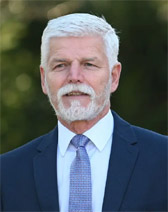
Petr Pavel
Military statesman whose career extended from special forces and the NATO Military Committee to the presidency of the Czech Republic
Born on November 1, 1961
Age: 65
Profession: President, Military Officer, Politician
Place of Birth: Planá, Czechoslovakia — now the Czech Republic
Petr Pavel was born on November 1, 1961, in Planá, then part of Czechoslovakia and now located in the Czech Republic. A Czech politician and retired army general, Petr Pavel has served as President of the Czech Republic since March 9, 2023. During a military career lasting from 1983 to 2018, he worked in airborne reconnaissance, special forces, military intelligence, operations and international defence diplomacy. He later became Chief of the General Staff of the Czech Armed Forces and Chairman of the NATO Military Committee, before defeating former prime minister Andrej Babis in the 2023 presidential election.
Early Life and Military Education
Petr Pavel grew up in a family closely associated with the military. His father was an army officer, and the disciplined environment of his childhood influenced his decision to pursue a professional military career. In 1975, at the age of 13, Petr Pavel entered the military grammar school in Opava, where he completed his secondary education in 1979.
He continued his studies at the Military College of Land Forces in Vyškov. After graduating in 1983, Petr Pavel joined the Czechoslovak military as an officer specializing in airborne reconnaissance and operations behind enemy lines. Between 1988 and 1991, he completed postgraduate studies at the Military Academy in Brno, with a focus connected to military intelligence.
Following the democratic transformation of Czechoslovakia, Petr Pavel attended several senior military institutions in the United Kingdom. He completed a senior officers’ course at the Staff College, Camberley in 1995 and studied at the Royal College of Defence Studies in London in 2005. He later earned a master’s degree in international relations from King’s College London.
Petr Pavel speaks English, French and Russian in addition to Czech. His language skills and international education became important during assignments in Belgium, the Netherlands, the United States and multinational military institutions.
Service in the Czechoslovak People’s Army
Petr Pavel began his active military career in 1983 as the commander of a special-purpose airborne reconnaissance platoon. The unit was trained to carry out reconnaissance and intelligence operations deep behind enemy lines. From 1985 to 1988, he commanded a larger special-purpose airborne reconnaissance company.
His first years as an officer took place within the Czechoslovak People’s Army, which formed part of the Soviet-led Warsaw Pact. Military advancement during this period was closely connected to the political institutions of the communist state.
Petr Pavel became a member of the Communist Party of Czechoslovakia in 1985 and remained a member until the collapse of communist rule in 1989. In 1988, he began postgraduate military intelligence training, completing the course after the Velvet Revolution had established a democratic political system.
Communist-Era Background and Later Controversy
The communist-era record of Petr Pavel became one of the most debated issues during his presidential campaign. Critics emphasized that he had voluntarily joined the Communist Party and had been trained for intelligence work at a time when Czechoslovakia remained under authoritarian rule.
Some historians argued that his preparation went beyond conventional diplomatic or military education and was designed for intelligence assignments outside the country. They also questioned whether Petr Pavel had initially described this part of his career with sufficient clarity.
Petr Pavel acknowledged his party membership and described it as a mistake for which he accepted responsibility. He maintained that he had entered the system as a young soldier pursuing a military career and that his later service to democratic Czechoslovakia and the Czech Republic demonstrated the political and professional transformation he underwent after 1989.
Supporters pointed to his subsequent work under democratic governments, his contribution to the Czech Republic’s integration into Western defence institutions and his election to the highest military position within NATO’s committee structure. For many voters, his record after the fall of communism outweighed his early membership in the Communist Party.
Military Intelligence and International Assignments
From 1991 to 1993, Petr Pavel served as a military intelligence officer. Between 1993 and 1994, he worked as deputy military and air attaché at the Czech diplomatic mission in Belgium. He later returned to military intelligence and served as an aide to the director of the intelligence service.
These assignments gave Petr Pavel experience in strategic analysis, defence diplomacy and relations with emerging Western partners. The newly independent Czech Republic was restructuring its armed forces and moving away from Warsaw Pact doctrine toward closer cooperation with the European Union and NATO.
The Rescue Operation in the Former Yugoslavia
One of the defining events in the military career of Petr Pavel occurred during the conflicts accompanying the breakup of Yugoslavia. He served with the joint Czechoslovak battalion deployed as part of the United Nations Protection Force.
In January 1993, French peacekeepers stationed at the Karin base in Croatia became trapped by fighting and artillery fire. Roads and bridges in the area had been damaged, making a conventional evacuation extremely difficult. Petr Pavel led a group of Czech and Slovak soldiers equipped with armoured personnel carriers through the conflict zone to reach the surrounded troops.
The operation succeeded in evacuating more than 50 French soldiers. The unit encountered blocked roads, mortar fire and armed groups during the mission, but Petr Pavel was credited by fellow officers with remaining calm and making carefully considered decisions under pressure.
France awarded Petr Pavel the French Cross for Military Valour for his role in the operation. He later also received the Legion of Honour, the Czech Medal for Heroism and other national and international military decorations.
Special Forces and Senior Command
After returning from the Balkans, Petr Pavel continued to rise through the command structure of the Czech military. From 1997 to 1999, he commanded a special forces brigade. He subsequently worked at the regional NATO command in Brunssum in the Netherlands, where he gained further experience in multinational operations and alliance planning.
In 2002, Petr Pavel became deputy commander of a mechanized division and was promoted to brigadier general. He then served as commander of the Czech specialized forces.
During the opening months of the Iraq War in 2003, he represented the Czech Republic at United States Central Command in Tampa and at the forward headquarters in Qatar. He later became deputy joint force commander and held senior positions in the operations division of the Czech Ministry of Defence.
From 2007 to 2009, Petr Pavel served as deputy military representative of the Czech Republic to the European Union in Brussels. He later represented the country at Supreme Headquarters Allied Powers Europe in Mons, Belgium. These posts placed him at the intersection of national military planning, European defence policy and NATO operations.
Chief of the General Staff
Petr Pavel was appointed deputy chief of the General Staff and chief of staff in July 2011. In July 2012, he became Chief of the General Staff of the Czech Armed Forces, making him the country’s highest-ranking professional soldier and the principal military adviser to the Czech government.
His term coincided with Czech participation in international missions, including operations in Afghanistan. He was responsible for military readiness, personnel, modernization programs and the development of relations with allied forces.
Petr Pavel was promoted to the rank of general in May 2014. His domestic military leadership, multinational operational experience and ability to work in English and French contributed to his nomination for a senior NATO position.
Chairman of the NATO Military Committee
In September 2014, the chiefs of defence of the NATO member states elected Petr Pavel Chairman of the NATO Military Committee. He formally assumed the position on June 26, 2015, succeeding Danish general Knud Bartels.
The Military Committee consists of the chiefs of defence of NATO member countries and provides military advice to the North Atlantic Council and the NATO secretary general. Its chairman serves as the committee’s principal representative and communicates collective military recommendations to the alliance’s political leadership.
As chairman, Petr Pavel worked during a period marked by Russia’s annexation of Crimea, the war in eastern Ukraine, instability in the Middle East, terrorism and growing concern about NATO’s eastern borders. He supported stronger deterrence while also maintaining that military communication with Russia should remain possible to prevent misunderstandings and uncontrolled escalation.
In 2017, Petr Pavel participated in talks with Russian Chief of the General Staff Valery Gerasimov. The meeting was part of an effort to preserve military communication between Russia and NATO despite the deterioration in political relations following the annexation of Crimea.
Petr Pavel served as Chairman of the NATO Military Committee until June 2018. He was the first military officer from a former Warsaw Pact country to hold the position, symbolizing the transformation of Central European defence institutions after the Cold War.
Retirement from Military Service
After completing his NATO assignment, Petr Pavel retired from active military service in 2018. His formal military career had lasted approximately 35 years and had extended from the armed forces of communist Czechoslovakia to the highest professional structures of the Western alliance.
Following retirement, he worked as a lecturer and public speaker on defence, international relations and security policy. He also participated in civil-society initiatives and continued to comment publicly on democratic institutions, national resilience and the strategic position of the Czech Republic.
His calm manner, military record and distance from established party structures contributed to increasing public discussion of a possible presidential candidacy. He cultivated a less formal public image through regional visits and motorcycle journeys, while emphasizing order, responsibility and predictable government.
2023 Presidential Campaign
Petr Pavel entered the 2023 presidential election as an independent candidate nominated through citizen signatures. Although he did not formally belong to a political party, his candidacy was supported by the center-right coalition that then controlled the government.
His campaign emphasized the Czech Republic’s firm position within NATO and the European Union, institutional stability, respect for constitutional rules and continued support for Ukraine. He also presented himself as an alternative to the confrontational and sometimes unpredictable presidential style associated with Miloš Zeman.
Using the slogan Let’s Restore Order and Calm to Czechia, Petr Pavel attempted to combine military leadership with an image of moderation. He supported several socially liberal positions, including same-sex marriage, and expressed support for the eventual adoption of the euro when economic conditions made it appropriate.
In the first round of the election, Petr Pavel received approximately 35.4 percent of the vote, narrowly finishing ahead of former prime minister Andrej Babis. Because neither candidate won an absolute majority, the election proceeded to a runoff.
Election as President
In the runoff held on January 27 and 28, 2023, Petr Pavel defeated Andrej Babis with 58.32 percent of the vote. He received approximately 3.36 million votes, almost one million more than his opponent. Turnout reached 70.25 percent, the highest recorded in a Czech direct presidential election at that time.
After his victory, Petr Pavel stated that he did not view society as divided between winning and defeated voters. He presented truth, dignity and respect as principles that should guide the presidency and promised to communicate with citizens who had not supported him.
Petr Pavel took the presidential oath on March 9, 2023, succeeding Miloš Zeman and becoming the fourth president of the Czech Republic.
Presidential Role and Domestic Priorities
The Czech presidency does not control the daily administration of government, but it carries important constitutional authority. The president appoints the prime minister, government ministers, senior judges and members of the central bank board. The office also represents the country abroad and holds a significant role in public and political debate.
During his presidency, Petr Pavel has emphasized institutional trust, constitutional restraint and cooperation between state authorities. He has also focused on political polarization, communication with regions outside Prague and the need to involve younger generations more closely in public affairs.
His public manner has generally been less confrontational than that of Miloš Zeman. Supporters have described Petr Pavel as calm, disciplined and predictable, while critics have argued that his positions are sometimes too closely aligned with the foreign and security priorities of Western institutions.
European Union, NATO and Defence Policy
Petr Pavel is a consistent supporter of Czech membership in both the European Union and NATO. He views the two institutions as central to the country’s economic stability, international influence and national security.
His military background has led him to place particular emphasis on defence investment, modern equipment, European military capabilities and the fulfilment of NATO spending commitments. He has argued that Russia’s war against Ukraine demonstrates that European states cannot assume that major armed conflict is no longer possible.
Petr Pavel has also supported stronger cooperation between European defence industries and a greater European contribution to collective security. His approach combines continued reliance on the transatlantic alliance with the view that European countries must accept more responsibility for their own military readiness.
Support for Ukraine
Since taking office, Petr Pavel has been one of the most prominent European supporters of Ukraine’s defence against the Russian invasion. He has backed military and humanitarian assistance, argued that Ukraine must be placed in a strong position for any future negotiations and warned that a Russian victory would create wider dangers for European security.
He became closely associated with the Czech-led international ammunition initiative, through which Czech defence companies and officials identified artillery ammunition available on international markets while allied governments supplied the necessary financing.
By February 2026, approximately 4.4 million large-calibre rounds had reportedly been delivered to Ukraine through the initiative. Petr Pavel argued that these supplies were essential to Ukraine’s ability to maintain an effective defence.
His approach contrasted with that of the second government led by Andrej Babis, which returned to office in December 2025 and adopted a more restrictive policy toward nationally financed military aid. Although the government allowed the ammunition program to continue with foreign funding, it declined to contribute Czech state funds to the purchases.
Relations with the Second Babiš Government
The return of Andrej Babis to the premiership created a new period of political tension for Petr Pavel. The two men had competed directly in the 2023 presidential election and differed significantly over defence spending, support for Ukraine and the Czech Republic’s relationship with NATO and the European Union.
Disagreements also emerged over proposed ministerial appointments. Petr Pavel refused to appoint a controversial nominee associated with the eurosceptic Motorists for Themselves party, arguing that the individual was unsuitable for ministerial office. The dispute intensified criticism of the president from members of the governing coalition.
The conflict reached a new level in June 2026 when the government attempted to exclude Petr Pavel from the Czech delegation to the NATO summit in Ankara. The government argued that it was responsible for conducting foreign policy and needed to explain its own defence and spending decisions directly to allied leaders.
Petr Pavel appealed to the Constitutional Court of the Czech Republic, maintaining that excluding the president from the delegation interfered with the constitutional responsibility of the head of state to represent the country abroad. He noted that Czech presidents had led delegations at almost every NATO summit since the country joined the alliance.
On June 24, 2026, the Constitutional Court issued a provisional order requiring the government to ensure that Petr Pavel could attend the summit. He subsequently travelled to Ankara, although he and Prime Minister Andrej Babis operated through largely separate political and protocol arrangements. The episode demonstrated the growing conflict between the presidency and government over foreign-policy representation and constitutional authority.
Political Identity and Public Image
Petr Pavel is generally associated with pro-European, pro-NATO and socially moderate or liberal positions. Although he entered the presidency as an independent, his principal political support came from voters and parties opposed to the populist and Eurosceptic forces represented by Andrej Babis and some of his allies.
His supporters regard him as a disciplined public servant whose experience in international military leadership allows him to understand security risks and communicate credibly with allied governments. His rescue operation in the former Yugoslavia and later NATO service have reinforced an image of calm leadership under pressure.
Critics focus on his membership in the Communist Party, his military intelligence education and his strong identification with Western defence policy. Some opponents also argue that a former general should exercise particular caution when intervening in domestic political disputes.
The contrast between his early career in a Warsaw Pact military and his later chairmanship of NATO’s highest military committee is one of the most distinctive elements of the life of Petr Pavel. For supporters, it represents the successful democratic transformation of the Czech state. For critics, it remains evidence of an unresolved personal connection to the former regime.
Personal Life
Petr Pavel has two sons, Jan Pavel and Petr Pavel, from his first marriage to Hana Pavelová. The marriage later ended in divorce.
He has been married to Eva Pavlová since 2004. She is a former Czech Army officer who attained the rank of lieutenant colonel. She became First Lady of the Czech Republic when Petr Pavel assumed the presidency in 2023 and has accompanied him during official state visits and public events.
Outside his official responsibilities, Petr Pavel is known for his interest in motorcycling, travel, photography and literature. His motorcycle journeys formed part of the informal public image he developed before the presidential election.
Position in Contemporary Czech Politics
The career of Petr Pavel brings together several major stages of modern Czech history: communist Czechoslovakia, the democratic transition after 1989, integration into NATO, military operations in the Balkans and the renewed European security crisis created by Russia’s war against Ukraine.
As Chief of the General Staff, Chairman of the NATO Military Committee and President of the Czech Republic, Petr Pavel has held important national and international responsibilities. His military experience has given his presidency particular authority in questions of defence, foreign policy and European security.
His presidency has also required him to move beyond military affairs. Political polarization, institutional trust, relations between Prague and economically weaker regions, social change and the constitutional limits of presidential authority have all formed part of his public agenda.
By 2026, his disputes with the government of Andrej Babis had made Petr Pavel an important institutional counterweight within Czech politics. Supporters regard him as a defender of the country’s democratic and Euro-Atlantic orientation, while opponents accuse him of exceeding the restrained role expected of a parliamentary republic’s president.
Selected Offices and Positions
- 1983–1985 – Commander of a Special-Purpose Airborne Reconnaissance Platoon
- 1985–1988 – Commander of a Special-Purpose Airborne Reconnaissance Company
- 1991–1993 – Military Intelligence Officer
- 1993–1994 – Deputy Military and Air Attaché in Belgium
- 1997–1999 – Commander of the Special Forces Brigade
- 2002–2003 – Commander of Czech Specialized Forces
- 2003 – Czech Military Representative to United States Central Command
- 2007–2009 – Deputy Czech Military Representative to the European Union
- 2011–2012 – Deputy Chief of the General Staff and Chief of Staff
- 2012–2015 – Chief of the General Staff of the Czech Armed Forces
- 2015–2018 – Chairman of the NATO Military Committee
- 2018 – Retired from Active Military Service
- 2023–Present – President of the Czech Republic
Source: Biyografiler.com
Frequently asked questions about Petr Pavel
Who is Petr Pavel?, Petr Pavel biography, Petr Pavel life story, Petr Pavel age, Petr Pavel facts, Petr Pavel birthplace, Petr Pavel photos, Petr Pavel videos, Petr Pavel career
Related Biographies

Lamine Yamal
Professional footballer

Erling Haaland
Professional footballer

Sam Altman
Entrepreneur, Investor, CEO

Kylian Mbappe
Professional footballer

Giorgia Meloni
Politician, Journalist

Alice Weidel
Politician, Economist


Hongjoong
Singer, Rapper, Songwriter, Composer

Ludacris
Rapper, Actor

Kwon Eunbi
Singer

Sarah Wayne Callies
Actress, Screenwriter, Producer, Director

LaTavia Roberson
Singer, Actress, Entrepreneur
Lamine Yamal
Professional footballer

Elena Andreyevna Rybakina
Professional Tennis Player
Sam Altman
Entrepreneur, Investor, CEO
Alice Weidel
Politician, Economist

Bad Bunny
Rapper, Songwriter

Leonor, Princess of Asturias
Princess