
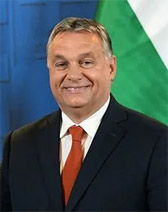
Viktor Orban
Prime Minister of Hungary
Born on May 31, 1963
Age: 63
Profession: Politician, Lawyer
Place of Birth: Székesfehérvár, Hungary
Viktor Orbán was born on May 31, 1963, in Székesfehérvár, Hungary, as the first son of a middle-class family. His father, Győző Orbán, was an agricultural engineer, and his mother, Erzsébet Sípos, worked as a speech therapist. His full name is Viktor Mihály Orbán. He spent his childhood in towns near Fejér County and graduated in 1981 from Blanka Teleki Secondary School in the region. After completing two years of compulsory military service, he studied law at Eötvös Loránd University in Budapest, where he wrote his master’s thesis on the Polish Solidarity Movement. He graduated in 1987.
After graduation, Viktor Orbán lived in Szolnok for two years before taking a job as a sociologist at the Ministry of Agriculture and Food in Budapest. In 1989, he briefly studied politics at Pembroke College, University of Oxford, in the United Kingdom.
At the ages of fourteen and fifteen, Viktor Orbán served as secretary of his school’s communist youth organization (KISZ), membership of which was mandatory for university admission. In later interviews, he stated that his political views changed sharply during his military service, noting that he had previously regarded himself as a “naive and devoted supporter” of the communist regime.
Viktor Orbán was among the founding members of the Fidesz – Hungarian Civic Alliance (Fiatal Demokraták Szövetsége, Alliance of Young Democrats), established on March 30, 1988. He began his political career as the party’s first spokesperson. The founders and early members of Fidesz, including Orbán, were students at the Bibó István College who opposed the communist regime. During this period, Orbán was involved in publishing the social sciences journal Századvég (“End of the Century”).
While studying at Pembroke College in Oxford, Viktor Orbán returned to Hungary ahead of the 1989 Revolutions and joined the political student movement known as the Hungarian Civic Alliance.
Viktor Orbán married Anikó Lévai in 1986. The couple has five children: Gáspár Orbán, Flóra Orbán, Ráhel Orbán, Sára Orbán, and Róza Orbán.
Under Viktor Orbán’s leadership, Fidesz shifted from its original classical liberal and pro-European orientation toward a center-right and national conservative political line.
At a commemorative event in 1989 honoring the victims of the suppressed 1956 Hungarian Revolution led by Imre Nagy, Viktor Orbán delivered a speech openly demanding the withdrawal of Soviet troops from Hungary. This speech brought him national recognition as a political figure.
Following the dissolution of the one-party communist Hungarian People’s Republic, Viktor Orbán entered parliament in 1990 after being elected as a Fidesz candidate from Pest in the first democratic elections. He was appointed parliamentary group leader of Fidesz and held this position until May 1993. In 1993, he was elected as the first chairman of the Fidesz party.
In the 1994 general elections, Fidesz narrowly passed the 5 percent threshold. Viktor Orbán was elected to parliament from Fejér County and served as chairman of the Committee on European Integration Affairs between 1994 and 1998.
In the 1998 general elections, Fidesz won a parliamentary majority, and Viktor Orbán became Prime Minister of Hungary for the first time. He served in this role from 1998 to 2002.
Fidesz and Viktor Orbán narrowly lost the 2002 and 2006 general elections to the Hungarian Socialist Party, leading Orbán to serve as leader of the opposition for eight years. Public support for the socialist government declined significantly following political scandals involving Prime Minister Ferenc Gyurcsány. As a result, Fidesz won the 2010 general elections by a landslide, marking the beginning of Orbán’s second term as Prime Minister.
Fidesz and Viktor Orbán maintained their parliamentary dominance in the 2014 and 2018 elections, during which they introduced major constitutional reforms. Throughout his tenure, Orbán has pursued foreign policies emphasizing close relations with countries such as Russia, Turkey, Israel, and China rather than a strictly pro-European approach.
Viktor Orbán has served as Prime Minister of Hungary continuously since May 29, 2010.
Political Party:
Fidesz – Hungarian Civic Alliance
Source: Biyografiler.com
News about Viktor Orban
Orban era ends after 16 years as Peter Magyar secures historic victory
Hungary has entered a new political era after Viktor Orban lost power following 16 years in office. In the April 12, 2026 election, opposition leader ...
Rubio Backs Orbán’s Fifth-Term Bid During Budapest Visit
U.S. Secretary of State Marco Rubio openly endorsed Prime Minister Viktor Orban’s bid for a fifth consecutive term during a high-profile visit to Bu...
Frequently asked questions about Viktor Orban
Who is Viktor Orban?, Viktor Orban biography, Viktor Orban life story, Viktor Orban age, Viktor Orban facts, Viktor Orban birthplace, Viktor Orban photos, Viktor Orban videos, Viktor Orban career

Lamine Yamal
Professional footballer

Sam Altman
Entrepreneur, Investor, CEO

Erling Haaland
Professional footballer

Kylian Mbappe
Professional footballer

Alice Weidel
Politician, Economist

Giorgia Meloni
Politician, Journalist


Hongjoong
Singer, Rapper, Songwriter, Composer

Ludacris
Rapper, Actor

Kwon Eunbi
Singer

Sarah Wayne Callies
Actress, Screenwriter, Producer, Director

LaTavia Roberson
Singer, Actress, Entrepreneur

Sydney Sweeney
Actress

Kevin Warsh
Economist

Ursula von der Leyen
Politician, Physician
Lamine Yamal
Professional footballer

Mustafa Suleyman
Business Leader, Entrepreneur

Xi Jinping
Politician, Statesman, Head of State