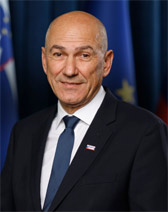
Janez Jansa
Conservative politician whose career extends from Slovenia’s independence struggle to four separate terms as prime minister
Born on September 17, 1958
Age: 68
Profession: Politician, Author
Place of Birth: Ljubljana, Yugoslavia — now Slovenia
Janez Janša was born on September 17, 1958, in Ljubljana, then part of socialist Yugoslavia and now the capital of Slovenia. Born Ivan Janša and publicly known as Janez Janša, he is a Slovenian politician, writer, former defence minister and longtime leader of the Slovenian Democratic Party. He served as prime minister from 2004 to 2008, from 2012 to 2013 and from 2020 to 2022 before returning to office for a fourth term in 2026. His political career has been closely connected with Slovenia’s independence, the creation of its armed forces, European and Atlantic integration, conservative politics and some of the most divisive institutional conflicts in the country’s modern history.
Early Life and Education
Janez Janša grew up in the area around Grosuplje, southeast of Ljubljana. He attended primary school in Žalna and Grosuplje before continuing his secondary education at the classical grammar school in Stična. His childhood and education took place under the political system of the Socialist Federal Republic of Yugoslavia.
He later enrolled at the Faculty of Sociology, Political Science and Journalism of the University of Ljubljana. Janez Janša studied defence science, concentrating on military organization, security policy and the structure of Yugoslavia’s defence system. He graduated in 1982.
His academic background gave him detailed knowledge of military doctrine and civil-defence organization. This expertise later became especially important during Slovenia’s preparations for independence and the armed confrontation with the Yugoslav People’s Army.
Communist Youth Politics and Growing Dissent
As a young man, Janez Janša participated in the political institutions of socialist Yugoslavia and was active within the League of Communists of Yugoslavia. His early political involvement initially followed the conventional path available to ambitious young people within the one-party system.
During the 1980s, however, Janez Janša became increasingly critical of the communist leadership, the political influence of the Yugoslav military and restrictions on freedom of expression. He wrote articles concerning defence policy and the relationship between the civilian authorities and the armed forces.
His criticism brought him into conflict with party institutions and eventually cost him positions within the communist political structure. He became associated with younger Slovenian intellectuals, journalists and activists who were demanding greater political openness, freedom of expression and national autonomy.
Journalism and Opposition Activity
Janez Janša wrote for several Slovenian publications and became particularly associated with the alternative weekly magazine Mladina. The magazine published critical material concerning the Yugoslav military, senior political figures and subjects that state-controlled media generally avoided.
His writings questioned the privileged position of the Yugoslav People’s Army and criticized its role as the military protector of a centralized Yugoslav state. These arguments attracted the attention of military security officials and made Janez Janša one of the most visible young critics of the system.
He also participated in democratic opposition movements and became involved in small private technology enterprises. These activities reflected the wider political and cultural change taking place in Slovenia during the final years of Yugoslav communist rule.
The JBTZ Trial
In May 1988, Janez Janša was arrested after military documents were obtained by individuals connected with Mladina. He was accused of revealing military secrets together with army officer Ivan Borštner, journalist David Tasić and editor Franci Zavrl.
The proceedings became known as the JBTZ Trial, an abbreviation formed from the surnames of the four defendants. The case was heard before a Yugoslav military court, largely behind closed doors, and was conducted in Serbo-Croatian rather than Slovene. The use of a different language in a trial held in Slovenia added to public anger surrounding the proceedings.
Janez Janša was sentenced to imprisonment. The arrests and trial triggered mass demonstrations and encouraged the creation of the Committee for the Defence of Human Rights, which rapidly became one of the largest civil-society movements in Slovenia.
The prosecution was intended to silence criticism of the Yugoslav military, but it produced the opposite effect. The case brought together liberals, nationalists, intellectuals and human-rights activists and became one of the defining events of the democratic movement known as the Slovenian Spring.
Release and Democratic Opposition
After his release from prison, Janez Janša became an influential figure within the emerging democratic opposition. His imprisonment gave him the public reputation of a dissident who had confronted both the Yugoslav military establishment and the limitations of one-party rule.
He participated in the formation of new political organizations as Slovenia prepared for its first multiparty elections. The political movement with which he was associated supported parliamentary democracy, Slovenian sovereignty, human rights and the creation of independent state institutions.
The collapse of communist authority across Central and Eastern Europe accelerated these developments. By 1990, Slovenia was moving rapidly toward democratic elections and a confrontation with the federal authorities over its political future.
Minister of Defence
Following Slovenia’s first democratic multiparty election in 1990, Janez Janša entered parliament and became Minister of Defence in the government led by Lojze Peterle. At the age of 31, he assumed responsibility for constructing a defence system capable of functioning independently from the Yugoslav military.
His ministry helped reorganize Slovenia’s Territorial Defence forces after the Yugoslav authorities attempted to bring their weapons and command structure under federal control. Weapons were concealed, alternative command networks were created and military preparations were coordinated with the Slovenian police.
Janez Janša became one of the principal architects of the new Slovenian defence establishment. His responsibilities included military planning, mobilization, weapons procurement and preparations for a possible attempt by the federal army to prevent independence.
Slovenian Independence and the Ten-Day War
Slovenia declared independence from Yugoslavia on June 25, 1991. The Yugoslav People’s Army responded by attempting to secure border crossings, airports and other strategic sites.
During the resulting Ten-Day War, Janez Janša was one of the central leaders of Slovenia’s military defence. Working with the police, Territorial Defence commanders and the political leadership, he helped coordinate resistance against the Yugoslav units deployed across the country.
Slovenian forces blocked military movements, surrounded federal units and maintained control over important infrastructure. The short conflict ended with an agreement that led to the withdrawal of the Yugoslav army from Slovenia.
The successful defence of independence became the most important achievement associated with Janez Janša. Supporters regard him as one of the principal founders of the Slovenian state and armed forces, while even many political opponents acknowledge his significant role during the independence struggle.
Defence Minister after Independence
Janez Janša remained Minister of Defence after independence and participated in the transformation of the Territorial Defence into the armed forces of the new republic. The process required the creation of national command structures, military training programs, procurement systems and civilian oversight.
His position made him one of the most powerful members of the new political establishment. It also generated conflicts over the role of military intelligence, weapons transactions and the relationship between the armed forces, police and civilian political institutions.
In 1994, he was removed from the Ministry of Defence following a political crisis connected with the Depala Vas Affair, in which military personnel detained and mistreated a civilian connected with police intelligence. The episode intensified the rivalry between Janez Janša and sections of the political establishment led by Prime Minister Janez Drnovšek.
Leadership of the Slovenian Democratic Party
In May 1993, Janez Janša was elected leader of the party then known as the Social Democratic Party of Slovenia. The organization later adopted the name Slovenian Democratic Party, commonly abbreviated as SDS.
Under his leadership, the party gradually moved from a social-democratic opposition background toward the conservative and liberal-conservative right. It combined support for markets, private enterprise and Atlantic integration with national identity, anti-communism and socially conservative positions.
Janez Janša has remained party leader continuously since 1993, giving him one of the longest tenures of any major European party leader. His personal authority has shaped the party’s ideology, organization, candidate selection and communication strategy.
Political Polarization
The political position of Janez Janša has long been connected to competing interpretations of Slovenia’s transition from communism. His supporters argue that former communist networks retained excessive influence in the judiciary, media, business and public administration after independence.
His opponents maintain that he uses anti-communism to divide society and portray criticism of his leadership as the work of a hidden political establishment. These disputes have transformed political disagreements into conflicts over legitimacy, national identity and the interpretation of recent history.
The result has been a highly personalized political environment. For many Slovenian voters, support for or opposition to Janez Janša has become one of the defining divisions within national politics.
First Term as Prime Minister
Following the 2004 parliamentary election, Janez Janša formed a coalition with New Slovenia–Christian People’s Party, the Slovenian People’s Party and the Democratic Party of Pensioners of Slovenia. His first government took office on December 3, 2004.
The government benefited initially from strong economic growth, rising investment and Slovenia’s expanding role within European institutions. It promoted tax reform, privatization, business development and the modernization of public administration.
During this period, Slovenia adopted the euro in January 2007 and entered the Schengen Area later that year. In the first half of 2008, it became the first of the European Union states admitted in 2004 to hold the rotating presidency of the Council of the European Union. Janez Janša also chaired the European Council during the presidency.
His first administration sought to present Slovenia as a successful post-communist state that had completed its integration into the main European and Atlantic institutions. Critics, however, accused the government of increasing political pressure on the media and using appointments within state-owned companies to expand party influence.
Return to Opposition
In the 2008 election, the Slovenian Democratic Party finished behind the center-left Social Democrats led by Borut Pahor. Janez Janša left the premiership and returned to parliament as leader of the opposition.
The global financial crisis placed Slovenia under growing economic pressure. Bank losses, corporate debt and declining economic activity weakened the government and created a new opportunity for Janez Janša to return to power.
Second Term as Prime Minister
The 2011 early election produced a fragmented parliament. Although Positive Slovenia led by Zoran Janković finished first, it was unable to form a government. Janez Janša assembled a coalition involving the Slovenian Democratic Party, Gregor Virant’s Civic List, the Democratic Party of Pensioners of Slovenia, the Slovenian People’s Party and New Slovenia.
His second government took office on February 10, 2012. It inherited a banking crisis, high public debt and concern that Slovenia might require international financial assistance.
The administration introduced austerity measures, spending reductions, pension changes and reforms intended to stabilize public finances and restructure the banking sector. These policies generated major demonstrations and opposition from public-sector employees, trade unions and student groups.
The coalition collapsed after political disputes and allegations concerning the financial declarations of senior leaders. Several coalition partners withdrew their support, and the National Assembly approved a constructive vote of no confidence in February 2013. Alenka Bratušek replaced Janez Janša as prime minister the following month.
The Patria Case
One of the most important legal controversies in the career of Janez Janša concerned a defence contract involving the Finnish company Patria. Prosecutors alleged that bribes had been promised in connection with Slovenia’s purchase of armoured vehicles during his first premiership.
Janez Janša denied receiving or arranging any illegal payment and described the proceedings as an attempt to remove him from politics. He was convicted and received a two-year prison sentence, which he began serving in June 2014 while continuing to lead his party.
In April 2015, the Constitutional Court of Slovenia annulled the conviction, citing procedural and evidentiary problems, and ordered a retrial. The renewed proceedings were later terminated after the statutory limitation period expired.
Supporters of Janez Janša regard the case as evidence that judicial institutions were used against a conservative opposition leader. Critics note that the termination of the proceedings did not constitute a full factual examination of every allegation.
Continued Parliamentary Leadership
Despite his imprisonment and legal disputes, Janez Janša retained control of the Slovenian Democratic Party and continued to win election to the National Assembly. The Constitutional Court also overturned a parliamentary decision that had temporarily removed his mandate as a deputy.
His ability to preserve party unity during periods of political and legal pressure reinforced his reputation among supporters as a resilient opposition leader. It also strengthened the highly centralized relationship between the party and its longtime chairman.
Return to Government in 2020
The resignation of Prime Minister Marjan Šarec in January 2020 created another opportunity for Janez Janša to form a government without an immediate election. He assembled a coalition involving the Slovenian Democratic Party, New Slovenia, the Modern Centre Party and the Democratic Party of Pensioners of Slovenia.
His third government took office on March 13, 2020, as the COVID-19 pandemic was rapidly spreading across Europe. The administration introduced restrictions, border controls, economic-support packages and public-health measures intended to limit infections and protect employment.
The government provided assistance to businesses, workers and vulnerable groups, but its pandemic policies also generated opposition over movement restrictions, policing and the use of emergency powers. Weekly demonstrations became a regular feature of political life in Ljubljana and other cities.
Media Freedom and Democratic Institutions
During his third premiership, Janez Janša faced criticism from journalists, media-freedom organizations and members of the European Parliament. Critics accused the government of placing financial and political pressure on the Slovenian Press Agency, attacking journalists through social media and attempting to reshape public broadcasting.
European press-freedom organizations described the environment as increasingly hostile toward critical media. Parliamentary institutions within the European Union held discussions concerning press freedom, the rule of law and the government’s relationship with independent oversight bodies.
Janez Janša rejected the claim that his government was undermining democracy. He argued that much of the Slovenian media was politically aligned with the left and that criticism of journalists and public broadcasters was part of legitimate democratic debate rather than censorship.
Relations with Viktor Orbán and Donald Trump
Janez Janša developed close political relationships with conservative and nationalist leaders in Europe and the United States. He was particularly associated with Hungarian leader Viktor Orban and publicly expressed admiration for the political approach of Donald Trump.
These relationships strengthened his profile within the European right but also contributed to criticism that he wanted to move Slovenia toward a more centralized and confrontational model of government.
Supporters argued that cooperation with conservative leaders did not imply rejection of democratic institutions and that Janez Janša remained firmly committed to the European Union and NATO. His opponents described his communication methods, cultural policies and attacks on critics as evidence of an increasingly illiberal approach.
European Union Presidency in 2021
Slovenia held the rotating presidency of the Council of the European Union during the second half of 2021. Janez Janša used the presidency to emphasize European enlargement, resilience after the pandemic, cybersecurity and the integration of the Western Balkans.
The presidency also placed Slovenia’s domestic disputes under greater European scrutiny. Questions concerning media freedom, the rule of law and delays in appointing prosecutors to the European Public Prosecutor’s Office complicated relations between his government and several European institutions.
Support for Ukraine
Janez Janša became one of the strongest regional supporters of Ukraine after Russia launched its full-scale invasion in February 2022. He called for severe sanctions against Russia, military and humanitarian aid for Ukraine and an accelerated European Union membership process.
On March 15, 2022, he travelled by train to Kyiv with Czech Prime Minister Petr Fiala, Polish Prime Minister Mateusz Morawiecki and Polish Deputy Prime Minister Jarosław Kaczyński. The visit took place while the Ukrainian capital remained under military threat and was intended to demonstrate political solidarity with President Volodymyr Zelenskyy.
Janez Janša argued that Ukraine required modern weapons, financial support, humanitarian aid and a credible European future. His strong position distinguished him from some other nationalist politicians in Europe who adopted more accommodating policies toward Russia.
Defeat in the 2022 Election
In the April 2022 parliamentary election, the Slovenian Democratic Party was defeated by the newly created Freedom Movement led by energy executive Robert Golob.
The election produced a strong mobilization among voters opposed to the government’s political style and pandemic administration. Robert Golob formed a center-left coalition, and Janez Janša left office in June 2022.
Despite the defeat, he remained leader of the Slovenian Democratic Party and the principal figure of the parliamentary opposition. He continued criticizing the government over taxes, public spending, healthcare reform, migration and foreign policy.
Additional Legal Controversy and Acquittal
In a separate case involving property transactions dating from his first premiership, prosecutors accused Janez Janša of corruption and abuse of office. He denied wrongdoing and argued that the proceedings were another politically motivated effort to weaken him before the 2026 election.
In April 2025, a court acquitted Janez Janša of the charges. The decision strengthened his claim that repeated criminal proceedings had been used as political weapons, although his opponents continued to reject his broader accusations against the judicial system.
The 2026 Parliamentary Election
Slovenia held a parliamentary election on March 22, 2026. The Freedom Movement led by Robert Golob narrowly remained the largest party with 29 seats, while the Slovenian Democratic Party won 28.
Neither party possessed a majority in the 90-seat National Assembly. Although Robert Golob finished first, he was unable to secure enough partners to continue his center-left government.
Janez Janša negotiated with smaller right-leaning and anti-establishment parties. His ability to combine parties with different political backgrounds allowed him to establish a potential majority despite finishing one seat behind the election winner.
Formation of the Fourth Janša Government
On May 22, 2026, the National Assembly approved Janez Janša as prime minister-designate by 51 votes in the 90-member chamber. The vote ended approximately two months of political deadlock following the election.
The governing arrangement was built around the Slovenian Democratic Party, New Slovenia–Christian Democrats and Anže Logar’s Democrats. It also received support from Focus, the Slovenian People’s Party, the right-wing Resnica party and representatives of Slovenia’s national minorities.
The 15-member cabinet was approved on June 4, 2026, by 49 votes to 30. This formally established the fourth government led by Janez Janša.
Economic Program of the 2026 Government
The new government announced tax relief for households and businesses, greater support for start-ups and rapidly growing companies and policies intended to increase economic competitiveness.
Janez Janša argued that high taxation, expanding bureaucracy and unpredictable regulation had weakened Slovenia’s ability to attract investment. His government promised to simplify administrative procedures, reduce reporting obligations and accelerate major development projects.
The coalition also proposed the establishment of a special fund to support the long-term financing of the pension system. Demographic change and the aging population were identified as strategic challenges requiring cooperation among government, businesses and social institutions.
Other priorities included targeted public spending, stronger anti-corruption measures and the transfer of selected responsibilities from the central government to municipalities.
Foreign and Security Policy after Returning to Office
Janez Janša described the new government’s foreign policy as Atlantic-oriented and closely connected to Slovenia’s responsibilities within the European Union and NATO. He criticized elements of the previous administration’s foreign policy that he regarded as ideological activism inconsistent with national interests.
His return was expected to produce a more favorable policy toward Israel and a reassessment of measures adopted after Slovenia recognized a Palestinian state in 2024. The issue remained politically sensitive because several of his coalition partners and supporters held strongly pro-Israel positions.
At the July 2026 NATO summit, Janez Janša reaffirmed Slovenia’s support for collective defence and confirmed that assistance to Ukraine would continue, with particular emphasis on air-defence capabilities protecting civilians from Russian attacks.
Political Ideology
Janez Janša is generally described as a conservative, nationalist, Atlanticist and economically center-right politician. His party supports private enterprise, lower taxation, national security, traditional cultural values and a strong Slovenian state within European and transatlantic alliances.
He supports membership in the European Union but frequently criticizes European political institutions that he considers ideologically selective or insufficiently respectful of national sovereignty.
Janez Janša has also supported stricter migration controls and has argued that European governments must protect their borders, cultural identity and internal security. These positions have brought him closer to several nationalist and conservative movements across Europe.
Leadership Style and Public Image
Janez Janša is known for an assertive, disciplined and confrontational political style. He maintains a loyal electoral base and a highly organized party structure capable of remaining competitive through repeated changes of government.
Supporters regard him as a founder of the independent Slovenian state, an experienced international leader and a politician willing to challenge institutions they believe remain influenced by communist-era networks.
Critics describe Janez Janša as polarizing and accuse him of attempting to weaken independent media, civil society and institutional oversight. They also object to his aggressive use of social media and his tendency to portray journalists, judges and political opponents as members of a hostile establishment.
The contrast between these interpretations has made him the central figure in Slovenian politics for more than three decades. His political influence extends beyond his periods in government because national coalitions and election campaigns are frequently organized either in support of or opposition to his return to power.
Writing and Publications
Janez Janša is the author of political, historical and autobiographical works dealing with Slovenia’s independence, defence policy and the transition from communist government to parliamentary democracy.
His best-known books include The Making of the Slovenian State, originally published in Slovenian as Premiki, and Barricades, published as Okopi. These works present his interpretation of the independence period, political conflict and the construction of Slovenian state institutions.
His books form an important part of his political identity because they combine personal testimony with arguments concerning national history and the legitimacy of Slovenia’s democratic transformation. The official government biography describes him as the author of numerous bestselling works.
Personal Life
Janez Janša married physician Urška Bačovnik Janša in 2009. She has appeared with him at official events and has maintained her own professional identity as a medical doctor.
Janez Janša has four children. He and Urška Bačovnik Janša have two sons, while he also has two children from an earlier relationship. The couple have spoken publicly about family life, childhood experiences and the values they seek to pass to their children.
Outside politics, Janez Janša has been associated with mountaineering, skiing, football, golf and other outdoor activities. His interest in mountains and sport has frequently appeared in his public communication and personal image.
Position in Contemporary Slovenian Politics
The political career of Janez Janša extends from communist Yugoslavia and the democratic opposition of the 1980s to the creation of an independent Slovenian state and four separate periods as prime minister.
His role in the defence of Slovenia during the Ten-Day War established his position in national history. His leadership of the Slovenian Democratic Party since 1993 made him the most durable party leader in the country’s post-independence era.
His four governments have overseen European integration, economic reform, financial crisis, pandemic management and a period of renewed military insecurity caused by Russia’s invasion of Ukraine.
At the same time, legal proceedings, corruption allegations, disputes with the media and accusations of democratic backsliding have made Janez Janša one of the most controversial political leaders in the European Union.
For supporters, he remains a symbol of independence, statehood and resistance to former communist power structures. For opponents, he represents an increasingly nationalist and confrontational style of government. His return to the premiership in 2026 confirmed that, more than three decades after independence, Janez Janša remains one of the most influential figures in Slovenian public life.
Selected Offices and Positions
- 1990–1994 – Minister of Defence of Slovenia
- 1993–Present – President of the Slovenian Democratic Party
- 2000 – Minister of Defence of Slovenia
- 2004–2008 – Prime Minister of Slovenia, First Government
- 2008 – President-in-Office of the European Council
- 2012–2013 – Prime Minister of Slovenia, Second Government
- 2020–2022 – Prime Minister of Slovenia, Third Government
- 2021 – President of the Council of the European Union during Slovenia’s rotating presidency
- May 22, 2026–Present – Prime Minister of Slovenia, Fourth Government
- June 4, 2026–Present – Head of the 16th Government of the Republic of Slovenia
Source: Biyografiler.com
Frequently asked questions about Janez Jansa
Who is Janez Jansa?, Janez Jansa biography, Janez Jansa life story, Janez Jansa age, Janez Jansa facts, Janez Jansa birthplace, Janez Jansa photos, Janez Jansa videos, Janez Jansa career
Related Biographies

Lamine Yamal
Professional footballer

Sam Altman
Entrepreneur, Investor, CEO

Kylian Mbappe
Professional footballer

Alice Weidel
Politician, Economist

Erling Haaland
Professional footballer

Giorgia Meloni
Politician, Journalist


Hongjoong
Singer, Rapper, Songwriter, Composer

Ludacris
Rapper, Actor

Kwon Eunbi
Singer

Sarah Wayne Callies
Actress, Screenwriter, Producer, Director

LaTavia Roberson
Singer, Actress, Entrepreneur
Lamine Yamal
Professional footballer

Austin Abrams
Actor

Xi Jinping
Politician, Statesman, Head of State

Claudia Sheinbaum
President, Politician, Scientist, Academic

Colman Domingo
Actor, Director, Producer

Kaia Gerber
Model, Actress