
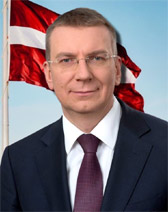
Edgars Rinkevics
Experienced diplomat who became President of Latvia after serving for nearly twelve years as the country’s longest-serving foreign minister
Born on September 21, 1973
Age: 53
Profession: Politician, Diplomat, President
Place of Birth: Jūrmala, Latvia
Edgars Rinkēvičs was born on September 21, 1973, in Jūrmala, Latvia. A Latvian politician, diplomat and national-security specialist, Edgars Rinkēvičs has served as President of Latvia since July 8, 2023. Before entering the presidency, he spent nearly twelve years as Minister of Foreign Affairs, becoming the longest-serving foreign minister in the history of the Latvian state. His earlier career included senior positions in the Ministry of Defence of Latvia, participation in the country’s accession process to NATO and service as Head of the Chancery of the President. His presidency has emphasized national defence, support for Ukraine, European and transatlantic cooperation, democratic resilience, education and demographic renewal.
Early Life in Jūrmala
Edgars Rinkēvičs was born and raised in Jūrmala, a coastal city located west of Riga on the Gulf of Riga. His childhood and early education took place during the period when Latvia was incorporated into the Soviet Union.
He completed his secondary education at Jūrmala Secondary School No. 4, now known as Pumpuri Secondary School, graduating in 1991. That year was also one of the most important in modern Latvian history, as the country restored its independence following the collapse of Soviet authority.
The political transformation of the Baltic region strongly influenced the professional environment in which Edgars Rinkēvičs entered adulthood. Latvia needed to rebuild democratic institutions, establish its own defence policy and secure international recognition while preparing for integration with Western political and security organizations.
Studies at the University of Latvia
Edgars Rinkēvičs studied at the Faculty of History and Philosophy of the University of Latvia. He received a bachelor’s degree in history in 1995.
His historical studies covered political development, international relations and the transformation of states and institutions. Latvia’s twentieth-century experience of independence, occupation, war and restored sovereignty provided an important background to his later work in diplomacy and national security.
Edgars Rinkēvičs continued his education at the same university and completed a master’s degree in political science in 1998. His postgraduate work gave him a stronger foundation in public administration, political institutions and foreign and security policy.
Studies in the Netherlands
Between 1994 and 1995, Edgars Rinkēvičs studied political science and international relations at the University of Groningen in the Netherlands.
The program introduced him to Western European approaches to diplomacy, democratic government and international institutions at a time when Latvia was seeking closer relations with the European Union and NATO.
His education abroad also helped develop the international perspective that became central to his later career. Rather than treating national sovereignty and European cooperation as competing ideas, Edgars Rinkēvičs came to view participation in Western institutions as essential to protecting Latvia’s restored independence.
National Security Studies in Washington
From 1999 to 2000, Edgars Rinkēvičs studied in Washington, D.C., at the United States National Defense University. He completed the Industrial College of the Armed Forces program in national-security resource strategy.
His studies examined defence planning, economic resources, military strategy, crisis management and the relationship between national institutions and collective security alliances.
The program strengthened his understanding of the American defence system and transatlantic security policy. This experience later proved valuable during Latvia’s negotiations to join NATO and in his work with allied governments.
Early Career in Journalism
While completing his university education, Edgars Rinkēvičs worked as a journalist for Latvian Radio between 1993 and 1994. His reporting concentrated on foreign policy and international relations.
The position gave him early experience in explaining diplomatic and political developments to the public. It also introduced him to the relationship between government policy, media communication and public opinion.
Although his career soon moved toward public administration, the communication skills developed through journalism remained visible in his later work as foreign minister and president. Edgars Rinkēvičs became known for delivering direct assessments of international events without relying heavily on ceremonial diplomatic language.
Entry into the Ministry of Defence
In 1995, Edgars Rinkēvičs joined the Ministry of Defence of Latvia as a senior policy officer. Latvia had regained independence only a few years earlier and was still constructing the institutions required for an independent defence policy.
His early responsibilities included security analysis, international defence relations and the preparation of policy documents. The ministry was working to transform military structures inherited from the Soviet period and develop democratic civilian control over the armed forces.
In March 1996, Edgars Rinkēvičs became Director of the Defence Policy Department. Later that year, he was appointed Deputy State Secretary for Defence Policy.
These appointments placed him among the officials responsible for defining Latvia’s strategic direction. The country’s principal objective was to secure full integration with Western political and military institutions while developing armed forces appropriate to its size and geographic position.
State Secretary of the Ministry of Defence
Edgars Rinkēvičs served briefly as Acting State Secretary in 1997 before becoming State Secretary of the Ministry of Defence of Latvia in August of that year. He remained in the position until October 2008.
The state secretary is the senior civil servant responsible for the administrative continuity and professional management of a Latvian ministry. In this capacity, Edgars Rinkēvičs worked with different defence ministers and governments while maintaining long-term strategic programs.
His responsibilities included defence planning, international military cooperation, procurement, budgeting and the institutional development of the Latvian National Armed Forces.
He also participated in reforms intended to make the armed forces compatible with NATO structures. These included improvements in military training, command systems, communications, logistics and civilian oversight.
Latvia’s NATO Accession
One of the defining achievements of the early career of Edgars Rinkēvičs was his participation in Latvia’s accession to NATO. He served as deputy head of the Latvian delegation involved in membership negotiations between 2002 and 2005.
Latvia regarded NATO membership as the most reliable guarantee against renewed foreign domination. The country’s experience of Soviet occupation created broad political support for integration with the transatlantic alliance.
The accession process required Latvia to reform its armed forces, protect classified information, strengthen democratic institutions and demonstrate its willingness to contribute to collective defence.
Latvia formally joined NATO in March 2004 together with Estonia, Lithuania and several Central and Eastern European states. Edgars Rinkēvičs regarded accession not as the end of Latvia’s security transformation but as the beginning of new responsibilities within the alliance.
European Union Membership
Latvia also joined the European Union in May 2004. Although Edgars Rinkēvičs worked primarily in defence policy during this period, European Union membership became inseparable from the country’s broader security and economic strategy.
Membership connected Latvia more closely with the democratic and legal institutions of Western Europe. It also provided access to investment, trade, infrastructure funding and political cooperation.
The simultaneous entry into NATO and the European Union established the foreign-policy direction that Edgars Rinkēvičs later defended throughout his years as foreign minister and president: a sovereign Latvia anchored firmly within European and transatlantic institutions.
The 2006 NATO Summit in Riga
Between 2005 and 2007, Edgars Rinkēvičs headed the office responsible for organizing the NATO Riga Summit. The summit, held in November 2006, was the first NATO leaders’ meeting organized in a former Soviet republic.
The event carried considerable symbolic importance for Latvia. Only fifteen years after restoring independence, the country hosted the heads of state and government of the world’s principal transatlantic military alliance.
Organizing the summit required coordination among the government, armed forces, police, intelligence services, municipal authorities and international delegations. Security, transportation, communications and diplomatic protocol all had to meet alliance standards.
The success of the meeting strengthened the professional reputation of Edgars Rinkēvičs. It demonstrated his ability to manage complicated international projects and communicate with senior officials from multiple countries.
Head of the Presidential Chancery
In October 2008, Edgars Rinkēvičs left the Ministry of Defence and became Head of the Chancery of the President of Latvia under President Valdis Zatlers. He held the position until July 2011.
The role gave him direct experience of the constitutional and administrative operation of the presidency. He coordinated the president’s advisers, official schedule, diplomatic engagements and institutional communication.
Edgars Rinkēvičs also gained a detailed understanding of relations among the presidency, the Saeima, the government and Latvia’s judicial and security institutions.
This period later proved valuable when he became president himself. He entered the office already familiar with its legal powers, internal organization and relationship with other branches of the Latvian state.
Appointment as Minister of Foreign Affairs
Edgars Rinkēvičs became Minister of Foreign Affairs on October 25, 2011. His appointment began one of the longest and most stable ministerial careers in modern Latvian politics.
He remained foreign minister under several prime ministers and coalition governments. This continuity allowed him to develop long-term relationships with European, North American and regional partners.
His foreign-policy approach was based on several consistent principles: membership in NATO and the European Union, close cooperation with the United States, strong Baltic and Nordic relations, resistance to Russian pressure and support for democratic states in Eastern Europe.
Edgars Rinkēvičs also promoted Latvia’s economic diplomacy, international trade and participation in multilateral institutions. His ministry worked with Latvian companies seeking access to foreign markets and with international investors considering opportunities in Latvia.
Latvia’s Longest-Serving Foreign Minister
Edgars Rinkēvičs served as foreign minister from October 2011 until July 2023, making him the longest-serving holder of the office in the history of independent Latvia.
His tenure covered a period of major international upheaval. These events included the eurozone crisis, Russia’s annexation of Crimea, the war in eastern Ukraine, the COVID-19 pandemic, political repression in Belarus and Russia’s full-scale invasion of Ukraine.
The duration of his service gave Latvia a high level of diplomatic continuity. International partners increasingly identified Edgars Rinkēvičs with the country’s foreign-policy direction and Baltic security concerns.
Supporters regarded his experience as an important national asset. Critics occasionally argued that his political longevity made him too closely associated with the established governing system, but his professional standing remained strong across changes in coalition politics.
Relations with the European Union
As foreign minister, Edgars Rinkēvičs supported deeper cooperation within the European Union while defending the interests of smaller member states.
He participated in European discussions concerning sanctions, enlargement, energy security, migration, trade and the Union’s relations with neighboring countries.
Edgars Rinkēvičs argued that European unity was especially important for Latvia because individual Baltic states possessed limited ability to respond alone to economic coercion, security threats or external political pressure.
His approach remained strongly integrationist without abandoning national sovereignty. He viewed European institutions as mechanisms through which Latvia could exercise greater influence and protect its independence.
Latvia’s Presidency of the Council of the European Union
During the first half of 2015, Latvia held the rotating presidency of the Council of the European Union. As foreign minister, Edgars Rinkēvičs played a central role in coordinating meetings, negotiations and the country’s diplomatic priorities.
The presidency focused on European competitiveness, digital development, energy policy, security and relations with the Union’s eastern neighbors.
Latvia also hosted the Eastern Partnership Summit in Riga. The meeting addressed relations with Ukraine, Georgia, Moldova, Armenia, Azerbaijan and Belarus.
The presidency provided Edgars Rinkēvičs with an opportunity to present Latvia as an active European state capable of organizing negotiations and contributing to common policy rather than merely receiving decisions made by larger countries.
Response to the Annexation of Crimea
Russia’s annexation of Crimea in 2014 fundamentally changed the security environment surrounding Latvia. Edgars Rinkēvičs condemned the annexation as a violation of Ukrainian sovereignty and international law.
He supported European Union sanctions against Russia and called for a stronger NATO presence in the Baltic region. Latvia feared that hybrid warfare, disinformation, cyberattacks and military intimidation could also be directed against other former Soviet republics.
Edgars Rinkēvičs repeatedly warned European partners against treating Russia’s actions as a temporary regional dispute. He argued that the Kremlin was challenging the wider principle that borders could not be changed by force.
NATO’s Eastern Flank
Strengthening NATO’s eastern flank became one of the central objectives of Edgars Rinkēvičs as foreign minister. He supported the deployment of allied forces, increased military exercises and improved plans for defending the Baltic states.
Following the 2016 NATO summit in Warsaw, a multinational battlegroup led by Canada was deployed to Latvia as part of the alliance’s enhanced forward presence.
Edgars Rinkēvičs welcomed the deployment as an important demonstration that an attack on Latvia would immediately involve forces from several allied states.
He nevertheless continued to call for stronger air defence, larger military reserves and faster reinforcement capabilities. In his view, political commitments were credible only when supported by trained forces, equipment, infrastructure and ammunition.
Relations with the United States
Edgars Rinkēvičs has consistently regarded the United States as Latvia’s principal transatlantic security partner. His education in Washington and long defence-policy career helped him establish close relationships with American officials.
As foreign minister, he supported the continued presence of American military forces in Europe and stronger United States engagement in the Baltic region.
He also promoted cooperation in energy, technology, cybersecurity and defence procurement. Edgars Rinkēvičs argued that stronger European defence capabilities should reinforce NATO rather than replace the transatlantic alliance.
Baltic and Nordic Cooperation
Cooperation with Estonia and Lithuania has remained one of the foundations of the foreign policy of Edgars Rinkēvičs. The three Baltic states coordinate their positions on defence, energy, sanctions and European policy.
He has also supported closer relations with Finland, Sweden, Denmark, Norway and Iceland. The accession of Finland and Sweden to NATO further strengthened the strategic connection between the Baltic and Nordic regions.
Edgars Rinkēvičs views the Baltic Sea as an increasingly integrated security area. Defence planning, undersea infrastructure, energy networks, maritime surveillance and cyber resilience require cooperation across national borders.
Belarus and Democratic Opposition
Following the disputed Belarusian presidential election of 2020, Edgars Rinkēvičs condemned violence against protesters and supported sanctions against officials associated with repression.
Latvia backed the democratic opposition led by Sviatlana Tsikhanouskaya and called for the release of political prisoners.
The relationship with Belarus became more difficult after the government of Alexander Lukashenko facilitated irregular migration toward the borders of Latvia, Lithuania and Poland. Baltic governments described the campaign as a hybrid operation intended to place political pressure on the European Union.
Edgars Rinkēvičs supported stronger border protection while also emphasizing the need for a coordinated European response.
Support for Ukraine before 2022
Edgars Rinkēvičs supported Ukraine’s European development and territorial integrity throughout his years as foreign minister. Latvia provided political assistance, training, humanitarian aid and support for Ukrainian reforms after 2014.
He argued that Ukraine’s success as a democratic European state was directly connected to Baltic security. A stable and sovereign Ukraine would limit Russian expansion and strengthen the wider European order.
This position prepared Latvia for the much larger political and military response required after Russia launched its full-scale invasion in February 2022.
Russia’s Full-Scale Invasion of Ukraine
After the invasion began, Edgars Rinkēvičs became one of Europe’s strongest advocates of military and political assistance to Ukraine. He supported deliveries of weapons, ammunition, training and financial aid.
He called for increasingly severe sanctions against Russia and measures targeting the country’s energy revenues, financial institutions, military industry and officials responsible for aggression.
Edgars Rinkēvičs rejected proposals that would require Ukraine to surrender territory in exchange for an unstable ceasefire. He argued that rewarding aggression would create conditions for a renewed war and increase the danger faced by other European states.
He also supported Ukraine’s eventual membership in the European Union and NATO. In his view, long-term peace requires security arrangements strong enough to prevent another Russian invasion.
Political Affiliation
During different periods of his career, Edgars Rinkēvičs was associated with Latvian centrist and liberal political organizations. He became a prominent member of Unity and later New Unity, the principal pro-European center-right force in Latvian politics.
His political identity nevertheless remained strongly connected to diplomacy and national security rather than domestic party ideology. He served in governments based on different coalition arrangements and maintained a reputation for institutional continuity.
After his election as president, Edgars Rinkēvičs suspended his party affiliation in accordance with the expectation that the head of state should operate independently of daily party competition.
Coming Out in 2014
In November 2014, Edgars Rinkēvičs publicly announced that he was gay. At the time, he was serving as foreign minister and was one of the most senior political officials in Latvia.
The announcement attracted considerable attention because Latvian society remained relatively conservative on questions involving sexual orientation and family law.
Edgars Rinkēvičs expressed support for legal protections and equal treatment while continuing to focus his ministerial work primarily on diplomacy and security.
His decision to come out made him an important figure in European discussions concerning political representation. He did not build his entire public identity around the announcement, but its significance grew when he later entered the presidency.
Election as President
In 2023, Edgars Rinkēvičs became a candidate for President of Latvia. The Latvian president is elected by the 100 members of the Saeima rather than through a direct national vote.
The candidates included Edgars Rinkēvičs, business executive Uldis Pīlēns and civil-society representative Elīna Pinto. A candidate required at least 51 votes to be elected.
The election took place on May 31, 2023. After no candidate obtained the required majority in the opening ballots, Edgars Rinkēvičs won the third round with 52 votes.
His support came from members of the governing center-right and liberal parties together with opposition deputies from the Union of Greens and Farmers. The result demonstrated his ability to secure parliamentary backing beyond his original political alliance.
Inauguration as President
Edgars Rinkēvičs took the presidential oath before the Saeima on July 8, 2023, succeeding Egils Levits.
In his inaugural address, he promised to defend Latvia’s independence, democracy and security while working for a more inclusive and prosperous society.
He also emphasized the need for political cooperation and argued that citizens expected institutions to solve practical problems rather than remain trapped in permanent conflict.
His inauguration made Edgars Rinkēvičs the first openly gay head of state in a member country of the European Union. The event gave his presidency an international symbolic importance alongside his established reputation as a diplomat and security specialist.
Constitutional Role of the Latvian President
Latvia is a parliamentary republic in which executive authority is exercised mainly by the government. The president nevertheless possesses important constitutional powers and represents the state internationally.
The head of state nominates a candidate for prime minister, promulgates legislation and may return laws to the Saeima for reconsideration. Under specified circumstances, the president may also propose the dissolution of parliament, although such a decision must be approved through a referendum.
The president is commander-in-chief of the Latvian National Armed Forces and chairs the National Security Council. These responsibilities have given the defence and diplomatic experience of Edgars Rinkēvičs particular relevance.
He has approached the presidency as an active institution capable of proposing legislation, encouraging cooperation and drawing attention to long-term national priorities.
National Security as the Central Priority
National security has remained the dominant issue of the presidency of Edgars Rinkēvičs. He argues that Latvia must use the time created by Ukrainian resistance and NATO deterrence to prepare its own society and armed forces.
His security agenda includes military readiness, allied deployments, ammunition reserves, air defence, drones, cyber protection and stronger internal-security institutions.
Edgars Rinkēvičs has repeatedly stated that defence cannot be treated as a temporary response to one stage of the war in Ukraine. Russia is expected to remain a long-term strategic threat even after active fighting declines or a ceasefire is reached.
He therefore supports predictable multi-year defence planning rather than spending increases that depend on short-term political circumstances.
Proposal for Five Percent Defence Spending
In February 2026, Edgars Rinkēvičs proposed a legislative commitment requiring Latvia to allocate at least five percent of gross domestic product to national defence from 2027 onward.
He argued that the previous minimum target no longer reflected the seriousness of the security environment. NATO capability requirements, allied infrastructure and the expansion of the Latvian defence industry would require sustained investment.
The proposal also sought to make defence spending more predictable. Long-term contracts for weapons, ammunition, military construction and technological development cannot be managed effectively if funding changes dramatically from one annual budget to another.
Critics have warned that such a high level of military expenditure could place pressure on healthcare, education and social services. Edgars Rinkēvičs responds that national security is the condition that allows every other public service to function.
Support for Ukraine as President
As president, Edgars Rinkēvičs has continued the strongly pro-Ukrainian policy he pursued as foreign minister. Latvia has provided military equipment, training, humanitarian assistance and support for reconstruction.
He argues that Ukraine currently forms the first line of European defence against Russian expansion. The stronger Ukraine remains, the safer Latvia and the rest of Europe will be.
Edgars Rinkēvičs supports continued political and economic pressure on Russia, action against its shadow fleet and restrictions on the resources used to finance the war.
He has also urged European societies not to normalize aggression or lose interest as the conflict continues. In his view, political fatigue would benefit Russia and weaken the rules protecting smaller states.
Civil Defence and Social Resilience
The security policy of Edgars Rinkēvičs extends beyond conventional military forces. He has called for stronger civil-defence planning, functioning shelters, emergency supplies and clear public instructions.
Latvian residents are encouraged to prepare supplies sufficient for at least seventy-two hours. The president has argued that official guidance must explain not only what people should store but also where they should go and how they should respond during different emergencies.
He supports stronger cooperation among municipalities, emergency services, hospitals, communications providers and energy companies. War, cyberattacks, severe weather and infrastructure failures can all disrupt essential services.
Edgars Rinkēvičs presents resilience as a shared national responsibility. State institutions must prepare effective systems, while citizens and businesses must understand their own roles during a crisis.
Internal Security and Border Protection
Edgars Rinkēvičs has emphasized the need to strengthen Latvia’s police, border guards, intelligence institutions and emergency services.
The border with Russia and Belarus creates challenges involving espionage, organized crime, illegal migration and hybrid operations. Critical infrastructure, including ports, railways, energy facilities and communications networks, also requires stronger protection.
The president supports investment in personnel, equipment and cooperation among internal-security institutions. He argues that military defence and domestic security must be planned as connected elements of the same national strategy.
European Defence and Transatlantic Cooperation
Edgars Rinkēvičs supports a stronger European contribution to collective defence while remaining committed to the United States and NATO.
He has urged European governments to increase weapons production, coordinate procurement and invest in military mobility and infrastructure.
His position is that Europe must become a more capable strategic partner rather than assume that the United States will always carry a disproportionate share of the burden.
At the same time, Edgars Rinkēvičs rejects the idea that European defence should compete with NATO. He views stronger European capabilities as essential to maintaining a credible and balanced transatlantic alliance.
Demographic Challenges
Population decline is one of the most serious long-term domestic issues identified by Edgars Rinkēvičs. Latvia has experienced low birth rates, emigration and the aging of its population.
These changes affect the labour market, pension system, schools, healthcare and the ability of smaller regions to maintain public services.
The president supports policies that make it easier for families to raise children, improve housing conditions and combine employment with parental responsibilities.
He has also emphasized the importance of encouraging Latvian citizens living abroad to return. Economic opportunity, efficient institutions and confidence in the country’s future are necessary if Latvia is to compete for skilled workers.
Education and Human Capital
Edgars Rinkēvičs regards education as both an economic and national-security priority. Latvia’s declining school-age population requires changes in the organization and financing of education.
He argues that every child should have access to high-quality teaching regardless of region or family income. Smaller schools, teacher shortages and unequal educational results create difficult choices for municipalities and the national government.
The president supports stronger science, technology, engineering and mathematics education together with vocational training connected to the needs of businesses and public institutions.
He has also emphasized that education must develop civic understanding, media literacy and the ability to recognize disinformation. These skills are increasingly important in a country exposed to hostile information campaigns.
Economic Competitiveness
Although foreign and security policy remain his strongest areas of expertise, Edgars Rinkēvičs has also emphasized economic competitiveness and innovation.
He supports cooperation among universities, businesses and government institutions and has called for administrative procedures that make investment and entrepreneurship easier.
Latvia’s small domestic market makes international trade, digital services, advanced manufacturing and transport connections especially important. The country must also improve productivity if wages and public services are to rise sustainably.
Edgars Rinkēvičs connects economic development with security. A wealthier and more innovative society can invest more effectively in defence, infrastructure and social resilience.
Democracy and the Rule of Law
Edgars Rinkēvičs describes Latvia as a democratic, law-based and European state whose institutions must remain accountable to citizens.
He has called for better-quality legislation and has used the presidential power to return laws to parliament when he believes their consequences or wording require further consideration.
The president also emphasizes the importance of combating corruption, foreign influence and attempts to manipulate democratic debate.
His approach is generally institutional rather than populist. Edgars Rinkēvičs argues that governments must respond to public dissatisfaction without weakening constitutional safeguards or independent institutions.
Equality and Social Inclusion
The presidency of Edgars Rinkēvičs carries symbolic importance for representation and equality because of his position as the European Union’s first openly gay head of state.
He has expressed support for a Latvia in which citizens are respected regardless of personal identity and where discrimination does not prevent people from participating fully in public life.
Latvia introduced a legal partnership framework in 2024 that provided limited recognition and protections for both same-sex and opposite-sex couples. The reform did not create marriage equality or full adoption and inheritance rights, but it represented a significant legal change.
Edgars Rinkēvičs has generally addressed equality through a broader language of constitutional rights and social inclusion rather than making personal identity the central subject of his presidency.
Political Style and Public Image
Edgars Rinkēvičs is known for a direct, pragmatic and disciplined communication style. His long diplomatic career gave him experience in presenting difficult security assessments without creating unnecessary alarm.
Supporters regard him as one of Latvia’s most experienced public officials and value his knowledge of NATO, the European Union and regional security.
His frequent use of social media has also helped him communicate with citizens in a more informal manner than many traditional diplomats. He combines official statements with observations on public life and current events.
Critics sometimes argue that his career is closely connected to the established political system and that the presidency requires greater attention to economic and social issues beyond foreign affairs.
His broad public standing nevertheless reflects a reputation for competence, predictability and seriousness at a time of heightened security concerns.
Personal Life
Edgars Rinkēvičs has generally kept his private life outside political debate. He publicly disclosed his sexual orientation in 2014 but has shared few details concerning personal relationships.
He is unmarried and has no children. His public identity has remained focused primarily on diplomacy, state administration and national security.
Edgars Rinkēvičs speaks Latvian as his native language and is also proficient in English, Russian and French. These language skills supported his work in international negotiations and multilateral diplomacy.
Position in Contemporary Latvian Politics
The career of Edgars Rinkēvičs extends across journalism, defence administration, presidential management, diplomacy and national leadership.
He joined the Ministry of Defence while Latvia was still developing the institutions of restored independence and later helped guide the country toward NATO membership.
His nearly twelve years as foreign minister provided unusual continuity during a period in which relations with Russia deteriorated and the security of the Baltic states became a central European concern.
As president, Edgars Rinkēvičs has used this experience to advocate military readiness, civil resilience, support for Ukraine and stronger European defence capabilities.
His election also carried wider social significance by making him the first openly gay head of state in the European Union. He has approached that distinction within a broader commitment to equal citizenship and democratic institutions.
From Latvia’s accession to NATO to the challenges created by Russia’s war against Ukraine, the professional life of Edgars Rinkēvičs has followed the country’s transformation into a firmly European and transatlantic state. His presidency represents the combination of diplomatic experience, national-security expertise and a pragmatic vision of Latvia’s place in Europe.
Selected Offices and Positions
- 1993–1994 – Foreign Policy and International Relations Journalist at Latvian Radio
- 1995–1996 – Senior Policy Officer at the Ministry of Defence of Latvia
- 1996 – Director of the Defence Policy Department
- 1996–1997 – Deputy State Secretary for Defence Policy
- 1997 – Acting State Secretary of the Ministry of Defence of Latvia
- 1997–2008 – State Secretary of the Ministry of Defence of Latvia
- 2002–2005 – Deputy Head of Latvia’s Delegation for Accession Negotiations with NATO
- 2005–2007 – Head of the Office for the Organization of the NATO Riga Summit
- 2008–2011 – Head of the Chancery of the President of Latvia
- 2011–2023 – Minister of Foreign Affairs of Latvia
- May 31, 2023 – Elected President by the Saeima
- July 8, 2023–Present – President of Latvia
- July 8, 2023–Present – Commander-in-Chief of the Latvian National Armed Forces
Source: Biyografiler.com
Frequently asked questions about Edgars Rinkevics
Who is Edgars Rinkevics?, Edgars Rinkevics biography, Edgars Rinkevics life story, Edgars Rinkevics age, Edgars Rinkevics facts, Edgars Rinkevics birthplace, Edgars Rinkevics photos, Edgars Rinkevics videos, Edgars Rinkevics career

Lamine Yamal
Professional footballer

Sam Altman
Entrepreneur, Investor, CEO

Kylian Mbappe
Professional footballer

Erling Haaland
Professional footballer

Alice Weidel
Politician, Economist

Giorgia Meloni
Politician, Journalist


Hongjoong
Singer, Rapper, Songwriter, Composer

Ludacris
Rapper, Actor

Kwon Eunbi
Singer

Sarah Wayne Callies
Actress, Screenwriter, Producer, Director

LaTavia Roberson
Singer, Actress, Entrepreneur

Austin Abrams
Actor
Lamine Yamal
Professional footballer

Rob Jetten
Politician

Sydney Sweeney
Actress

David Fincher
Film Director

Ursula von der Leyen
Politician, Physician