
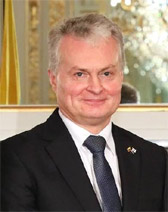
Gitanas Nauseda
Economist and former central banker who champions Lithuania’s security, European integration and long-term support for Ukraine
Born on May 19, 1964
Age: 62
Profession: Politician, Economist, Head of State
Place of Birth: Klaipėda, Lithuania
Gitanas Nausėda was born on May 19, 1964, in Klaipėda, Lithuania. A Lithuanian economist, academic, former banker and independent politician, Gitanas Nausėda has served as President of Lithuania since July 12, 2019. He won a second five-year term in 2024 with one of the largest presidential election victories in the country’s post-Soviet history. Before entering politics, he developed an extensive career in monetary policy, central banking, economic research and private-sector finance. His presidency has focused on national defence, support for Ukraine, cooperation within NATO and the European Union, regional security and the creation of a more socially balanced Lithuanian economy.
Early Life in Klaipėda
Gitanas Nausėda grew up in Klaipėda, Lithuania’s principal seaport on the Baltic Sea. He was born into a family in which his father worked as an engineer and his mother as a teacher. The professional and educational environment of the household encouraged academic discipline and an early interest in public affairs.
Klaipėda’s position as a port city gave it a distinctive economic and cultural character. Maritime trade, industry and the city’s complicated German, Lithuanian and Soviet history influenced the wider environment in which Gitanas Nausėda spent his childhood.
His formative years took place while Lithuania was incorporated into the Soviet Union. Public institutions, education and economic life operated within a centrally planned system, while independent Lithuanian statehood survived primarily through historical memory, cultural traditions and the activities of dissidents.
Gitanas Nausėda completed his secondary education in Klaipėda before moving to Vilnius for university. His later economic career was shaped by the contrast between the Soviet economic system he studied as a young man and the market economy Lithuania constructed after restoring independence.
Education at Vilnius University
In 1982, Gitanas Nausėda entered the Faculty of Industrial Economics at Vilnius University. His studies included political economy, industrial organization, statistics, economic planning and the operation of financial institutions within the Soviet system.
He graduated as an economist in 1987 and continued postgraduate studies at the university’s Faculty of Economics between 1987 and 1989. During this period, the Soviet economy was facing stagnation, shortages and growing pressure for political and economic reform.
The transformation associated with Mikhail Gorbachev’s policies of restructuring and greater openness created new opportunities for economists to discuss inflation, market mechanisms, enterprise reform and the weaknesses of centralized planning. These developments shaped the research interests of Gitanas Nausėda.
He also began teaching at Vilnius University, establishing an academic connection that continued through different stages of his professional career.
Studies at the University of Mannheim
Between 1990 and 1992, Gitanas Nausėda studied at the University of Mannheim in Germany through a scholarship provided by the German Academic Exchange Service. His period in Germany coincided with the restoration of Lithuanian independence and the country’s difficult transition toward a market economy.
The University of Mannheim was known for economics, finance and business administration. Studying there allowed Gitanas Nausėda to examine Western monetary institutions, market-based pricing and the operation of the German social-market economy.
His German education gave him direct exposure to the economic structures Lithuania was attempting to build. It also strengthened his command of German and established professional connections with European economists and institutions.
In 1993, Gitanas Nausėda received a doctorate in social sciences. His doctoral work examined income policy under conditions of inflation and stagflation, subjects of immediate importance to post-Soviet economies experiencing rapidly rising prices and declining production.
Early Academic Career
Gitanas Nausėda taught at the Faculty of Economics of Vilnius University from 1987 until 2004. His academic work covered monetary policy, macroeconomics, inflation, banking and the economic transition from central planning to competitive markets.
Lithuania’s transformation during the early 1990s provided economists with an unusually direct opportunity to observe the creation of new institutions. The country needed a national currency, independent central banking, commercial banks, competition law and fiscal policies suited to a democratic state.
Gitanas Nausėda combined theoretical research with professional work inside the institutions managing that transition. This combination of teaching, government analysis and banking later became a defining feature of his public reputation.
In 2009, he became an associate professor at the Vilnius University International Business School. He continued teaching and participating in academic life while working as one of Lithuania’s most visible private-sector economists.
Internship at the German Bundestag
In 1994, Gitanas Nausėda completed a political-science internship at the German Bundestag in Bonn. The experience introduced him to parliamentary decision-making, democratic political institutions and the relationship between elected government and economic policy.
Germany was an important model for Lithuania during its return to Europe. Its combination of a market economy, federal democracy, social protection and European integration influenced debates among Lithuanian economists and policymakers.
The internship broadened the professional experience of Gitanas Nausėda beyond economics and helped familiarize him with the political processes through which economic reforms are negotiated and implemented.
Work at the Lithuanian Competition Council
From 1993 to 1994, Gitanas Nausėda headed the Financial Markets Department at the Lithuanian Competition Council. The institution was responsible for supporting market competition and limiting monopolistic practices during the transition from state ownership to a market-based system.
The position required analysis of newly developing financial markets, commercial regulation and the changing relationship between the state and private businesses. Lithuania was privatizing enterprises and creating legal frameworks for competition while attempting to prevent excessive concentration of economic power.
This work gave Gitanas Nausėda early experience in public administration and economic regulation. It also prepared him for the more important monetary-policy responsibilities he soon assumed at the central bank.
Career at the Bank of Lithuania
In 1994, Gitanas Nausėda joined the Bank of Lithuania. He initially served as deputy head of the Methodology and Analysis Division within the Commercial Banks Supervision Department.
Lithuania’s banking sector was still developing, and the central bank was responsible for establishing regulatory standards, supervising commercial institutions and maintaining confidence in the national currency. Several post-Soviet banking systems experienced failures and instability during this period.
From 1996 to 2000, Gitanas Nausėda served as Director of the Monetary Policy Department. Between 1998 and 2000, he was also a member of the board of the Bank of Lithuania.
His work involved inflation analysis, interest-rate policy, exchange-rate stability and preparations for Lithuania’s increasing integration with European financial institutions. He became one of the economists helping to establish the credibility of the Lithuanian litas and the wider monetary framework of the independent state.
Monetary Policy and Economic Transition
The period in which Gitanas Nausėda worked at the central bank was one of rapid economic change. Lithuania had to control inflation, stabilize public confidence and encourage investment while restructuring industries that had previously depended on Soviet markets.
The country adopted a currency-board arrangement that linked the Lithuanian litas first to the United States dollar and later to the euro. This system limited monetary flexibility but strengthened credibility and helped control inflation.
Gitanas Nausėda supported monetary stability and predictable economic policy. His central-banking experience strengthened his belief that sustainable wage growth and social spending required disciplined public finances and confidence in national institutions.
His later political platform combined this concern for stability with the argument that the benefits of economic growth had to be distributed more evenly among regions, workers, families and pensioners.
Move to Private Banking
In 2000, Gitanas Nausėda left the Bank of Lithuania and joined Vilniaus Bankas, one of the country’s largest commercial financial institutions. The bank later became part of the Swedish SEB Group and was renamed SEB Bankas.
From 2000 to 2008, he served as adviser to the chairman of Vilniaus Bankas. His work involved economic forecasting, financial-market analysis and advice concerning the wider Lithuanian and European economy.
In 2008, Gitanas Nausėda became adviser to the chairman and chief economist of SEB Bankas. He remained in these positions until 2018.
The role made him one of the most visible economic commentators in Lithuania. He regularly discussed growth, taxation, wages, housing markets, government budgets and the effects of European economic developments on Lithuanian households and businesses.
The Global Financial Crisis
The international financial crisis of 2008 and the subsequent Baltic recession increased the public profile of Gitanas Nausėda. Lithuania experienced a sharp economic contraction, falling employment, declining property values and pressure on public finances.
As chief economist of a major bank, he explained the crisis to the public and commented on government responses, fiscal consolidation and the prospects for recovery. His television and newspaper appearances made him familiar to citizens who had little direct interest in technical economic analysis.
Gitanas Nausėda generally supported fiscal responsibility but also emphasized the social consequences of economic policy. This balance later shaped his presidential message of combining economic competitiveness with social solidarity.
Adviser to President Valdas Adamkus
In 2004, Gitanas Nausėda served as an economic adviser to Lithuanian President Valdas Adamkus. Although the role was relatively brief, it gave him direct experience within the presidential institution.
That year was particularly important for Lithuania because the country joined both the European Union and NATO. Economic policy, foreign investment and integration with Western institutions were closely connected.
Working with Valdas Adamkus allowed Gitanas Nausėda to observe the responsibilities of a Lithuanian president in foreign policy, national security and relations with the government. Fifteen years later, he would enter the same office as an elected independent candidate.
Public Reputation as an Economist
Before entering politics, Gitanas Nausėda was known primarily as an economist rather than a party figure. His frequent media appearances allowed him to develop a reputation for explaining complicated financial developments in accessible language.
He commented on wages, inflation, pensions, taxation and household purchasing power while also discussing Lithuania’s adoption of the euro and its integration with European financial markets.
Unlike politicians whose careers developed through party youth organizations or parliamentary office, Gitanas Nausėda entered electoral politics with a professional identity based on expertise, moderation and distance from traditional political institutions.
Independent Presidential Candidacy
In 2018, Gitanas Nausėda announced that he would stand as an independent candidate in the 2019 presidential election. He resigned from his banking position to concentrate on the campaign.
He presented himself as a politically moderate figure capable of cooperating with different parties. His campaign combined pro-European and pro-NATO foreign policy with domestic promises concerning social inequality, regional development and stronger public services.
Gitanas Nausėda used the idea of a Welfare State as the central concept of his campaign. He argued that Lithuania’s successful economic transformation had not benefited every region and social group equally.
His program emphasized higher pensions, improved education and healthcare, greater support for families and policies intended to reduce income differences. At the same time, he defended fiscal stability and private-sector economic growth.
The 2019 Presidential Election
The first round of the 2019 presidential election produced a close contest between Gitanas Nausėda, former finance minister Ingrida Šimonytė and Prime Minister Saulius Skvernelis. Ingrida Šimonytė narrowly led the first round, while Gitanas Nausėda advanced to the runoff in second place.
The second round was held on May 26, 2019. Gitanas Nausėda won approximately two-thirds of the vote, defeating Ingrida Šimonytė by a wide margin.
His victory demonstrated his ability to attract voters from different political backgrounds. Moderate conservatives, centrists, social-democratic voters and citizens dissatisfied with established parties all contributed to his result.
Gitanas Nausėda formally took office on July 12, 2019, succeeding Dalia Grybauskaitė, who had completed the constitutional limit of two presidential terms.
Constitutional Role of the Lithuanian President
Lithuania has a semi-presidential political system in which executive responsibilities are divided between the president and the government. The president plays a particularly important role in foreign affairs, defence, national security and senior state appointments.
The head of state represents Lithuania internationally and serves as commander-in-chief of the armed forces. The president participates in the formation of governments, appoints the prime minister with parliamentary approval and has powers involving legislation, diplomacy and the judiciary.
Domestic economic policy is managed primarily by the government and parliament. Nevertheless, Gitanas Nausėda has used speeches, legislative proposals and consultations to influence taxation, welfare, pensions and regional development.
The Welfare State Vision
The principal domestic theme of the first presidential term of Gitanas Nausėda was the creation of a more inclusive welfare state. He argued that economic growth had to produce visible improvements for lower-income workers, pensioners, families and residents outside the major cities.
His proposals included faster pension growth, greater tax fairness, stronger social protection and improved access to education and healthcare. He also emphasized the importance of reducing regional inequality between Vilnius and less prosperous municipalities.
Gitanas Nausėda did not advocate the abandonment of Lithuania’s market-oriented economic model. Instead, he argued that business, government and civil society had to cooperate in ensuring that prosperity strengthened social cohesion.
His critics maintained that the presidency lacked sufficient authority to deliver many of these promises. Supporters argued that the welfare-state concept influenced political debate and encouraged governments to give greater priority to pensions, family policy and household income.
The COVID-19 Pandemic
The COVID-19 pandemic became the first major crisis of the presidency of Gitanas Nausėda. Lithuania introduced restrictions, vaccination programs and economic-support measures while dealing with pressure on hospitals and public institutions.
The president called for cooperation among the government, municipalities, healthcare professionals and scientific institutions. He also emphasized the need to protect employment and assist citizens whose incomes had been affected by restrictions.
Political disagreements emerged over the timing and scale of public-health measures. Gitanas Nausėda attempted to balance support for medical recommendations with concerns about constitutional rights and social trust.
The 2020 Belarus Crisis
Following the disputed presidential election in Belarus in August 2020, Gitanas Nausėda condemned violence against protesters and rejected the legitimacy of the announced result that kept Alexander Lukashenko in power.
Lithuania became one of the strongest supporters of the Belarusian democratic opposition. Opposition leader Sviatlana Tsikhanouskaya and numerous activists, journalists and civil-society representatives found refuge in Lithuania.
Gitanas Nausėda called for the release of political prisoners, new democratic elections and stronger European pressure on the Belarusian government. He also supported sanctions against officials involved in repression.
The Belarus crisis reinforced Lithuania’s role as an advocate for democratic movements in Eastern Europe. It also increased tensions with Minsk and Moscow and contributed to new security challenges along Lithuania’s southeastern border.
Migration Pressure from Belarus
In 2021, Lithuania faced a sharp increase in irregular migration across its border with Belarus. Lithuanian and European authorities accused the government of Alexander Lukashenko of organizing or facilitating the movement of migrants as retaliation for sanctions and support for the Belarusian opposition.
Gitanas Nausėda described the situation as a hybrid attack intended to destabilize the European Union’s external border. He supported stronger border protection, European assistance and measures against Belarusian officials.
The crisis created difficult debates over security, asylum rights and humanitarian treatment. The government expanded border infrastructure and introduced emergency procedures while human-rights organizations warned against collective removals and inadequate protection for vulnerable migrants.
Russia’s Full-Scale Invasion of Ukraine
Russia’s invasion of Ukraine in February 2022 transformed the security priorities of the presidency of Gitanas Nausėda. Lithuania became one of Ukraine’s most committed supporters in proportion to the size of its economy and population.
Gitanas Nausėda supported extensive military, financial and humanitarian assistance. He repeatedly visited Ukraine, met President Volodymyr Zelenskyy and called on European governments to provide advanced weapons and ammunition.
He argued that Ukraine was defending not only its own territory but also the security and democratic order of Europe. In his view, any settlement that rewarded Russian territorial conquest would encourage future aggression.
Gitanas Nausėda has consistently supported Ukraine’s eventual membership in the European Union and NATO. He has also called for stronger sanctions against Russia and the use of immobilized Russian assets to support Ukrainian defence and reconstruction.
The NATO Summit in Vilnius
Lithuania hosted the NATO Summit in Vilnius in July 2023. The meeting brought together allied leaders during a critical period in the war in Ukraine.
Gitanas Nausėda used the summit to call for stronger defence plans for the Baltic region, additional air-defence capabilities and a clearer path toward Ukrainian membership in the alliance.
The summit also demonstrated Lithuania’s strategic position on NATO’s eastern frontier. The country borders both Belarus and the Russian region of Kaliningrad and is located close to the Suwałki corridor connecting the Baltic states with Poland.
Although Ukraine did not receive an immediate membership invitation, the summit strengthened political support, created the NATO–Ukraine Council and confirmed long-term assistance. Gitanas Nausėda continued to argue that membership would ultimately provide the most reliable security guarantee.
German Brigade in Lithuania
Gitanas Nausėda has supported the permanent deployment of a German combat brigade in Lithuania. The project is intended to strengthen deterrence and provide a rapid allied response in the event of aggression.
Germany’s decision to station a brigade in Lithuania represented a major development in NATO’s defence posture. Lithuania committed itself to building military bases, training areas, housing and logistical infrastructure for several thousand German personnel and their families.
Gitanas Nausėda has described the deployment as evidence of Germany’s commitment to Baltic security and the principle that allied territory must be defended from the first moment of an attack.
Relations with the European Union
Gitanas Nausėda is a strong supporter of Lithuania’s membership in the European Union. He regards the Union as an essential source of economic opportunity, political influence and collective security.
His European policy emphasizes a strong single market, investment in defence, energy independence and continued enlargement toward Ukraine, Moldova and other democratic candidate countries.
He has also called for greater European competitiveness in technology, manufacturing and energy. Lithuania’s security, in his view, depends on an economically strong Europe capable of producing weapons, maintaining critical infrastructure and reducing dependence on authoritarian states.
Energy Independence
Energy security has remained a major concern during the presidency of Gitanas Nausėda. Lithuania spent years reducing its dependence on Russian oil, gas and electricity systems.
The Klaipėda LNG Terminal, electricity connections with European partners and the synchronization of the Baltic electricity network with continental Europe strengthened the country’s strategic independence.
In 2025, Lithuania, Latvia and Estonia disconnected from the Russian-controlled electricity system and synchronized with continental European networks. Gitanas Nausėda described the process as an important completion of the Baltic states’ integration with Europe.
He has argued that energy infrastructure is inseparable from national defence. Electricity networks, gas terminals, undersea cables and digital systems must be protected against sabotage, cyberattacks and political pressure.
Relations with the United States
Gitanas Nausėda considers the United States Lithuania’s principal transatlantic security partner. He supports a permanent American military presence in Europe and close cooperation in defence, intelligence and energy.
Lithuania has sought stronger bilateral ties with successive American administrations and has emphasized its willingness to contribute substantially to collective defence.
Gitanas Nausėda argues that the transatlantic relationship must remain based on shared interests, mutual responsibility and credible defence investment. He also supports stronger European military capabilities as a complement to, rather than a replacement for, NATO.
Relations with Poland and the Baltic States
Regional cooperation with Poland, Latvia and Estonia is central to the foreign policy of Gitanas Nausėda. These countries share concerns about Russia, Belarus, energy security and the defence of NATO’s eastern frontier.
Lithuania and Poland have strengthened military planning, infrastructure links and political coordination. The security of the Suwałki corridor is particularly important because it provides the only land connection between the Baltic states and the rest of NATO territory.
Gitanas Nausėda has also worked closely with the presidents of Latvia and Estonia on Ukraine, sanctions, defence spending and Baltic infrastructure. The three states regularly coordinate their positions before European and NATO meetings.
Relations with China and Taiwan
During the first term of Gitanas Nausėda, Lithuania’s relations with China deteriorated following the decision to allow Taiwan to open a representative office in Vilnius using the name “Taiwanese.”
China reduced diplomatic relations and introduced commercial pressure affecting Lithuanian companies and European businesses using Lithuanian components.
Gitanas Nausėda supported closer relations with democratic partners in the Indo-Pacific but questioned aspects of the communication and consultation surrounding the naming decision. He maintained that Lithuania should defend its sovereign foreign-policy choices while working with European partners to resist economic coercion.
The 2024 Presidential Election
Gitanas Nausėda stood for a second and constitutionally final term in the 2024 presidential election. The campaign was dominated by the war in Ukraine, the threat from Russia and Belarus and the financing of national defence.
He finished first in the opening round with approximately 44 percent of the vote but did not reach the threshold required for immediate reelection. Prime Minister Ingrida Šimonytė advanced to the second round.
The runoff was held on May 26, 2024. Gitanas Nausėda won approximately 74.5 percent of the vote, while Ingrida Šimonytė received about 24 percent.
The result was the most decisive Lithuanian presidential election victory since the restoration of independence. It demonstrated broad approval of his foreign and security policies and his moderate position within domestic politics.
Beginning of the Second Presidential Term
Gitanas Nausėda began his second term on July 12, 2024. The inauguration renewed his constitutional mandate for another five years and confirmed that he cannot seek a third consecutive term.
He identified national security, economic resilience, social cohesion and demographic development as leading priorities. Lithuania faced the simultaneous challenge of financing a historic military expansion while maintaining healthcare, education, pensions and household purchasing power.
The president also continued to emphasize that democratic institutions and public trust were essential parts of national resilience. A society divided by inequality, regional decline or political hostility would be more vulnerable to external interference.
Defence Spending above Five Percent
During the second term of Gitanas Nausėda, Lithuania accelerated its military investment. By 2026, the country was spending more than five percent of gross domestic product on defence.
The additional resources were directed toward ammunition, air defence, drones, military infrastructure, armoured vehicles, long-range capabilities and the accommodation of allied troops.
Gitanas Nausėda has argued that security requires rapid preparation rather than gradual promises. Lithuania’s geographical position means that it must possess the ability to resist aggression immediately while allied reinforcements arrive.
He also supports the wider NATO objective of increasing defence and security investment. In 2026, he continued calling for long-term assistance to Ukraine and greater European production of weapons and ammunition.
Defence Industry and Technological Security
Gitanas Nausėda supports the development of Lithuania’s domestic defence industry. His administration has encouraged international manufacturers to invest in ammunition, drones, communications and military technology.
He argues that defence production can strengthen both national security and economic growth. Investment in engineering, cybersecurity, artificial intelligence and advanced manufacturing may create skilled employment while reducing dependence on distant suppliers.
The president has emphasized the need for faster government decisions, simplified procurement and close cooperation among the military, universities and private businesses.
Social Inequality during the Second Term
Despite the growing importance of defence, Gitanas Nausėda has continued to emphasize social inequality. Lithuania has achieved rapid economic growth since joining the European Union, but differences in income, healthcare access and regional opportunity remain significant.
He supports higher pensions, improved public services and policies enabling families to combine employment with raising children. Demographic decline and emigration remain long-term challenges for the country.
In his 2026 State of the Nation address, Gitanas Nausėda connected economic concentration and inequality with pressure on democratic institutions. He argued that economic modernization should strengthen social trust rather than create permanent groups of winners and losers.
Political Identity
Gitanas Nausėda has remained formally independent of political parties. He is generally described as a centrist or moderate conservative who combines market-oriented economics with support for a stronger welfare state.
On foreign and defence policy, he holds strongly Atlanticist, pro-European and anti-Kremlin positions. His approach reflects the broad Lithuanian consensus that national security depends on close cooperation with NATO, the United States and European allies.
On some social questions, Gitanas Nausėda has adopted more conservative positions than liberal parties. These positions have generated disagreements concerning family law, minority rights and the recognition of same-sex partnerships.
His broad electoral support is partly explained by his ability to appeal to voters across ideological divisions. Supporters view him as stable and presidential, while critics argue that his political positioning can be cautious or deliberately ambiguous.
Leadership Style and Public Image
Gitanas Nausėda is known for a formal, measured and economically informed communication style. His background in banking and academia is visible in speeches that frequently refer to statistics, institutional capacity and long-term planning.
Supporters value his diplomatic manner, professional experience and strong defence policy. His second election victory demonstrated that he retained substantial popularity even after five years in office.
Critics have accused him of intervening too actively in government formation and domestic legislation while avoiding clear responsibility for policies managed by the cabinet. Others argue that the president’s constitutional responsibilities make such involvement unavoidable.
His public image has changed as security questions have become more urgent. The economist initially elected on a welfare-state platform has increasingly become known as one of Europe’s strongest advocates of defence spending and military support for Ukraine.
Personal Life
Gitanas Nausėda married Diana Nausėdienė, born Diana Nepaitė, in 1990. The couple have two daughters, Gedailė Nausėdaitė and Ugnė Nausėdaitė.
Diana Nausėdienė has worked in education and social initiatives and became First Lady of Lithuania when her husband assumed the presidency in 2019.
Gitanas Nausėda speaks Lithuanian, English, German and Russian. His knowledge of German reflects his years at the University of Mannheim, while Russian was widely taught and used during the Soviet period.
Since 1997, Gitanas Nausėda has collected antique and rare books. His collection reflects an interest in Lithuanian culture, history and printed heritage.
Position in Contemporary Lithuanian Politics
The career of Gitanas Nausėda brings together academic economics, central banking, private finance and national political leadership. Unlike many presidents, he entered electoral politics without first serving as a member of parliament, cabinet minister or party leader.
His first election was based largely on economic competence, political moderation and a promise to build a welfare state. Russia’s invasion of Ukraine transformed his presidency and made military security, NATO deterrence and international diplomacy the dominant issues of his administration.
His landslide reelection in 2024 gave Gitanas Nausėda a strong mandate during one of the most dangerous periods for Baltic security since Lithuania restored independence.
Supporters regard him as a dependable European statesman who combines economic knowledge with a clear understanding of the Russian threat. Critics continue to debate the effectiveness of his welfare-state agenda, his interventions in domestic politics and his positions on social issues.
From monetary policy and banking to the presidency of a frontline NATO state, Gitanas Nausėda has become one of the most influential political figures in the Baltic region. His long-term reputation will depend on whether Lithuania can strengthen its military security while preserving democratic trust, social solidarity and economic prosperity.
Selected Offices and Positions
- 1987–2004 – Lecturer at the Faculty of Economics of Vilnius University
- 1993–1994 – Head of the Financial Markets Department at the Lithuanian Competition Council
- 1994–1996 – Deputy Head of the Methodology and Analysis Division at the Bank of Lithuania
- 1996–2000 – Director of the Monetary Policy Department at the Bank of Lithuania
- 1998–2000 – Member of the Board of the Bank of Lithuania
- 2000–2008 – Adviser to the Chairman of Vilniaus Bankas
- 2004 – Economic Adviser to President Valdas Adamkus
- 2008–2018 – Chief Economist and Adviser to the Chairman of SEB Bankas
- 2009–2018 – Associate Professor at the Vilnius University International Business School
- July 12, 2019–July 12, 2024 – President of Lithuania, First Term
- July 12, 2024–Present – President of Lithuania, Second Term
Source: Biyografiler.com
Frequently asked questions about Gitanas Nauseda
Who is Gitanas Nauseda?, Gitanas Nauseda biography, Gitanas Nauseda life story, Gitanas Nauseda age, Gitanas Nauseda facts, Gitanas Nauseda birthplace, Gitanas Nauseda photos, Gitanas Nauseda videos, Gitanas Nauseda career

Lamine Yamal
Professional footballer

Sam Altman
Entrepreneur, Investor, CEO

Kylian Mbappe
Professional footballer

Erling Haaland
Professional footballer

Alice Weidel
Politician, Economist

Giorgia Meloni
Politician, Journalist


Hongjoong
Singer, Rapper, Songwriter, Composer

Ludacris
Rapper, Actor

Kwon Eunbi
Singer

Sarah Wayne Callies
Actress, Screenwriter, Producer, Director

LaTavia Roberson
Singer, Actress, Entrepreneur
Lamine Yamal
Professional footballer

Kaia Gerber
Model, Actress
Giorgia Meloni
Politician, Journalist

Austin Abrams
Actor

Eliezer Yudkowsky
Researcher, Writer
Kylian Mbappe
Professional footballer