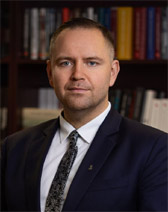
Karol Nawrocki
Historian who rose to the presidency through nationalist memory politics, traditional values and a [[[Poland First]]] political platform
Born on March 3, 1983
Age: 43
Profession: Historian, Academic, President
Place of Birth: Gdańsk, Poland
Karol Nawrocki was born on March 3, 1983, in Gdańsk, Poland. His full name is Karol Tadeusz Nawrocki. A Polish historian, researcher, museum administrator and politician, Karol Nawrocki has served as President of the Republic of Poland since August 6, 2025. Before entering the presidency, he directed the Museum of the Second World War in Gdańsk and served as President of the Institute of National Remembrance. His public career has been shaped by a nationalist interpretation of modern Polish history, anti-communism, traditional social values, Atlantic security cooperation and the protection of national sovereignty within the European Union.
Early Life and Interest in History
Karol Nawrocki grew up in Gdańsk, a city whose modern identity is closely connected with the Second World War, the Solidarity movement and Poland’s struggle against communist rule. From an early age, he developed a particular interest in the country’s twentieth-century history and the relationship between historical memory and national identity.
As a teenager, Karol Nawrocki participated in community and educational activities, including historical re-enactments and patriotic events. These early experiences anticipated his later professional emphasis on presenting history not only through academic publications but also through museums, ceremonies, public commemorations and digital media.
Between 1998 and 2002, he attended the Fourth High School in Gdańsk. His youth in the coastal city also contributed to his continuing interest in sport, especially football and boxing, activities that later became a visible part of his presidential campaign image.
University Education
Karol Nawrocki entered the Faculty of History at the University of Gdańsk and completed his degree in 2008. His academic interests concentrated on communist Poland, anti-communist opposition, political repression, organized crime and the ways in which local communities resisted authoritarian government.
He continued his doctoral studies at the same university. In 2013, Karol Nawrocki defended a doctoral dissertation examining social resistance to communist rule in the Elbląg Voivodeship between 1976 and 1989. The research explored political opposition, civic mobilization and the social networks that challenged the communist state during its final decades.
In 2023, he completed postgraduate International MBA studies in strategy, programme and project management at the Gdańsk University of Technology. The qualification added organizational and executive-management training to his academic background as a historian.
Early Work at the Institute of National Remembrance
In 2009, Karol Nawrocki began working professionally at the Institute of National Remembrance, commonly known by its Polish abbreviation IPN. The institution conducts historical research, manages archives, supports public education and investigates crimes committed under Nazi occupation and communist rule.
At the institute’s Gdańsk branch, he participated in research, exhibitions, educational programs and public commemorations. His work focused on the German occupation, communist repression, anti-communist resistance and the experiences of individuals who had been marginalized or condemned by the post-war communist authorities.
From 2013 to 2017, Karol Nawrocki headed the Public Education Office of the Gdańsk branch. The role allowed him to combine academic history with large-scale public communication and the political culture of national remembrance.
Local Civic Activity in Gdańsk
Between 2011 and 2017, Karol Nawrocki served as chairman of the Siedlce District Council in Gdańsk. Although the position was local rather than national, it gave him practical experience in community organization, local administration and communication with residents.
His civic and historical activities frequently overlapped. Karol Nawrocki supported initiatives that restored public recognition to figures associated with anti-Nazi and anti-communist resistance and promoted patriotic education within local communities.
The Funeral of Inka and Zagończyk
In 2016, Karol Nawrocki helped organize the state funeral ceremonies in Gdańsk for Danuta Siedzikówna, known by the resistance name Inka, and Feliks Selmanowicz, known as Zagończyk. Both had participated in anti-communist underground activity and were executed by the communist authorities in 1946.
The ceremonies became an important element of Poland’s wider effort to restore public recognition to the so-called Cursed Soldiers, members of the armed underground who continued resisting Soviet-backed communist rule after the end of the Second World War.
Supporters viewed the funeral as an act of historical justice toward individuals whose remains and reputations had been deliberately concealed. Critics of the broader state memory program argued that the history of the post-war armed underground required greater attention to internal divisions, civilian casualties and the political complexity of the period.
Director of the Museum of the Second World War
In 2017, Karol Nawrocki became director of the Museum of the Second World War in Gdańsk. He remained in the position until 2021 and oversaw administrative and substantive changes to one of Poland’s most important historical museums.
Under his leadership, the museum placed greater emphasis on Polish suffering, resistance, military heroism and the specific national experience of occupation. Karol Nawrocki argued that the original presentation did not give sufficient prominence to the scale of Polish sacrifice or to individuals whose actions symbolized courage under German occupation.
The changes generated a major dispute among historians and museum professionals. Critics argued that the original exhibition had presented the conflict through a broad international and civilian perspective and that the revisions moved it toward a more narrowly nationalist interpretation. Historians including Norman Davies and Timothy Snyder, who had advised or supported the original project, were among those associated with criticism of the changes.
Supporters of Karol Nawrocki responded that a national museum located in the city where the war began had a duty to communicate the exceptional scale of Poland’s losses, occupation and resistance. The dispute became an example of the wider struggle over historical interpretation during the governments led by the conservative Law and Justice Party.
Return to the Institute of National Remembrance
In 2021, Karol Nawrocki returned to the Institute of National Remembrance as its deputy president. The lower house of the Polish Parliament subsequently elected him president of the institution, and the appointment received the approval of the Senate.
He formally assumed the presidency of the institute on July 23, 2021. In this position, Karol Nawrocki supervised historical research, archives, educational programs, international cooperation and investigations into crimes committed against the Polish nation.
His leadership gave the institute a strongly defined emphasis on German and Soviet totalitarianism, communist repression, anti-communist resistance and the defence of Poland’s international historical reputation. Admirers considered this approach necessary to correct decades of propaganda and neglect. Critics argued that the institute increasingly operated as an instrument of conservative memory politics.
Removal of Soviet-Era Monuments
After Russia launched its full-scale invasion of Ukraine in 2022, Karol Nawrocki initiated a campaign to remove Soviet-era monuments regarded by the institute as propaganda objects rather than genuine war graves or neutral memorials.
During his presidency of the Institute of National Remembrance, 42 such objects were removed from Polish public spaces. Karol Nawrocki argued that monuments celebrating the Red Army promoted a false narrative of liberation and ignored the Soviet political domination that followed the defeat of Nazi Germany.
Russian authorities opened proceedings connected with the removal of Soviet monuments and placed Karol Nawrocki on a wanted list. He treated the action as confirmation that the Kremlin continued to use historical symbolism as a political weapon against Poland and other countries in Central and Eastern Europe.
Digital History and International Projects
Karol Nawrocki supported the use of computer games, online platforms, digital applications and interactive exhibitions to introduce younger audiences to modern Polish history. He argued that research institutions could not depend only on conventional books, conferences and museum displays if they wanted to reach new generations.
Under his leadership, the institute expanded projects involving memorial institutions in Europe and the United States. He also promoted the international project Trails of Hope: The Odyssey of Freedom, which presented the global routes and wartime experiences of Polish military personnel and civilians.
Karol Nawrocki also supported renewed attention to unresolved crimes committed during the final decade of communist rule. His public approach treated historical investigation as a continuing responsibility of the democratic state rather than a matter confined to academic debate.
Books and Historical Publications
Karol Nawrocki is the author, co-author or editor of numerous academic and popular publications dealing with communist Poland, opposition movements, organized crime and sports history. His research has frequently concentrated on regional experiences in northern Poland and the institutions of the Polish People’s Republic.
His books include The Kwidzyn Case 1982: Internment, Beatings, Trial, Social Resistance to Communist Power in the Elbląg Voivodeship, 1976–1989 and Poland: A Strong History. He has also edited publication series and participated in the preparation of historical exhibitions.
His work on organized crime during communist rule also led him to publish under the pseudonym Tadeusz Batyr. During the 2025 campaign, earlier promotional activity in which the disguised supposed author praised the historical work of Karol Nawrocki became a subject of ridicule and criticism.
Presidential Candidacy
In November 2024, Karol Nawrocki entered the presidential contest as a formally independent civic candidate supported by the nationalist-conservative Law and Justice Party. He had never previously served in parliament or in a national government.
The party presented him as a candidate from outside the professional political class whose background in history, sport and state institutions would appeal to conservative voters. His campaign visited hundreds of cities and towns and emphasized direct contact with communities outside the largest metropolitan centres.
Karol Nawrocki campaigned under a Poland First message. He promised to defend national sovereignty, traditional family values, border security and the economic interests of Polish citizens while opposing what he regarded as excessive interference by European Union institutions.
Political Platform
The campaign of Karol Nawrocki combined social conservatism, economic nationalism and strong Atlantic security commitments. He opposed liberalization of abortion law, expressed support for the traditional definition of marriage and criticized irregular migration and European asylum-distribution policies.
In economic policy, he promised to resist tax increases affecting ordinary households and small businesses. His political language frequently distinguished between the interests of Polish citizens and policies that he argued gave excessive priority to foreign institutions, migrants or external commercial interests.
Although critical of greater centralization within the European Union, Karol Nawrocki did not advocate Polish withdrawal from the organization. He instead presented membership as cooperation among sovereign nations whose constitutional authority should remain protected.
The First Round of the 2025 Election
The first round of the presidential election was held on May 18, 2025. Warsaw Mayor Rafał Trzaskowski, supported by the governing Civic Coalition, finished first, while Karol Nawrocki placed second and advanced to the runoff.
The result demonstrated the continuing strength of the conservative electorate despite the loss of government by the Law and Justice Party in 2023. It also showed that the presidential contest had become a wider judgment on the coalition government led by Prime Minister Donald Tusk.
Runoff against Rafał Trzaskowski
The second round became a choice between two contrasting political directions. Rafał Trzaskowski presented himself as a liberal, urban and strongly pro-European candidate. Karol Nawrocki emphasized patriotism, conservative social values, sovereignty and closer identification with the political style of the American right.
Karol Nawrocki also received political encouragement from Donald Trump and met the American president at the White House during the campaign. The visit strengthened his position among voters who regarded a close relationship with the United States as essential to Polish security.
The runoff was exceptionally close and reflected Poland’s deep political division between liberal metropolitan regions and more conservative rural and small-town areas.
Election as President
In the runoff held on June 1, 2025, Karol Nawrocki received 10,606,877 votes, representing 50.89 percent of the valid ballots. Rafał Trzaskowski received 49.11 percent.
The victory gave the conservative opposition control of the presidency while Prime Minister Donald Tusk and his pro-European coalition continued to control the government and parliament. Because the president can veto legislation and the governing coalition lacks the qualified majority required to override a veto, the result created the prospect of prolonged political deadlock.
Supporters regarded the result as a rejection of the liberal government’s reform program and a restoration of conservative influence after the 2023 parliamentary defeat of the Law and Justice Party. Opponents viewed it as a major obstacle to judicial, social and institutional reforms.
Inauguration as President
Karol Nawrocki took the presidential oath before the National Assembly on August 6, 2025, succeeding Andrzej Duda. He became the seventh president of the Republic of Poland under the post-communist constitutional order.
At the beginning of his term, Karol Nawrocki presented his presidency as a new opening based on placing Polish citizens, sovereignty and national security at the centre of government. He promised to use the constitutional powers of the presidency actively rather than serve as a ceremonial or politically neutral head of state.
His inauguration immediately established a period of institutional rivalry between the presidential palace and the administration of Donald Tusk. Foreign policy, judicial reform, migration, social policy and relations with European institutions became major areas of disagreement.
Relations with Donald Tusk’s Government
Karol Nawrocki has said that he is prepared to cooperate with Prime Minister Donald Tusk on matters that serve the national interest. At the same time, he has promised to defend presidential authority and oppose legislation that conflicts with his conservative and sovereigntist program.
The conflict is intensified by the structure of Poland’s political system. The government controls most domestic administration, but the president can veto legislation, participate in foreign and security policy and influence appointments to important institutions.
In February 2026, Karol Nawrocki vetoed legislation intended to reform the system used to appoint members of the National Council of the Judiciary. The government argued that the measure would help restore judicial independence, while the president maintained that it would divide judges and question the legitimacy of existing appointments.
The veto deepened the continuing dispute over judicial changes introduced by earlier Law and Justice Party governments. The disagreement has remained central to Poland’s relationship with European institutions and to the domestic struggle over the constitutional rule of law.
European Union and National Sovereignty
Karol Nawrocki supports continued Polish membership in the European Union but opposes the transfer of powers that he believes are not clearly established in European treaties. He presents the Union as a partnership among sovereign states rather than a structure moving toward a centralized federal authority.
In March 2026, he vetoed legislation intended to allow Poland to use approximately €43.7 billion in loans from the European Security Action for Europe defence program. Karol Nawrocki argued that the financing would create long-term foreign-currency debt and expose Polish defence spending to political conditions imposed from Brussels.
The government of Donald Tusk maintained that the European financing was affordable and essential to accelerating Poland’s military modernization in response to the Russian threat. The disagreement demonstrated how European integration, debt policy and national defence had become interconnected elements of the struggle between the president and government.
Security, NATO and the Polish Armed Forces
Karol Nawrocki supports strengthening the eastern flank of NATO and maintaining a close strategic partnership with the United States. He has called for a larger Polish military equipped with modern weapons, advanced technology and sufficient ammunition for a prolonged conflict.
His presidency has promoted investment in military innovation, domestic defence production and new technologies. Karol Nawrocki has argued that Poland must combine conventional military strength with drones, cybersecurity, artificial intelligence and modern battlefield communications.
He regards Russia as the principal military threat to Poland and the wider region. His historical work on Soviet domination and his dispute with Moscow over communist-era monuments reinforce the anti-Kremlin orientation of his security policy.
Ukraine Policy
Karol Nawrocki supports military assistance that enables Ukraine to defend itself against Russia. His position differs from those of some other nationalist leaders in Central Europe who have opposed weapons deliveries or sought closer relations with Moscow.
At the same time, he has taken a more cautious position on Ukraine’s rapid accession to NATO and the European Union. He has argued that security cooperation should not prevent Poland from protecting its economic interests or demanding greater recognition of unresolved historical disputes.
The Volhynia massacres and the historical role of Ukrainian nationalist organizations remain particularly sensitive subjects for Karol Nawrocki. His approach combines support for Ukraine’s defence against Russian aggression with demands that Polish historical grievances receive formal acknowledgment.
Traditional Values and Social Policy
Karol Nawrocki identifies strongly with Poland’s Catholic and socially conservative political tradition. He supports the traditional family model and opposes major liberalization of abortion law.
He has also expressed opposition to irregular migration and compulsory European systems for redistributing asylum seekers. His supporters view these positions as a defence of social cohesion, border security and national cultural identity.
Critics argue that his political program may obstruct changes concerning reproductive rights, civil partnerships and minority protections. The presidential veto gives Karol Nawrocki substantial power to delay or block liberal reforms proposed by the government.
The Apartment Controversy
During the 2025 campaign, Karol Nawrocki faced intense scrutiny over an apartment he had acquired from an elderly and vulnerable man. Media reports alleged that the property had been transferred in connection with a promise that Karol Nawrocki would provide continuing care.
Questions arose after the man was found to be living in a publicly funded care facility. Political opponents accused Karol Nawrocki of failing to provide the support he had promised and criticized an earlier campaign statement in which he appeared to suggest that he owned only one property.
Karol Nawrocki rejected the reports as media distortion and denied exploiting the man. He subsequently announced that the apartment would be transferred to a charitable organization.
Organized Fights and Football Supporter Culture
Media reports during the campaign also revealed that Karol Nawrocki had participated in an organized mass fight involving rival football supporter groups. When questioned, he acknowledged involvement and characterized the event as a form of physically demanding competition.
The disclosure reinforced the physically combative image he had already cultivated through boxing, shooting-range appearances and sports videos. Supporters regarded his athletic identity as evidence of discipline and personal toughness.
Critics argued that organized hooligan violence could not be treated as ordinary sport and questioned whether participation was compatible with the dignity of the presidency. The controversy nevertheless failed to prevent him from consolidating conservative and right-wing voters before the runoff.
Other Campaign Allegations
Shortly before the runoff, Polish media published allegations that Karol Nawrocki had helped arrange prostitutes for hotel guests while working in security at a luxury hotel during his youth. The allegations were based on unnamed former colleagues whose accounts the reporting organization said it had verified.
Karol Nawrocki categorically denied the allegations and announced that he would pursue civil and criminal legal action against the publisher. The claims were not established by a criminal conviction, and his campaign described them as part of a politically motivated attempt to damage him before the election.
The apartment dispute, the organized fight and the hotel allegations made personal history a central feature of the final campaign. His supporters largely accepted his argument that liberal media and government-aligned political forces were conducting a coordinated attack.
Sport and Public Image
Karol Nawrocki has maintained a long-standing interest in boxing, football and physical training. He competed as an amateur boxer and has been publicly associated with Lechia Gdańsk, the football club of his home city.
During his presidential campaign, images from boxing rings, sports halls and shooting ranges were used to present him as a physically strong and determined political outsider. This image contrasted deliberately with the more cosmopolitan and administrative profile of Rafał Trzaskowski.
The strategy helped Karol Nawrocki appeal to voters who valued toughness, patriotism and resistance to established elites. Critics regarded the presentation as a populist attempt to convert aggressive masculinity into political credibility.
Political Identity and Leadership Style
Karol Nawrocki is generally described as a nationalist-conservative, sovereigntist and socially traditional politician. Although he entered the election as a formally independent candidate, his presidency is politically aligned with many of the priorities of the Law and Justice Party.
His supporters regard him as a patriot who is willing to defend Polish historical memory, border security, national institutions and traditional values against pressure from foreign governments and domestic liberal elites.
Critics describe him as a highly partisan head of state whose approach to history, European policy and social questions may deepen political polarization. They also argue that his use of presidential vetoes risks extending institutional gridlock and preventing the government from carrying out the program for which it received a parliamentary mandate.
His presidency reflects the political importance of historical identity in contemporary Poland. For Karol Nawrocki, national memory is not separate from current policy; it influences relations with Germany, Russia, Ukraine, the European Union and Poland’s own post-communist institutions.
Personal Life
Karol Nawrocki married Marta Nawrocka, born Marta Smoleń, on May 22, 2010. She studied law and administration and worked for eighteen years within the Polish Customs Service and the National Revenue Administration.
Marta Nawrocka worked on cases involving illegal gambling, organized crime, counterfeit goods and the unlawful trade in tobacco, alcohol and petroleum products. She became First Lady of Poland when Karol Nawrocki assumed the presidency in August 2025.
The couple are raising three children: Daniel Nawrocki, Antoni Nawrocki and Katarzyna Nawrocka. The family appeared prominently during the presidential campaign and on election night.
Position in Contemporary Polish Politics
The career of Karol Nawrocki differs from those of many previous Polish presidents. Before his election, he had not served as a member of parliament, cabinet minister or local executive. His national reputation was built through historical institutions, public memory campaigns and cultural administration.
His election demonstrated that historical identity, sovereignty and cultural conservatism remained powerful forces in Poland despite the victory of the pro-European coalition in the 2023 parliamentary election.
As president, Karol Nawrocki has become the principal institutional counterweight to the government of Donald Tusk. His vetoes concerning judicial reform and European defence financing have shown that he intends to use the office actively and confront policies he considers inconsistent with constitutional order or national sovereignty.
Supporters see Karol Nawrocki as a defender of Polish independence, military strength and traditional identity. Opponents view him as an obstacle to liberal reform and Poland’s closer political integration with Europe. The continuing struggle between the presidency and government has made him one of the most influential and divisive figures in contemporary Central European politics.
Selected Offices and Positions
- 2009–2017 – Researcher and Official at the Institute of National Remembrance
- 2011–2017 – Chairman of the Siedlce District Council in Gdańsk
- 2013–2017 – Head of the Public Education Office at the Gdańsk Branch of the Institute of National Remembrance
- 2017–2021 – Director of the Museum of the Second World War in Gdańsk
- 2021 – Deputy President of the Institute of National Remembrance
- July 23, 2021–August 6, 2025 – President of the Institute of National Remembrance
- August 6, 2025–Present – President of the Republic of Poland
Source: Biyografiler.com
Frequently asked questions about Karol Nawrocki
Who is Karol Nawrocki?, Karol Nawrocki biography, Karol Nawrocki life story, Karol Nawrocki age, Karol Nawrocki facts, Karol Nawrocki birthplace, Karol Nawrocki photos, Karol Nawrocki videos, Karol Nawrocki career
Related Biographies

Lamine Yamal
Professional footballer

Sam Altman
Entrepreneur, Investor, CEO

Kylian Mbappe
Professional footballer

Alice Weidel
Politician, Economist

Erling Haaland
Professional footballer

Giorgia Meloni
Politician, Journalist


Hongjoong
Singer, Rapper, Songwriter, Composer

Ludacris
Rapper, Actor

Kwon Eunbi
Singer

Sarah Wayne Callies
Actress, Screenwriter, Producer, Director

LaTavia Roberson
Singer, Actress, Entrepreneur
Lamine Yamal
Professional footballer

Austin Abrams
Actor

Xi Jinping
Politician, Statesman, Head of State

Claudia Sheinbaum
President, Politician, Scientist, Academic

Colman Domingo
Actor, Director, Producer

Kaia Gerber
Model, Actress