
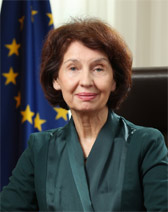
Gordana Siljanovska-Davkova
North Macedonia’s first female president and one of the country’s leading authorities on constitutional law and political institutions
Born on May 11, 1953
Age: 73
Profession: Politician, Lawyer, Academic, President
Place of Birth: Ohrid, Yugoslavia — now North Macedonia
Gordana Siljanovska-Davkova was born on May 11, 1953, in Ohrid, then part of socialist Yugoslavia and now located within North Macedonia. A Macedonian constitutional lawyer, retired university professor and politician, Gordana Siljanovska-Davkova has served as President of North Macedonia since May 12, 2024. Before entering the presidency, she built a long academic and public-service career focused on constitutional law, political systems, local government, democratic institutions, gender equality and European legal standards. Her election made her the first woman to become head of state in the country’s history.
Early Life and Education
Gordana Siljanovska-Davkova was born in the historic city of Ohrid but completed her primary and secondary education in Skopje. She grew up during the period when the Socialist Republic of Macedonia formed one of the federal republics of Yugoslavia.
Her interest in public institutions, law and political organization led her to the Faculty of Law at Ss. Cyril and Methodius University in Skopje. She completed her undergraduate legal studies in 1978 and continued with postgraduate education at the same institution.
Gordana Siljanovska-Davkova later pursued doctoral research at the Faculty of Law of the University of Ljubljana in present-day Slovenia. She completed her doctorate with distinction in 1994. Her research examined local government, political institutions and the relationship between formal legal rules and political reality.
The constitutional transformation of Yugoslavia and the emergence of new democratic states provided the wider historical context for her academic development. Questions involving federalism, decentralization, democratic legitimacy and the authority of public institutions became central to both her scholarship and later political career.
Academic Career at Ss. Cyril and Methodius University
Gordana Siljanovska-Davkova developed most of her academic career at the Iustinianus Primus Faculty of Law of Ss. Cyril and Methodius University in Skopje. She became an assistant professor in 1994, an associate professor in 1999 and a full professor in 2004.
Her principal teaching fields included constitutional law, political systems, contemporary models of government and local self-government. She also taught courses addressing the political participation of women and the institutional development of democratic states.
As a professor, Gordana Siljanovska-Davkova became known for connecting constitutional theory with contemporary political controversies. Her lectures examined not only the wording of constitutions but also the ways in which political parties, governments, parliaments and courts exercised power in practice.
Her academic interests extended across presidential and parliamentary systems, electoral law, judicial independence, decentralization, minority rights, political parties and the challenges faced by democratic societies emerging from authoritarian rule.
Leadership within the Faculty of Law
During her university career, Gordana Siljanovska-Davkova held several senior academic and administrative responsibilities. She headed the Institute for Legal and Legal-Political Sciences and later led the Department of Constitutional Law and Political System.
She also served within the faculty’s governing and academic bodies. These positions allowed her to influence curriculum development, academic research and the institutional organization of legal education.
Gordana Siljanovska-Davkova was one of the founders of clinical legal education in the country. The model introduced students to practical legal work and encouraged them to apply constitutional and legal principles to real cases rather than limiting their education to lectures and theoretical examinations.
She managed the faculty’s Center for Legal Clinical Education and worked with international organizations interested in improving public-interest law and practical legal training. Her work contributed to the modernization of legal education during the country’s transition from socialist government to a pluralist constitutional system.
Research and Publications
Gordana Siljanovska-Davkova is the author or co-author of more than 200 academic works in constitutional law, political systems, local government, electoral law, democratic transition and gender equality.
Her publications have examined parliamentary democracy, constitutional courts, political parties, minority representation, administrative protection, local autonomy and the relationship between national constitutions and European legal standards.
Among her major areas of research was local self-government. She examined the European principles of municipal autonomy and the extent to which national institutions allowed local communities to manage their own administrative and financial affairs.
Gordana Siljanovska-Davkova also wrote about the constitutional structure of multiethnic societies. Her scholarship addressed the difficult balance between individual citizenship, group identity, political representation and democratic decision-making in the Western Balkans.
Books and Major Academic Contributions
Her published work includes books and studies such as Local Self-Government, Macedonian Transition: From a Unitary toward a Bi-National State, Constitutional Law and contributions to publications on political institutions, electoral systems and democratic consolidation.
Gordana Siljanovska-Davkova contributed to commentaries on electoral legislation and participated in comparative studies involving political parties and voters across the former Yugoslav republics.
Her academic writing frequently emphasized that democracy required more than periodic elections. Independent courts, accountable political parties, functioning parliaments, local autonomy and meaningful citizen participation were equally important to constitutional government.
In 2016, students at the Iustinianus Primus Faculty of Law voted Gordana Siljanovska-Davkova the faculty’s most inspiring professor. The recognition reflected her long teaching career and her reputation for encouraging critical debate on political and constitutional questions.
Participation in Macedonia’s Constitutional Transition
As Yugoslavia entered a period of political disintegration, Gordana Siljanovska-Davkova became directly involved in public affairs. In 1991, she participated in a group of experts connected with the Geneva Conference on the Former Yugoslavia.
From 1991 to 1992, she served as a member of the Constitutional Commission of the Assembly of the Republic of Macedonia. The commission worked during the formative period in which the newly independent state was establishing its constitutional order.
The country’s Constitution was adopted in November 1991. The document created a parliamentary republic, protected civil and political rights and established the relationship between the presidency, parliament, government and judiciary.
Her participation in the constitutional process gave Gordana Siljanovska-Davkova practical experience of the transition from constitutional scholarship to state-building. It also placed her among the legal experts involved in designing the institutional foundations of independent Macedonia.
Minister without Portfolio
Between 1992 and 1994, Gordana Siljanovska-Davkova served as a minister without portfolio in the government led by Branko Crvenkovski. Her government work concentrated on institutional reform, legal cooperation and the democratic transformation of the new state.
She chaired the coordinating body responsible for cooperation with the Central and Eastern European Law Initiative, a program established by the American Bar Association. The initiative supported legal reform, judicial development and professional exchanges in countries moving away from communist government.
Gordana Siljanovska-Davkova was also among the founders of the first Macedonian council of the European Movement. Her participation reflected an early commitment to the integration of the country into European political and legal institutions.
After leaving the government, she returned primarily to academic and international legal work. Unlike many public officials of the period, she did not immediately develop a permanent career inside a political party.
Work on Gender Equality
Gender equality became another important area of the public work of Gordana Siljanovska-Davkova. From 1999 to 2002, she chaired the Macedonian National Committee for Equality between Women and Men.
She subsequently led the Women’s Lobby of the regional Gender Task Force between 2002 and 2004. Her work addressed women’s political participation, institutional discrimination, equal representation and the inclusion of gender perspectives in public policy.
Gordana Siljanovska-Davkova also worked as a gender expert for the United Nations Development Programme. Her academic teaching included courses on women and politics, connecting feminist legal analysis with questions of democratic representation.
Her later election as the first female president gave symbolic national importance to this earlier work. In public speeches, she has argued that women should participate in politics as decision-makers rather than merely as beneficiaries of equality programs.
International Legal and Democratic Work
Gordana Siljanovska-Davkova developed an extensive international career alongside her university work. She served as a United Nations expert on electoral matters and participated in projects concerning democratic governance, gender equality and legal reform.
Between 1996 and 2002, she was a member of the Steering Committee for Local and Regional Democracy of the Council of Europe. The committee worked on democratic standards, municipal government and the legal protection of local autonomy.
From 2002 to 2023, Gordana Siljanovska-Davkova served within the Group of Independent Experts responsible for monitoring the European Charter of Local Self-Government. She was vice-president of the group from 2004 to 2012.
This work involved examining whether national governments respected the political, administrative and financial independence of municipalities. It reinforced her reputation as one of the region’s leading authorities on local democracy.
The Venice Commission
From 2008 to 2016, Gordana Siljanovska-Davkova represented the Republic of Macedonia in the European Commission for Democracy through Law, commonly known as the Venice Commission.
The commission serves as the constitutional advisory body of the Council of Europe. It provides opinions on constitutions, electoral laws, judicial systems, emergency powers and the functioning of democratic institutions.
Gordana Siljanovska-Davkova participated in subcommissions dealing with democratic institutions, the judiciary, constitutional justice, minorities and Latin America. She also served as vice-president of the subcommission on minorities.
Her Venice Commission work strengthened her international profile and allowed her to contribute to debates extending beyond the Western Balkans. It also gave her direct experience of the constitutional standards later invoked during North Macedonia’s European integration process.
Political and Civic Organizations
Outside formal state institutions, Gordana Siljanovska-Davkova participated in several civic, academic and international organizations. She was associated with the International Association of Constitutional Law and helped establish the Euro-Balkan Institute.
She served as president of the Civic Movement of Macedonia and worked with networks researching local government and democratic institutions in Southeastern Europe.
These activities reflected her belief that constitutional democracy depended not only on state institutions but also on independent universities, professional associations and civil society.
The 2019 Presidential Campaign
In 2019, Gordana Siljanovska-Davkova entered electoral politics as a presidential candidate supported by the conservative VMRO-DPMNE coalition. Although backed by the party, she presented herself as an independent professor rather than a conventional party official.
The election occurred after the adoption of the Prespa Agreement, under which the country changed its constitutional name from the Republic of Macedonia to the Republic of North Macedonia. The agreement resolved the long-running name dispute with Greece and opened the path toward NATO membership.
Gordana Siljanovska-Davkova criticized the procedure through which the agreement and constitutional amendments had been adopted. She argued that questions of national identity and constitutional sovereignty had not received sufficient democratic legitimacy.
Her principal opponent was Stevo Pendarovski, supported by the governing Social Democratic Union of Macedonia. The two advanced to the second round after finishing closely in the opening vote.
Stevo Pendarovski won the runoff with approximately 51.7 percent, while Gordana Siljanovska-Davkova received around 44.7 percent. Although defeated, she became the first woman to advance to the final round of a Macedonian presidential election.
Election to Parliament
In the 2020 parliamentary election, Gordana Siljanovska-Davkova led the candidate list supported by VMRO-DPMNE and its coalition in the first electoral district. She was elected to the Assembly of North Macedonia as an independent deputy within the VMRO-DPMNE parliamentary group.
During her parliamentary term, she chaired the Commission for Equal Opportunities for Women and Men. She also served on bodies dealing with the political system, education and European integration.
Gordana Siljanovska-Davkova participated in parliamentary cooperation with the Swedish and Israeli legislatures and served as a deputy member of the Commission for European Affairs and the delegation to the Organization for Security and Co-operation in Europe.
Her speeches in parliament frequently addressed constitutional procedure, electoral reform, institutional accountability and the concentration of power within political parties.
Second Presidential Candidacy
Gordana Siljanovska-Davkova became a presidential candidate for a second time in 2024, again with the support of VMRO-DPMNE and its electoral partners.
Her campaign emphasized the rule of law, constitutional government, judicial reform, national dignity and the restoration of public confidence in state institutions. She argued that the presidency should exercise its constitutional responsibilities actively rather than function as an extension of the governing party.
The campaign took place during widespread dissatisfaction with corruption, economic conditions and the slow progress of negotiations for membership in the European Union. Relations with Bulgaria and the constitutional status of the Bulgarian minority were also major subjects.
Gordana Siljanovska-Davkova supported European integration in principle but opposed external conditions that she considered inconsistent with equality among candidate states or harmful to Macedonian linguistic and national identity.
First Round of the 2024 Election
The first round of the presidential election was held on April 24, 2024. Gordana Siljanovska-Davkova finished first with approximately 41 percent of the vote.
Incumbent president Stevo Pendarovski placed second with approximately 20 percent. The large difference demonstrated the extent of dissatisfaction with the governing Social Democrats and gave Gordana Siljanovska-Davkova a strong advantage before the runoff.
Other candidates represented ethnic Albanian parties, left-wing organizations and smaller political movements. Because no candidate received the required majority, the election proceeded to a second round.
Election as President
The presidential runoff was held on May 8, 2024, at the same time as the parliamentary election. Gordana Siljanovska-Davkova defeated Stevo Pendarovski by a wide margin, receiving approximately 69 percent of the valid vote.
Her victory made her the first woman elected President of North Macedonia. It also represented one of the most decisive presidential election results in the country’s history.
The result coincided with a major parliamentary victory for the coalition led by VMRO-DPMNE. The simultaneous results shifted political power away from the center-left administration that had governed during much of the previous period.
Although Gordana Siljanovska-Davkova had been supported by VMRO-DPMNE, she continued to emphasize her formal independence and her responsibility to represent all citizens rather than a single political organization.
Inauguration as the First Female President
Gordana Siljanovska-Davkova took the presidential oath before parliament on May 12, 2024, one day after her seventy-first birthday. She succeeded Stevo Pendarovski as head of state.
Her inauguration carried particular significance for women’s political representation. In her address, she emphasized the contributions of women to family life, education, public service, culture and national history.
Gordana Siljanovska-Davkova argued that the election of a woman to the presidency should not be treated as the final achievement of gender equality. She called for more women to enter government, diplomacy, universities, the judiciary and local administration.
The Constitutional Name Controversy
During her inauguration oath and address, Gordana Siljanovska-Davkova referred to the country as “Macedonia” rather than using its constitutional name, the Republic of North Macedonia.
The decision produced an immediate diplomatic reaction from Greece. The Greek ambassador left the ceremony, and the Greek government argued that the language violated the spirit and obligations of the Prespa Agreement.
European officials also emphasized that compliance with international agreements was essential to North Macedonia’s progress toward European Union membership. Greek Prime Minister Kyriakos Mitsotakis warned that continuing disputes over the name could affect bilateral relations and European integration.
The office of Gordana Siljanovska-Davkova subsequently stated that official documents and institutional communication would respect the constitutional name. At the same time, she defended her personal use of “Macedonia” as an expression of national and personal identity.
The episode demonstrated the tension that would characterize her presidency: support for European cooperation combined with resistance to obligations that she or her supporters regarded as diminishing Macedonian identity.
Constitutional Role of the Presidency
North Macedonia has a parliamentary political system in which executive authority is exercised primarily by the government. The president nevertheless holds important constitutional responsibilities in foreign policy, national security, government formation and senior appointments.
The president represents the state internationally, serves as commander-in-chief of the armed forces and chairs the Security Council of North Macedonia. The office also participates in the appointment of ambassadors and performs responsibilities involving legislation and government formation.
Gordana Siljanovska-Davkova has approached the office through the perspective of a constitutional-law professor. She frequently emphasizes the separation of powers, the legal limits of political authority and the duty of public institutions to follow constitutional procedure.
Appointment of Hristijan Mickoski
Following the May 2024 parliamentary election, the coalition led by VMRO-DPMNE emerged as the largest force in the Assembly. On June 6, 2024, Gordana Siljanovska-Davkova formally gave party leader Hristijan Mickoski the mandate to form a government.
The decision followed consultations and evidence that Hristijan Mickoski could command a parliamentary majority. His coalition eventually included the ethnic Albanian alliance Vredi and the movement ZNAM.
The formation of the government created a political environment in which the president and prime minister came from the same broad conservative political camp. Nevertheless, Gordana Siljanovska-Davkova has stated that the presidency must retain institutional autonomy and should not become subordinate to any party leadership.
European Union Membership
Gordana Siljanovska-Davkova formally supports North Macedonia’s membership in the European Union. She regards European integration as important to economic development, democratic consolidation and regional security.
Her position is more critical, however, regarding the conditions attached to the accession process. She has argued that candidate countries should be evaluated according to the established Copenhagen criteria rather than bilateral historical, linguistic or identity disputes.
North Macedonia’s accession negotiations have been delayed first by the name dispute with Greece and later by disagreements with Bulgaria. Bulgaria has demanded constitutional recognition of the Bulgarian community and progress on several historical and cultural questions.
Gordana Siljanovska-Davkova opposes what she describes as the bilateralization of the enlargement process. She argues that allowing individual member states to impose identity-related conditions weakens the credibility of European institutions and creates unequal treatment among candidates.
Her critics warn that refusing constitutional amendments could leave the country’s membership process blocked. Supporters respond that European integration should not require concessions that challenge the distinct character of the Macedonian language, history or national identity.
Relations with Bulgaria
Relations with Bulgaria are among the most difficult foreign-policy issues facing the presidency of Gordana Siljanovska-Davkova. The two countries share geographical proximity and aspects of cultural history but disagree over language, identity and interpretations of the past.
Bulgaria has linked further progress in European accession talks to the inclusion of Bulgarians in the North Macedonian Constitution. The required amendment would need a two-thirds parliamentary majority.
Gordana Siljanovska-Davkova has argued that constitutional change should not be imposed through external pressure. She has also called for reciprocal respect, dialogue and guarantees that additional conditions will not be introduced after amendments are adopted.
Her approach combines constitutional caution with a broader criticism of national vetoes in European Union decision-making. She maintains that enlargement should be a strategic European policy rather than a mechanism through which unresolved bilateral disputes are transferred to candidate states.
Relations with Greece and the Prespa Agreement
Gordana Siljanovska-Davkova was a prominent critic of the Prespa Agreement before becoming president. She questioned both the constitutional procedure through which the name change was adopted and its implications for national identity.
As head of state, however, she has not attempted to withdraw North Macedonia from the agreement. Official state documents and international communications continue to use the constitutional name.
Her distinction between legal obligations and personal language remains controversial. Greek officials argue that selective use of the former name undermines confidence and the effective implementation of the agreement.
Gordana Siljanovska-Davkova presents her position as an attempt to reconcile international law with the individual right to national self-identification. The dispute remains an important test of her ability to combine domestic political commitments with diplomatic responsibility.
NATO and National Security
North Macedonia became a member of NATO in 2020 after the settlement of the name dispute with Greece. Gordana Siljanovska-Davkova recognizes the alliance as an important guarantee of national and regional security.
As president and commander-in-chief, she participates in discussions concerning defence modernization, military readiness and cooperation with allied countries. Her presidency has supported stronger institutional coordination between the armed forces, government and international partners.
Russia’s invasion of Ukraine increased the strategic importance of NATO membership throughout Southeastern Europe. Gordana Siljanovska-Davkova has emphasized respect for territorial integrity and the principles of international law while supporting the country’s existing Euro-Atlantic commitments.
She also argues that security must be understood more broadly than military defence. Energy supplies, cyber systems, climate emergencies, demographic change and institutional resilience all affect the stability of smaller states.
Rule of Law and Judicial Reform
The rule of law is one of the central subjects of the presidency of Gordana Siljanovska-Davkova. Her academic career was built around the idea that political power must remain subject to constitutional limits.
She has criticized political influence over the judiciary, inconsistent appointments and declining public trust in prosecutors and courts. Judicial reform is also one of the principal requirements of the European Union accession process.
Gordana Siljanovska-Davkova supports merit-based appointments, professional independence and stronger accountability. She argues that judicial institutions cannot protect democracy if they are treated as extensions of political parties.
Her critics contend that the conservative political movement supporting her has its own history of institutional control and partisan appointments. Her ability to apply constitutional principles consistently to both allies and opponents remains an important measure of her presidency.
Local Government and Decentralization
Local self-government remains one of the subjects most closely associated with the academic work of Gordana Siljanovska-Davkova. She has long argued that democracy should not be concentrated entirely in national institutions.
Municipalities require sufficient legal authority, professional administration and financial resources to address local services effectively. Without genuine fiscal and political autonomy, elected local governments can remain dependent on central ministries.
Her work with the Council of Europe strengthened her support for the principles of the European Charter of Local Self-Government. These include the right of local communities to manage a substantial share of public responsibilities under their own authority.
As president, Gordana Siljanovska-Davkova has continued to emphasize decentralization and balanced regional development. The concentration of population, employment and public resources in Skopje remains a long-term economic and social challenge.
Women in Political Life
The election of Gordana Siljanovska-Davkova as the country’s first female president represented a major symbolic change in Macedonian political life.
Her professional history includes decades of work on gender equality, women’s representation and the inclusion of gender analysis in law and public policy. She has argued that formal equality is insufficient when leadership structures remain dominated by men.
Gordana Siljanovska-Davkova supports greater participation by women in parliament, diplomacy, the judiciary, local government and security institutions. She also emphasizes the importance of education and economic independence.
Supporters regard her presidency as evidence that academic and professional achievement can overcome traditional gender barriers. Critics note that symbolic representation must be accompanied by concrete policies addressing violence, unequal employment and the underrepresentation of women in senior decision-making positions.
Multiethnic Democracy
North Macedonia is a multiethnic state in which Macedonians and Albanians form the two largest communities. Turks, Roma, Serbs, Bosniaks, Vlachs and other groups also contribute to the country’s cultural and political life.
Gordana Siljanovska-Davkova has written extensively about constitutional arrangements in multicultural societies. She emphasizes equal citizenship while recognizing the need to protect community identities and linguistic rights.
The Ohrid Framework Agreement of 2001 expanded the political and linguistic rights of ethnic Albanians and helped end an armed conflict. Its implementation continues to influence public employment, language policy and coalition government.
As president, Gordana Siljanovska-Davkova has called for institutions that unite citizens through equal legal status rather than permanently dividing them into competing ethnic blocs. The challenge is to balance common citizenship with the constitutional protections required by a diverse society.
Protection of Ohrid
As a native of Ohrid, Gordana Siljanovska-Davkova has taken a particular interest in the preservation of the city and the surrounding lake. The Ohrid region is recognized by UNESCO for both its cultural and natural importance.
Unregulated construction, environmental damage, wastewater and pressure from tourism have created concerns regarding the long-term protection of the area.
Gordana Siljanovska-Davkova has emphasized that safeguarding Ohrid transcends national politics. Preservation requires cooperation among local authorities, the central government, experts, citizens and neighboring Albania, which shares the lake.
Political Identity
Gordana Siljanovska-Davkova is generally described as a conservative, nationally oriented and constitutionally focused political figure. Although formally independent, both of her presidential campaigns were supported by VMRO-DPMNE.
She combines traditional positions on national identity with an academic commitment to constitutionalism, local autonomy and the separation of powers. She supports membership in European and Atlantic institutions but criticizes political conditions that she believes exceed established legal standards.
Her supporters see her as an intellectually independent president capable of defending national interests with constitutional arguments. Her critics regard her as politically aligned with nationalist forces and question whether her positions may slow European integration or damage relations with neighboring countries.
Leadership Style and Public Image
Gordana Siljanovska-Davkova is known for an academic and highly verbal political style. Her speeches frequently include constitutional concepts, literary references and comparisons with European democratic systems.
Supporters value her legal knowledge, professional experience and willingness to challenge established political practices. They regard her as a president who can introduce greater intellectual seriousness into national politics.
Critics argue that her language can be overly theoretical and that constitutional arguments sometimes conceal politically nationalist positions. The controversy surrounding the country’s name demonstrated how her personal interpretation of identity can produce significant diplomatic consequences.
Her age and long academic career distinguish her from leaders whose public reputations were built primarily through party organizations. She entered the presidency with extensive institutional knowledge but limited executive-government experience.
Personal Life
Gordana Siljanovska-Davkova is married to lawyer Blagoja Davkov. The couple have two children.
She has generally kept her private and family life outside daily political debate. Her public identity has remained closely connected to teaching, constitutional scholarship and institutional service.
Even after moving into electoral politics, Gordana Siljanovska-Davkova continued to be described primarily as a professor. Her academic career remains the foundation of both her authority and her political communication.
Position in Contemporary North Macedonian Politics
The career of Gordana Siljanovska-Davkova combines university teaching, constitutional reform, international legal work, government service, parliamentary politics and the presidency.
She participated in the creation of the constitutional institutions of independent Macedonia, advised international organizations and trained generations of law and political-science students before becoming a national political candidate.
Her 2024 election represented both a historic victory for women and a broader shift toward the conservative opposition. It placed a constitutional-law professor at the head of state during a period of difficult negotiations with Greece, Bulgaria and the European Union.
Supporters regard Gordana Siljanovska-Davkova as a defender of constitutional sovereignty, national dignity and institutional reform. Opponents argue that her positions on the country’s name and constitutional amendments could deepen diplomatic isolation and delay European accession.
Her presidency will ultimately be judged by whether she can reconcile these competing objectives: protecting Macedonian identity, respecting international agreements, strengthening the rule of law and keeping the country on a credible path toward membership in the European Union.
Selected Offices and Positions
- 1991–1992 – Member of the Constitutional Commission of the Assembly of the Republic of Macedonia
- 1992–1994 – Minister without Portfolio in the Government of the Republic of Macedonia
- 1992–1994 – President of the Coordinating Body for Cooperation with the Central and Eastern European Law Initiative
- 1994 onward – University Professor and Researcher in Constitutional Law and Political Systems
- 1996–2002 – Member of the Council of Europe Steering Committee for Local and Regional Democracy
- 1999–2002 – President of the Macedonian National Committee for Equality between Women and Men
- 2002–2023 – Member of the Group of Independent Experts on the European Charter of Local Self-Government
- 2004–2012 – Vice-President of the Group of Independent Experts on the European Charter of Local Self-Government
- 2008–2016 – Member of the Venice Commission
- 2019 – Presidential Candidate
- 2020–2024 – Member of the Assembly of North Macedonia
- 2020–2024 – President of the Parliamentary Commission for Equal Opportunities for Women and Men
- May 12, 2024–Present – President of North Macedonia
Source: Biyografiler.com
Frequently asked questions about Gordana Siljanovska-Davkova
Who is Gordana Siljanovska-Davkova?, Gordana Siljanovska-Davkova biography, Gordana Siljanovska-Davkova life story, Gordana Siljanovska-Davkova age, Gordana Siljanovska-Davkova facts, Gordana Siljanovska-Davkova birthplace, Gordana Siljanovska-Davkova photos, Gordana Siljanovska-Davkova videos, Gordana Siljanovska-Davkova career
Related Biographies

Lamine Yamal
Professional footballer

Sam Altman
Entrepreneur, Investor, CEO

Kylian Mbappe
Professional footballer

Erling Haaland
Professional footballer

Alice Weidel
Politician, Economist

Giorgia Meloni
Politician, Journalist


Hongjoong
Singer, Rapper, Songwriter, Composer

Ludacris
Rapper, Actor

Kwon Eunbi
Singer

Sarah Wayne Callies
Actress, Screenwriter, Producer, Director

LaTavia Roberson
Singer, Actress, Entrepreneur
Lamine Yamal
Professional footballer

Austin Abrams
Actor

Mustafa Suleyman
Business Leader, Entrepreneur

Augustus
Head of State

Helen Mirren
Actress

Chase Infiniti
Actress