
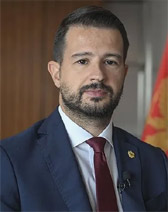
Jakov Milatovic
Pro-European economist who moved from international finance and economic reform to the presidency of Montenegro
Born on December 7, 1986
Age: 40
Profession: Politician, Economist, Head of State
Place of Birth: Podgorica, Yugoslavia — now Montenegro
Jakov Milatović was born on December 7, 1986, in Podgorica, then part of socialist Yugoslavia and now the capital of Montenegro. A Montenegrin economist and politician, Jakov Milatović has served as President of Montenegro since May 20, 2023. Before entering politics, he developed an international career in banking, economic analysis and development finance. He later became Minister of Economic Development, helped design the influential Europe Now economic reform program and co-founded the political movement of the same name. His election to the presidency marked a generational change in Montenegrin politics and ended the long period of national dominance associated with Milo Đukanović.
Early Life in Podgorica
Jakov Milatović was born and raised in Podgorica during the final years of the Socialist Federal Republic of Yugoslavia. His childhood coincided with the political and economic instability that accompanied the breakup of Yugoslavia and the international isolation experienced by Montenegro and Serbia during the 1990s.
He completed his primary and secondary education in Podgorica. From an early stage, Jakov Milatović showed a strong interest in economics, international affairs and the relationship between public policy and living standards.
The economic difficulties experienced by the region during his youth influenced his later political emphasis on employment, wages, institutional stability and European integration. Unlike many traditional Balkan political figures whose careers developed almost entirely inside party organizations, Jakov Milatović initially built his reputation through academic performance and international professional experience.
Economics Education at the University of Montenegro
Jakov Milatović studied economics at the Faculty of Economics of the University of Montenegro in Podgorica. He achieved the highest possible academic average and was recognized as the leading student of his graduating generation.
His undergraduate studies provided training in macroeconomics, microeconomics, public finance, statistics, international trade and economic development. These subjects later formed the basis of his work in banking, international financial institutions and government.
During his university years, Jakov Milatović received several academic awards and international scholarships. These opportunities allowed him to study in the United States, Austria and Italy and gave him experience of different educational, economic and political systems.
International Scholarship Programs
As a scholarship recipient of the United States government, Jakov Milatović spent an academic year at Illinois State University. The experience introduced him to the American university system and to economic debates concerning entrepreneurship, competition, innovation and public policy.
He later studied for one semester at the Vienna University of Economics and Business through a scholarship provided by the Austrian government. Studying in Vienna placed him in one of Central Europe’s principal economic and financial centres and exposed him to the institutions of the European social-market economy.
With support from the European Commission, Jakov Milatović also spent an academic year at Sapienza University of Rome. His studies in Italy strengthened his understanding of European integration, regional development and the economic differences among European Union member states.
These programs were important to the international outlook of Jakov Milatović. They reinforced his belief that Montenegro’s long-term economic development depended on stronger institutions, access to European markets and the adoption of standards associated with the European Union.
Master’s Degree at the University of Oxford
Jakov Milatović completed a master’s degree in economics at the University of Oxford. He studied in the United Kingdom with the support of a British government scholarship.
His postgraduate education concentrated on advanced economics, international finance, development policy and the relationship between institutions and economic growth. The program provided him with the analytical tools required to examine unemployment, productivity, investment and fiscal policy.
At Oxford, Jakov Milatović studied in an international academic environment that brought together economists and public-policy specialists from many countries. This experience later influenced his effort to present political questions through economic evidence rather than exclusively through national, ethnic or ideological arguments.
Additional International Training
Beyond his formal degrees, Jakov Milatović participated in educational and leadership programs organized by international institutions. These included programs associated with the United Nations, the International Monetary Fund, the London School of Economics and Political Science, the Konrad Adenauer Foundation and the Stanford University Leadership Academy.
He also attended academic and professional programs connected with Peking University, the University of Belgrade and international cooperation institutions in Montenegro and Italy.
This wide range of training contributed to his public image as a technically educated economist with direct experience of Western universities and international organizations. It also distinguished him from the older political generation that had governed Montenegro through the final Yugoslav years and the first decades of independence.
Beginning of His Banking Career
Jakov Milatović began his professional career in the banking sector. He worked in the risk-management department of NLB Bank in Podgorica, where he gained experience in assessing financial exposure, lending conditions and the operation of commercial banks.
He later worked for Deutsche Bank in Frankfurt. His responsibilities included credit-risk analysis relating to countries and financial institutions in Central and Eastern Europe.
The position gave Jakov Milatović practical knowledge of international banking, investment decisions and the criteria used by major financial institutions when assessing emerging economies. It also familiarized him with the importance of regulatory credibility and predictable government policy.
Career at the European Bank for Reconstruction and Development
In 2014, Jakov Milatović joined the European Bank for Reconstruction and Development, commonly known as the EBRD. The institution invests in private-sector development, infrastructure and economic reform across emerging markets.
He initially worked in the department responsible for economic and political analysis. His assignments covered Southeastern Europe and later the countries of the Western Balkans.
From the EBRD office in Podgorica, Jakov Milatović examined economic growth, investment conditions, public-sector reform and regional development. His work required cooperation with governments, businesses and financial institutions across countries undergoing political and economic transition.
In 2018, he moved to Bucharest and became the EBRD’s lead economist for Romania, Bulgaria, Croatia and Slovenia. The role expanded his responsibilities to include several European Union economies with different development levels and reform challenges.
His work at the EBRD strengthened his understanding of how institutional quality, political stability and access to investment affect economic performance. It also established his reputation as an internationally trained economist before he entered electoral politics.
Academic and Professional Publications
Jakov Milatović has written and contributed to professional studies concerning economics, development and regional reform. He has also co-authored books and participated in conferences dealing with the future of the Western Balkans.
In 2022, he served as a visiting lecturer at the Luxembourg School of Business. His academic work concentrated on economic policy, international development and the experiences of smaller European economies.
Although Jakov Milatović did not pursue a conventional university career, teaching and economic research remained an important part of his professional identity. His political speeches frequently use economic statistics, comparative examples and international indicators.
Entry into Government
The parliamentary election of August 2020 ended the long period in which the Democratic Party of Socialists and Milo Đukanović had dominated Montenegro’s national government. A new parliamentary majority brought together parties united primarily by their opposition to the former ruling establishment.
Prime Minister Zdravko Krivokapić formed a cabinet that included several technocratic figures without long careers in party politics. In December 2020, Jakov Milatović was appointed Minister of Economic Development.
The appointment brought him back to Montenegro after years of work in international finance. At the age of 34, he assumed responsibility for economic growth, investment, tourism, competitiveness and labour-market policy during a period of exceptional difficulty.
Economic Challenges during the Pandemic
Jakov Milatović entered government while Montenegro was experiencing the economic consequences of the COVID-19 pandemic. The country’s heavy dependence on tourism meant that travel restrictions and falling visitor numbers produced a severe economic contraction.
As Minister of Economic Development, Jakov Milatović worked on support measures for businesses, employees and the tourism industry. His ministry also attempted to encourage investment and prepare the economy for recovery after the pandemic.
The crisis reinforced his argument that Montenegro needed a broader and more productive economy. Although tourism remained essential, he supported greater development in technology, energy, agriculture and internationally competitive services.
The Europe Now Economic Program
The most important initiative associated with the ministerial career of Jakov Milatović was the Europe Now economic reform program. He developed and promoted the plan together with Finance Minister Milojko Spajić.
The program substantially increased the statutory minimum wage and reduced some of the labour-related charges paid by employees and employers. It also abolished compulsory healthcare contributions from salaries and moved healthcare financing toward the central government budget.
The objective was to raise workers’ net income, reduce the informal economy and improve the competitiveness of employment. Jakov Milatović argued that Montenegro’s low wages encouraged young and qualified citizens to leave the country.
The program produced an immediate increase in disposable income for many workers and became extremely popular. It also generated debate about the long-term financing of public healthcare, fiscal sustainability and the effects of rapid wage increases on prices and businesses.
Supporters presented Europe Now as the most significant improvement in living standards in modern Montenegro. Critics warned that the program depended on optimistic revenue assumptions and could create pressure on the state budget.
Collapse of the Krivokapić Government
The government of Zdravko Krivokapić was weakened by conflicts among the parties supporting it. Disagreements concerned cabinet appointments, relations with the Serbian Orthodox Church, national identity, foreign policy and the influence of party leaders over a government that had been presented as technocratic.
In February 2022, parliament approved a vote of no confidence and removed the administration. Jakov Milatović left the Ministry of Economic Development after approximately fourteen months in office.
His short ministerial term nevertheless gave him a strong national political profile. The popularity of the Europe Now program allowed him and Milojko Spajić to transform their economic initiative into a new political movement.
Foundation of the Europe Now Movement
In June 2022, Jakov Milatović and Milojko Spajić founded the Europe Now Movement. The organization positioned itself outside the traditional division between the long-ruling Democratic Party of Socialists and the older parties of the opposition.
The movement emphasized economic reform, higher wages, European Union membership, anti-corruption measures and the recruitment of younger professionals into public life. It avoided defining itself exclusively through the ethnic and religious disputes that had often dominated Montenegrin politics.
Jakov Milatović became one of the movement’s leading officials and served as deputy president. Milojko Spajić became the principal party leader.
The movement appealed to citizens who wanted political change but were dissatisfied with both the former governing establishment and nationalist opposition groups. Its message presented economic improvement and institutional competence as alternatives to permanent identity conflict.
Podgorica Local Election
In October 2022, Jakov Milatović led the Europe Now Movement list in the local election in Podgorica. The movement achieved a strong result and became a central part of the coalition capable of ending the long rule of the Democratic Party of Socialists in the capital.
The result demonstrated that the new movement could translate the popularity of its economic program into electoral support. It also established Jakov Milatović as a credible candidate for major national office.
His calm public style, international education and limited association with the conflicts of the older political generation helped him attract younger, urban and economically focused voters.
Presidential Candidacy
The Europe Now Movement initially intended to nominate Milojko Spajić for the 2023 presidential election. His candidacy was rejected after questions concerning his citizenship and residence status.
Jakov Milatović subsequently became the movement’s presidential candidate. The change occurred shortly before the election and required him to organize a national campaign within a limited period.
He campaigned on economic modernization, European integration, the rule of law and the end of political institutions built around a single long-serving leader. He presented himself as a candidate of generational and democratic change.
His principal political opponent was incumbent president Milo Đukanović, who had served as either president or prime minister for most of the period since the early 1990s.
First Round of the 2023 Presidential Election
The first round of the presidential election was held on March 19, 2023. Milo Đukanović finished first with approximately 35.4 percent of the vote.
Jakov Milatović received approximately 28.9 percent and advanced to the runoff. Conservative politician Andrija Mandić finished third, while Aleksa Bečić placed fourth.
After the first round, several opposition candidates supported Jakov Milatović. The runoff therefore became a broader contest between the long-established political order associated with Milo Đukanović and a coalition of voters seeking institutional change.
Election as President
The second round was held on April 2, 2023. Jakov Milatović received 58.88 percent of the vote, while Milo Đukanović received 41.12 percent.
The result ended the presidency of one of the longest-serving political leaders in Europe. It also represented the first time since the introduction of multiparty politics that a candidate outside the political structure led by Milo Đukanović had won the Montenegrin presidency.
Jakov Milatović performed strongly in Podgorica and many municipalities in the central and northern regions. His victory brought together pro-European reformists, conservative voters, Serbian-identifying citizens and people primarily motivated by opposition to the former government.
The breadth of this electoral coalition was a political advantage during the campaign but later created difficulties. The groups that supported Jakov Milatović did not always share the same views on national identity, relations with Serbia, Kosovo, the European Union or NATO.
Inauguration as President
Jakov Milatović took the presidential oath before the Parliament of Montenegro on May 20, 2023. He succeeded Milo Đukanović and became the youngest president in the country’s history.
In his inaugural address, Jakov Milatović promised to represent all citizens regardless of their political, ethnic or religious identity. He called for national reconciliation, stronger institutions and a rapid return to the European integration process.
He presented the presidency as an institution that should help overcome divisions rather than deepen them. His message emphasized economic development, equal opportunity and the restoration of public confidence in the state.
Constitutional Role of the Presidency
Montenegro has a parliamentary political system in which executive power is exercised primarily by the government. The president represents the state, appoints a candidate for prime minister after political consultations and performs important constitutional and diplomatic functions.
The president also promulgates legislation, calls parliamentary elections under specified conditions, appoints ambassadors on the government’s proposal and serves as commander-in-chief within the constitutional framework.
Jakov Milatović has used the office to promote European integration, institutional dialogue and economic diplomacy. He has also become involved in disputes over appointments, legislation and the direction of government policy.
European Union Membership
Accelerating Montenegro’s accession to the European Union is the principal foreign-policy objective of Jakov Milatović. Montenegro began membership negotiations in 2012 and has opened all negotiating chapters, but progress has frequently been delayed by political instability and institutional weakness.
Jakov Milatović has stated that Montenegro could become the 28th member of the European Union by 2028. He argues that the country’s small size, advanced negotiating position and widespread public support for membership make this target achievable.
He has emphasized that membership cannot be achieved through diplomatic statements alone. Judicial independence, electoral reform, media freedom, effective public administration and measurable results in the fight against corruption remain essential.
For Jakov Milatović, European Union membership is both an economic and geopolitical project. It would provide greater access to investment and public funding while confirming Montenegro’s place within the democratic institutions of Europe.
Rule of Law and Institutional Reform
Jakov Milatović argues that Montenegro’s state institutions must operate independently of individual politicians and political parties. The long concentration of power under the previous political order contributed to public distrust in the judiciary, prosecution service and public administration.
He supports merit-based appointments, transparent procurement and stronger mechanisms for investigating corruption and organized crime. He has also called for electoral reforms capable of improving accountability between representatives and voters.
The president has emphasized that replacing one political elite with another would not constitute genuine democratic change. In his view, reform requires institutions capable of applying the law equally regardless of party affiliation.
NATO and Atlantic Security
Jakov Milatović supports Montenegro’s membership in NATO, which the country joined in 2017. He regards the alliance as an important security guarantee for a small Balkan state located in a region with a history of conflict and external influence.
He has supported cooperation with the United States and European allies in defence, cybersecurity and regional stability. His position has sometimes required balancing relations with voters and political groups that opposed Montenegro’s NATO accession.
Jakov Milatović argues that democratic debate over earlier decisions should not create uncertainty about the country’s existing international commitments. His foreign policy is based on continued integration with Western political and security institutions.
Russia and the War in Ukraine
Jakov Milatović has supported the sovereignty and territorial integrity of Ukraine following Russia’s full-scale invasion. Montenegro aligned itself with European sanctions against Russia and provided political and humanitarian support to Ukraine.
His position reflects Montenegro’s NATO membership and European Union aspirations. At the same time, relations with Russia remain a sensitive domestic issue because of historic, religious and cultural connections and the presence of political parties with more favorable views of Moscow.
Jakov Milatović has generally adopted a pro-Western policy while emphasizing the need to preserve internal political stability and dialogue among citizens with different international orientations.
Relations with Serbia
Relations with Serbia are among the most important and politically sensitive elements of Montenegrin foreign policy. The two countries share close linguistic, cultural, religious and family connections, but their political relationship has frequently been affected by disputes over identity, church affairs and regional policy.
Jakov Milatović supports constructive and respectful relations with Serbia based on the sovereignty of both states. He has sought to reduce the confrontational atmosphere that characterized parts of the previous period.
His supporters argue that Montenegro can maintain close relations with Serbia while continuing its European and Atlantic integration. Critics worry that political forces favoring stronger Serbian influence could weaken Montenegro’s distinct national institutions or alter its foreign-policy orientation.
Kosovo and Regional Diplomacy
Montenegro recognized the independence of Kosovo in 2008. The decision remains controversial among sections of the country’s Serbian-identifying population.
Jakov Milatović has indicated that recognition is an established state policy rather than an issue he intends to reverse. He supports dialogue between Belgrade and Pristina and the normalization of regional relations through European mediation.
More broadly, Jakov Milatović promotes cooperation among the Western Balkan states in trade, transport, energy, tourism and security. He argues that unresolved historical and identity disputes should not prevent practical regional development.
Economic Philosophy
The political identity of Jakov Milatović is strongly connected to economics. He supports higher wages, private-sector development, foreign investment and a state administration capable of delivering efficient public services.
His approach combines elements of market liberalism with active intervention intended to improve household income. The Europe Now program demonstrated his willingness to restructure taxation and social contributions to produce immediate increases in net wages.
Jakov Milatović argues that economic policy should be judged by its effect on ordinary citizens rather than by abstract fiscal indicators alone. At the same time, his professional background leads him to emphasize macroeconomic stability, responsible borrowing and investor confidence.
He supports the diversification of Montenegro’s economy beyond tourism. Energy, agriculture, digital services, infrastructure and high-value professional sectors are among the fields he has identified as potential sources of long-term growth.
Youth, Employment and Emigration
One of the central themes of Jakov Milatović is the departure of young people from Montenegro. Limited employment opportunities, low salaries and distrust in public institutions have encouraged many educated citizens to build careers elsewhere in Europe.
He argues that higher income alone will not prevent emigration. Young people also require fair recruitment, professional advancement, functioning public services and confidence that personal connections are not more important than qualifications.
His own return from an international career became part of his political message. Jakov Milatović presents himself as an example of a professional who gained experience abroad and returned to contribute to national development.
Relationship with Milojko Spajić
The political partnership between Jakov Milatović and Milojko Spajić was central to the creation of both the Europe Now program and the Europe Now Movement. Their cooperation helped transform two former technocratic ministers into the most important representatives of a new political generation.
After the movement became the largest force in the 2023 parliamentary election, Milojko Spajić became prime minister. Differences between the two leaders gradually became more visible.
The disagreements concerned party management, government formation, political appointments and cooperation with pro-Serbian parties. Jakov Milatović criticized what he regarded as insufficient transparency and movement away from the original principles of competence, integrity and inclusive decision-making.
Departure from the Europe Now Movement
In February 2024, Jakov Milatović resigned as deputy president of the Europe Now Movement and left the organization. He stated that its methods and political direction no longer reflected the values on which the movement had been founded.
The departure ended the formal political partnership between Jakov Milatović and Milojko Spajić. It also created an unusual institutional situation in which the president and prime minister had emerged from the same new movement but were increasingly positioned as political rivals.
Since leaving the party, Jakov Milatović has continued his presidency as an independent political figure. His supporters argue that independence allows him to act above party interests, while critics suggest that the absence of a strong parliamentary organization limits his political influence.
Relations with the Government
The relationship between Jakov Milatović and the government led by Milojko Spajić has alternated between cooperation and disagreement. Both support European Union membership and economic development, but they have differed over institutional procedures, political alliances and the distribution of public authority.
Jakov Milatović has criticized appointments and decisions that he believes weaken merit-based government or the credibility of European reforms. Government supporters have accused him of using the presidency to build a separate political platform.
These tensions illustrate a broader question within Montenegro’s democratic transition: whether the removal of the old dominant party will produce stable institutions or simply create competition among new centres of political power.
Political Identity
Jakov Milatović is generally described as a centrist, economically reformist and pro-European politician. His political support has nevertheless come from a diverse coalition that includes liberal reformers, social conservatives and voters with strong Serbian cultural identities.
He has attempted to avoid the rigid ethnic divisions that have shaped much of Montenegrin politics. His public language emphasizes employment, public services, corruption and European integration rather than permanent conflict over identity.
Supporters regard Jakov Milatović as a representative of a younger, professionally educated and internationally experienced political generation. Critics argue that his movement benefited from economic populism and that he has not always defined clear positions on socially or geopolitically divisive questions.
Leadership Style and Public Image
Jakov Milatović is known for a measured and technically oriented communication style. He frequently discusses politics through economic indicators, reform benchmarks and comparisons with European countries.
His public image contrasts with the more confrontational style of many Balkan political leaders. He generally presents himself as calm, pragmatic and focused on solutions rather than ideological conflict.
Supporters describe him as educated, modern and capable of representing Montenegro internationally. His age and professional background have helped him appeal to voters seeking generational change.
Critics argue that his limited experience in party politics can make coalition management and institutional confrontation more difficult. They also question whether a president with restricted executive authority can deliver the broad economic and political transformation associated with his campaign.
Personal Life
Jakov Milatović is married to Milena Milatović. The couple have three children.
He generally keeps his family life outside daily political debate, although Milena Milatović has accompanied him at election events, state ceremonies and selected official engagements.
Jakov Milatović speaks English fluently and also speaks Italian and Spanish. His language skills and international education have supported his diplomatic work and communication with European institutions.
Position in Contemporary Montenegrin Politics
The rise of Jakov Milatović represents one of the most rapid political transformations in modern Montenegro. Within approximately three years, he moved from international economic analysis to a ministerial position, founded a successful political movement and defeated the country’s longest-serving leader in a presidential election.
His victory symbolized the end of an era dominated by Milo Đukanović and the Democratic Party of Socialists. It also demonstrated the appeal of economic reform, generational change and European integration among Montenegrin voters.
As president, Jakov Milatović must operate within a fragmented political system in which ideological, ethnic and institutional divisions remain strong. His influence depends on constitutional authority, public support and his ability to encourage cooperation among competing parliamentary forces.
Supporters view Jakov Milatović as a reformist leader capable of guiding Montenegro into the European Union and building institutions independent of dominant individuals and parties. Critics argue that tensions with the government and the absence of a unified political base may limit his ability to achieve those goals.
From international finance and the European Bank for Reconstruction and Development to economic reform and the presidency, the career of Jakov Milatović reflects the demand for a new political generation in the Western Balkans. His success will ultimately be judged by whether Montenegro can convert that generational change into stronger institutions, higher living standards and full membership in the European Union.
Selected Offices and Positions
- Early Career – Risk Management Officer at NLB Bank
- Early Career – Credit Risk Analyst at Deutsche Bank
- 2014–2020 – Economist and Lead Economic Analyst at the European Bank for Reconstruction and Development
- December 2020–April 2022 – Minister of Economic Development of Montenegro
- 2022 – Visiting Lecturer at the Luxembourg School of Business
- 2022–2024 – Co-founder and Deputy President of the Europe Now Movement
- May 20, 2023–Present – President of Montenegro
Source: Biyografiler.com
Frequently asked questions about Jakov Milatovic
Who is Jakov Milatovic?, Jakov Milatovic biography, Jakov Milatovic life story, Jakov Milatovic age, Jakov Milatovic facts, Jakov Milatovic birthplace, Jakov Milatovic photos, Jakov Milatovic videos, Jakov Milatovic career

Lamine Yamal
Professional footballer

Sam Altman
Entrepreneur, Investor, CEO

Kylian Mbappe
Professional footballer

Alice Weidel
Politician, Economist

Erling Haaland
Professional footballer

Giorgia Meloni
Politician, Journalist


Hongjoong
Singer, Rapper, Songwriter, Composer

Ludacris
Rapper, Actor

Kwon Eunbi
Singer

Sarah Wayne Callies
Actress, Screenwriter, Producer, Director

LaTavia Roberson
Singer, Actress, Entrepreneur
Lamine Yamal
Professional footballer

Austin Abrams
Actor

Xi Jinping
Politician, Statesman, Head of State

Claudia Sheinbaum
President, Politician, Scientist, Academic

Colman Domingo
Actor, Director, Producer

Kaia Gerber
Model, Actress