
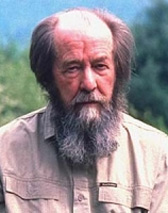
Aleksandr Soljenitsin
Russian novelist and historian awarded the 1970 Nobel Prize in Literature. His books One Day in the Life of Ivan Denisovich, Cancer Ward, The First Circle, and The Gulag Archipelago examined Soviet political repression, imprisonment, and the experiences of individuals under Stalinist rule.
Born on December 11, 1918
Died on August 3, 2008
Age at death: 90
Profession: Novelist, Historian, Poet
Place of Birth: Kislovodsk, Russian Soviet Federative Socialist Republic (present-day Russia)
Place of Death: Moscow, Russia
Aleksandr Solzhenitsyn (December 11, 1918 – August 3, 2008), born Aleksandr Isayevich Solzhenitsyn, was a Russian novelist, historian, essayist, and political dissident who received the Nobel Prize in Literature in 1970. A former officer in the Soviet Army, he was arrested in 1945 for criticizing Joseph Stalin in private correspondence and spent eight years in Soviet prisons and labor camps, followed by internal exile. His experiences provided material for One Day in the Life of Ivan Denisovich (1962), The First Circle (1968), Cancer Ward (1968), and The Gulag Archipelago (1973–1975), a documentary-literary investigation of the Soviet system of political imprisonment. Following the publication of The Gulag Archipelago abroad, Soviet authorities revoked his citizenship and expelled him from the country in February 1974. He lived in Switzerland and the United States before returning to Russia in 1994. His later writings included The Red Wheel, a series of historical novels examining the events surrounding the Russian Revolution, and essays on Russian history, politics, and society.
Early Life and Family Background
Aleksandr Solzhenitsyn was born on December 11, 1918, in Kislovodsk, in the northern Caucasus region of Russia. His father, Isaaky Solzhenitsyn, was a Russian Army officer who died in a hunting accident several months before his son's birth.
His mother, Taisiya Shcherbak, came from a family of Ukrainian Cossack background. After her husband's death, she raised Aleksandr under difficult financial circumstances.
In 1924, mother and son moved to Rostov-on-Don, where Solzhenitsyn attended school and developed an interest in Russian literature, history, and mathematics.
Although his family faced economic difficulties, his mother encouraged his education. During his childhood, he read works by Russian writers including Leo Tolstoy, Fyodor Dostoevsky, and Alexander Pushkin.
He also developed an early interest in writing historical fiction, particularly works dealing with the Russian Revolution and the years preceding it.
University Education and Literary Interests
In 1936, Aleksandr Solzhenitsyn entered Rostov State University, where he studied mathematics and physics.
At the same time, he pursued his interest in literature through independent reading and writing. In 1939, he enrolled in correspondence courses at the Moscow Institute of Philosophy, Literature and History.
He completed his degree in mathematics and physics at Rostov in 1941. His literary studies in Moscow were interrupted by the outbreak of war between Nazi Germany and the Soviet Union.
During his university years, he began planning an extensive historical narrative about the Russian Revolution. This project eventually developed into The Red Wheel, which occupied much of his later writing career.
Military Service During World War II
Following the German invasion of the Soviet Union in June 1941, Aleksandr Solzhenitsyn was called into the Red Army.
He initially performed transportation duties before receiving artillery training in 1942.
He subsequently became an officer commanding a sound-ranging battery, a military unit responsible for identifying enemy artillery positions through acoustic measurements.
During World War II, he served on the Eastern Front and participated in military operations against German forces.
He was promoted to captain in 1944 and received military decorations, including the Order of the Red Star and the Order of the Patriotic War.
Despite his military service, Solzhenitsyn became increasingly critical of Soviet political leadership and the conduct of the war.
In private correspondence, he criticized Joseph Stalin and questioned decisions made by the Soviet government. He also argued that Stalin's policies had contributed to the scale of the catastrophe suffered by the Soviet population during the war.
Arrest and Imprisonment in 1945
On February 9, 1945, Aleksandr Solzhenitsyn was arrested while serving in East Prussia.
Soviet military counterintelligence had intercepted letters he had written to a fellow officer, Nikolai Vitkevich, containing criticism of Stalin and the Soviet political system.
He was charged under Article 58 of the Soviet criminal code, which covered alleged counterrevolutionary activity and anti-Soviet agitation.
In July 1945, he received an eight-year sentence in a Soviet labor camp, followed by permanent internal exile.
He spent the early years of his imprisonment in several institutions, including a special prison near Moscow where scientists, engineers, and technically trained prisoners were assigned to research projects.
This type of institution was known as a Sharashka. His experiences in one such prison later provided the setting for his novel The First Circle.
Labor Camps in Kazakhstan
In 1950, Aleksandr Solzhenitsyn was transferred to a special labor camp at Ekibastuz, in present-day Kazakhstan.
He remained there until his release from imprisonment in 1953.
Prisoners were assigned physically demanding work under strict supervision. Solzhenitsyn worked on construction projects and in industrial facilities, including a machine shop.
The camp experience exposed him to prisoners from different social backgrounds, including political detainees, former soldiers, intellectuals, and people imprisoned under Soviet security legislation.
He later incorporated accounts of forced labor, interrogation, hunger, punishment, and relations among prisoners into his literary works.
The fictional prisoner Ivan Denisovich Shukhov, the central character of his first published major work, was partly drawn from these experiences.
Internal Exile and Cancer Treatment
After completing his prison sentence in February 1953, Aleksandr Solzhenitsyn was sent into permanent internal exile in the village of Kok-Terek, Kazakhstan.
He worked as a mathematics and physics teacher while continuing to write privately.
During this period, he was diagnosed with cancer and underwent treatment in Tashkent, in the Uzbek Soviet Socialist Republic.
His experiences with illness and hospital treatment later became material for Cancer Ward, a novel examining relationships among patients and the broader conditions of Soviet society.
Following the death of Joseph Stalin in March 1953 and the political changes introduced under Nikita Khrushchev, Soviet authorities began reviewing some convictions imposed during the Stalin era.
Solzhenitsyn was released from exile in 1956 and officially rehabilitated in 1957.
He subsequently settled in central Russia, teaching mathematics and physics in Ryazan while continuing his literary work.
One Day in the Life of Ivan Denisovich
In November 1962, Aleksandr Solzhenitsyn published One Day in the Life of Ivan Denisovich in the Soviet literary magazine Novy Mir.
The novella portrays a single day in the life of a prisoner in a Soviet forced-labor camp.
Its narrative follows Ivan Denisovich Shukhov through routine camp activities, including roll calls, work assignments, food distribution, and interactions with fellow prisoners.
The publication was authorized during the period of de-Stalinization associated with Nikita Khrushchev.
The work was read widely in the Soviet Union and subsequently translated into numerous languages.
It provided Soviet readers with a literary depiction of the labor camp system based on the experiences of a former prisoner.
In 1963, Solzhenitsyn published additional stories, including Matryona's Home and An Incident at Krechetovka Station.
Censorship and Conflict with Soviet Authorities
After Nikita Khrushchev was removed from power in October 1964, Soviet cultural policy became increasingly restrictive.
Aleksandr Solzhenitsyn encountered growing difficulties publishing his writing through official Soviet channels.
In 1965, Soviet security officers seized manuscripts and documents belonging to him during a search of an associate's apartment.
His later novels were rejected by Soviet publishers, and his works began circulating unofficially through Samizdat, a system of privately reproduced and distributed manuscripts.
He continued writing and appealed publicly for an end to literary censorship.
In 1967, he addressed an open letter to the Fourth Congress of the Union of Soviet Writers, criticizing restrictions imposed on writers.
In November 1969, he was expelled from the Union of Soviet Writers, removing him from the principal professional organization for authors in the Soviet Union.
The First Circle and Cancer Ward
During the 1960s, Aleksandr Solzhenitsyn completed two novels based partly on his experiences of imprisonment and illness.
The First Circle, published abroad in 1968, is set in a special Soviet prison where educated prisoners are assigned to scientific and technical work.
The novel examines the ethical choices of prisoners, scientists, government officials, and individuals working within a system of political repression.
Its title refers to the first circle of Hell in The Divine Comedy by Dante Alighieri.
Cancer Ward, also published abroad in 1968, takes place in a Soviet hospital during the period following Stalin's death.
The novel follows patients and medical workers whose different personal histories reveal aspects of Soviet political and social life.
Both books circulated internationally while remaining unavailable through normal Soviet publishing channels for many years.
1970 Nobel Prize in Literature
In October 1970, the Swedish Academy announced that Aleksandr Solzhenitsyn had been awarded the Nobel Prize in Literature.
The Swedish Academy recognized his treatment of ethical and historical questions within the traditions of Russian literature.
The award generated international attention, but Soviet authorities criticized the decision and accused the writer of participating in anti-Soviet political activities.
Solzhenitsyn did not travel to Stockholm for the December 1970 ceremony because he feared that the Soviet government would prevent him from returning home.
Efforts to arrange a private presentation of the prize in Moscow were unsuccessful.
His Nobel lecture was published in 1972, while he remained in the Soviet Union.
After his expulsion from the country, he traveled to Stockholm on December 10, 1974, and personally received his Nobel medal and diploma from Carl XVI Gustaf, King of Sweden.
The Gulag Archipelago
Between 1958 and 1968, Aleksandr Solzhenitsyn worked on The Gulag Archipelago, a documentary and literary investigation of Soviet political imprisonment from 1918 to 1956.
The work combined his personal experiences with testimony from former prisoners, historical documents, descriptions of interrogation procedures, and accounts of life in Soviet labor camps.
It examined the creation and expansion of the Soviet security and penal system, including arrests, forced confessions, deportations, prison conditions, and forced labor.
Solzhenitsyn collected material from numerous former prisoners while attempting to keep the manuscript hidden from Soviet authorities.
The first volume was published in Paris by YMCA Press in December 1973. The remaining volumes appeared in 1974 and 1975.
After publication, the Soviet press condemned the author, while the book received extensive international attention.
The work contributed to international debates about political repression in the Soviet Union. Its reception also generated disagreements concerning the author's interpretations, historical estimates, and political conclusions.
Arrest and Expulsion from the Soviet Union
On February 12, 1974, Aleksandr Solzhenitsyn was arrested by Soviet authorities following the publication of The Gulag Archipelago abroad.
He was accused of treason, stripped of his Soviet citizenship, and expelled from the country.
On February 13, he was transported to Frankfurt in West Germany.
He subsequently moved to Switzerland, settling in Zurich, where he continued writing and organizing the publication of his manuscripts.
His wife and children joined him there in March 1974.
In December 1974, he traveled to Sweden to receive the Nobel Prize in Literature that had been awarded to him four years earlier.
Exile in the United States
In 1976, Aleksandr Solzhenitsyn moved with his family to Cavendish, Vermont, in the northeastern United States.
He lived on a secluded property where he concentrated on writing and historical research.
During these years, he continued developing The Red Wheel, a multivolume historical narrative dealing with the Russian Empire, the First World War, and the events that led to the 1917 revolutions.
The series included August 1914, November 1916, March 1917, and April 1917.
He also wrote political and historical essays addressing Soviet communism, Russian national identity, Western political institutions, and the relationship between religion and public life.
In 1978, he delivered a speech at Harvard University titled A World Split Apart. In the address, he criticized aspects of Western consumer culture, political thinking, and the influence of materialism.
His criticisms of both Soviet communism and Western society generated debate among intellectuals and political commentators.
Political and Historical Writings
Outside his fictional works, Aleksandr Solzhenitsyn wrote extensively about the political and historical development of Russia.
In Letter to the Soviet Leaders (1974), he addressed the Soviet leadership directly, discussing political power, national traditions, and the future direction of the country.
The Oak and the Calf (1975) described his experiences as a writer confronting Soviet censorship and publishing restrictions.
His essay The Mortal Danger (1980) examined Western assumptions about Soviet ideology and foreign policy.
After the political reforms introduced by Mikhail Gorbachev, he published Rebuilding Russia (1990), proposing changes to Russia's political and administrative structure.
He subsequently addressed Russian history and national identity in The Russian Question at the End of the Twentieth Century (1995).
In 2001 and 2002, he published Two Hundred Years Together, a two-volume historical study of relations between Russians and Jews from the late eighteenth century through the twentieth century.
The book generated controversy over its interpretations of Jewish participation in Russian political and economic history, particularly its treatment of the revolutionary period.
Restoration of Citizenship and Return to Russia
During the period of political reform under Mikhail Gorbachev, Soviet authorities began reconsidering the official treatment of Aleksandr Solzhenitsyn and his writings.
His Soviet citizenship was restored in 1990, and the legal measures associated with his expulsion were subsequently reversed.
In May 1994, after approximately twenty years abroad, he returned to Russia with his family.
He entered the country through Vladivostok and traveled westward across Russia, meeting residents and speaking publicly about political and social conditions.
He eventually settled in the Moscow region, where he continued writing and participating in public discussions.
He criticized political corruption, the economic disruption of the post-Soviet transition, and the concentration of wealth among powerful business interests.
His views sometimes brought him into disagreement with Russian political leaders and with advocates of rapid economic liberalization.
Later Recognition
In 1997, Aleksandr Solzhenitsyn was elected a member of the Russian Academy of Sciences.
He continued publishing historical studies, memoirs, and essays during the final decade of his life.
In 2007, he received the Russian State Prize for achievements in the humanities. President Vladimir Putin visited him to present the award.
Although Solzhenitsyn supported some measures undertaken by Putin's administration, he also maintained independent positions on Russian history, national identity, and political institutions.
Personal Life
Aleksandr Solzhenitsyn married Natalya Reshetovskaya, a fellow student at Rostov University, in April 1940.
The couple divorced during his years of imprisonment and remarried in 1957 after his release from exile. Their second marriage ended in divorce in 1972.
In 1973, Solzhenitsyn married Natalya Svetlova, a mathematician who had assisted him with his literary work.
They had three sons, Yermolai, Ignat, and Stepan. He also became stepfather to Svetlova's son Dmitri from her earlier marriage.
Natalya Svetlova participated in preserving and organizing his manuscripts, particularly during the years when Soviet authorities restricted publication of his works.
The couple remained married until his death in 2008.
Death
Aleksandr Solzhenitsyn died of heart failure on August 3, 2008, at his home near Moscow, Russia, at the age of 89.
His funeral was attended by family members, writers, religious representatives, and government officials.
He was buried at the Donskoy Monastery in Moscow on August 6, 2008.
Selected Books and Publications
1962 – One Day in the Life of Ivan Denisovich
1963 – Matryona's Home
1963 – An Incident at Krechetovka Station
1963 – For the Good of the Cause
1968 – Cancer Ward
1968 – The First Circle
1969 – The Love-Girl and the Innocent (Play)
1971 – August 1914 (First part of The Red Wheel)
1973–1975 – The Gulag Archipelago (Three volumes)
1974 – Prussian Nights
1974 – Letter to the Soviet Leaders
1975 – The Oak and the Calf
1975 – Lenin in Zurich
1980 – The Mortal Danger: How Misconceptions about Russia Imperil America
1983 – November 1916 (Part of The Red Wheel)
1980s – Victory Celebrations (Play, English-language editions)
1980s – The Prisoners (Play, English-language editions)
1990 – Rebuilding Russia
1995 – March 1917 (Part of The Red Wheel)
1995 – April 1917 (Part of The Red Wheel)
1995 – The Russian Question at the End of the Twentieth Century
1996 – The Invisible Allies
1998 – Russia in Collapse
2000 – One Day in the Life of Ivan Denisovich (Additional translated editions)
2000 – An Incident at Krechetovka Station and Matryona's Home (Collected editions)
2001–2002 – Two Hundred Years Together: 1795–1995 (Two volumes)
Source: Biyografiler.com
Frequently asked questions about Aleksandr Soljenitsin
Who is Aleksandr Soljenitsin?, Aleksandr Soljenitsin biography, Aleksandr Soljenitsin life story, Aleksandr Soljenitsin age, Aleksandr Soljenitsin facts, Aleksandr Soljenitsin birthplace, Aleksandr Soljenitsin photos, Aleksandr Soljenitsin videos, Aleksandr Soljenitsin career
Related Biographies

Lamine Yamal
Professional footballer

Kylian Mbappe
Professional footballer

Erling Haaland
Professional footballer

Keanu Reeves
Actor

Ronaldinho
Professional footballer

Bad Bunny
Rapper, Songwriter

Andre Gide
Novelist, Essayist

Andreas Papandreu
Former Prime Minister, Politician, Economist

Andrea Mantegna
Painter

Andrea del Verrocchio
Sculptor, Painter

Andrea del Sarto
Painter

Andrea Bargnani
Former Professional Basketball Player

Elizabeth Taylor
Actress

Sam Altman
Entrepreneur, Investor, CEO

Alan Jones
Formula 1 Driver
Lamine Yamal
Professional footballer

Susie Wiles
Political Consultant

Colman Domingo
Actor, Director, Producer