
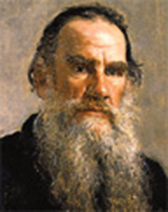
Leo Tolstoy
The author of the monumental novels War and Peace and Anna Karenina, one of the greatest masters of Russian and world literature.
Born on September 9, 1828
Died on November 20, 1910
Age at death: 82
Profession: Novelist, Philosopher
Place of Birth: Tula Province, Russian Empire
Place of Death: Astapovo, Russian Empire
Count Lev Nikolayevich Tolstoy was one of the greatest masters of Russian literature and the author of two of the most influential works of the nineteenth century, War and Peace and Anna Karenina. Born into an aristocratic family, he became a literary genius whose influence extended far beyond Russia and deeply shaped Western literature.
Lev Nikolayevich Tolstoy was born on September 9, 1828, in the Tula region of Russia, on the vast estates owned by his family. The Tolstoy family was an aristocratic lineage that produced many influential figures throughout Russian history. One of his ancestors served as a minister under Tsar Peter the Great. His nephew, Count Aleksey Konstantinovich Tolstoy, gained fame as a poet and playwright with works such as The Death of Ivan the Terrible. On his mother’s side, his grandfather Prince Nikolai Volkonsky was commander-in-chief of the armies of Empress Catherine the Great.
Being born into immense wealth and privilege might suggest a life of comfort and peace. As the owner of vast lands, the fate of hundreds of peasants rested on his decisions. He could easily have joined the glittering court life or entered the elite circles of St. Petersburg society. Yet from an early age, Tolstoy sought happiness not in luxury, but in spirituality and moral truth.
Tolstoy lost his mother before the age of six and his father at nine. He was raised with affection by relatives and siblings, forming a particularly strong bond with his aunt Tatyana Volkonskaya. Even as a child, his personality was full of contradictions: deep religious intensity mixed with a lively love of life. Though born an aristocrat, he never took pride in his noble status and instead regarded himself as a peasant at heart.
He was deeply troubled by his physical appearance and considered himself unattractive. To conceal this, he grew a beard from his youth. When his fame spread across Russia and Europe, admirers who expected a tall, majestic genius were often surprised to find a short, stocky man. Yet his piercing gaze beneath thick eyebrows captivated all who met him.
Tolstoy’s eyes hide hundreds of eyes. — Maxim Gorky
During his school years in St. Petersburg, Tolstoy was exposed to the carefree and irresponsible life of high society, yet he always strove to maintain moral integrity. At the age of twenty-two, in 1851, he faced a crucial decision: to return home and manage the family estates or to enter government service. Unable to choose, he made an unexpected decision.
Rejecting both paths, he joined his brother Nikolai Tolstoy, an officer in the Tsarist army, and went to the Caucasus, where Russian forces were suppressing regional uprisings. He voluntarily participated in military raids on mountain villages. Drawing on these experiences, he wrote his first major work, The Raid. Even in this early work, his narrative power and poetic mastery attracted the attention of major writers and critics.
Before The Raid, an autobiographical work titled Childhood had already been published in a St. Petersburg journal, signaling his immense potential. Later, he began writing his first major novel, The Cossacks, though it would not be published until 1863. His reputation grew further with Sevastopol Sketches, based on the Crimean War.
This young writer will overshadow us all. We might as well stop writing. — Ivan Turgenev
Military life never brought Tolstoy happiness. Witnessing the horrors of war, he developed a deep hatred for violence and began questioning the true meaning of life. At the age of twenty-six, in March 1855, he wrote in his diary:
I have a great idea that will astonish mankind… to create a new religion suitable for human development… a practical religion that ensures happiness on earth.
It would take another twenty-four years before he fully committed himself to realizing this vision. After leaving the army, Tolstoy lived briefly in St. Petersburg, traveled across Europe, and eventually returned to his estate at Yasnaya Polyana, where he devoted himself to managing his lands and observing peasant life.
He later founded a school at Yasnaya Polyana using radical educational methods: attendance was voluntary, there were no punishments or rewards, and children learned freely. Due to declining health and police suspicion, this experiment lasted only a year.
The years between 1862 and 1876 were the calmest and happiest of his life. In 1862, he married Sofia Behrs in a love match. Shortly afterward, he began writing War and Peace, widely regarded as one of the greatest novels ever written.
In 1873, Tolstoy began Anna Karenina. Despite personal tragedies and emotional turmoil, the novel emerged as an undeniable masterpiece, offering psychological depth rivaled only by William Shakespeare.
In his later years, Tolstoy fully embraced his moral and spiritual ideals. Works such as The Power of Darkness, The Kreutzer Sonata, and Resurrection reflect his commitment to ethical reform. He simplified his life, striving to live as a peasant.
In the final year of his life, Tolstoy left his home and family, seeking solitude among ordinary people. He fell ill during a train journey and died on November 20, 1910, at the age of eighty-two.
Major Works
Childhood
Boyhood
Youth
Sevastopol Sketches
The Cossacks
War and Peace
What Men Live By
The Death of Ivan Ilyich
Anna Karenina
The Kreutzer Sonata
Resurrection
Hadji Murat
Father Sergius
Master and Man
The Raid
The Wood Felling
Notes of a Billiard Marker
Two Hussars
After the Ball
Source: Biyografiler.com
Frequently asked questions about Leo Tolstoy
Who is Leo Tolstoy?, Leo Tolstoy biography, Leo Tolstoy life story, Leo Tolstoy age, Leo Tolstoy facts, Leo Tolstoy birthplace, Leo Tolstoy photos, Leo Tolstoy videos, Leo Tolstoy career
Related Biographies

Lamine Yamal
Professional footballer

Erling Haaland
Professional footballer

Kylian Mbappe
Professional footballer

Austin Abrams
Actor

Bad Bunny
Rapper, Songwriter

Sam Altman
Entrepreneur, Investor, CEO


Hongjoong
Singer, Rapper, Songwriter, Composer

Ludacris
Rapper, Actor

Kwon Eunbi
Singer

Sarah Wayne Callies
Actress, Screenwriter, Producer, Director

LaTavia Roberson
Singer, Actress, Entrepreneur

Amber Heard
Actress, Model
Lamine Yamal
Professional footballer
Bad Bunny
Rapper, Songwriter
Erling Haaland
Professional footballer
Kylian Mbappe
Professional footballer
Austin Abrams
Actor