
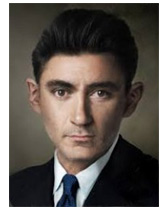
Franz Kafka
Born on July 3, 1883
Died on June 3, 1924
Age at death: 41
Profession: Writer, Novelist
Place of Birth: Prague, Bohemia (Austro-Hungarian Empire)
Place of Death: Kierling, near Vienna, Austria
Franz Kafka did not regard writing as a profession during his lifetime, yet he became one of the most influential modernist writers of the twentieth century. His stories and novels depict bureaucracy, alienation, guilt, and existential anxiety in a distinctive and unsettling literary style.
Franz Kafka was born on July 3, 1883, in Prague, as the first child of a father who had risen from the rural Czech proletariat to become a prosperous merchant, and a mother who was an educated German-speaking Jewish woman. His father, Hermann Kafka, was a strong-willed and dominant businessman. Kafka’s introverted and anxious personality was largely inherited from his mother, Julie Kafka, who possessed greater cultural refinement than her husband. His grandfather, Jacob Kafka, was a butcher who had moved to Prague from Osek. The family lived in Bohemia, a region largely populated by German-speaking Jews.
Kafka was the eldest of six children. His two younger brothers, Georg and Heinrich, died before Kafka reached the age of six. He also had three sisters named Gabriele, Valerie, and Ottilie. Both parents spent most of their time working, and his mother often worked more than twelve hours a day to support the family business. As a result, Kafka and his siblings were largely raised by nannies and servants. His three sisters later perished during the Holocaust organized by Nazi Germany.
Kafka experienced a deeply troubled childhood, particularly due to his strained relationship with his father. The pressure and emotional dominance exerted by Hermann Kafka began in childhood and persisted throughout Kafka’s life. His writings clearly reflect the resentment and fear he felt toward his father. Speaking German alienated him from Czechs, while his Jewish identity caused Germans to reject him as well.
Although German was his native language, Kafka also spoke Czech fluently. Later in life, he developed a strong interest in French language and culture, admiring French writers, especially Gustave Flaubert. Due to family dynamics and social pressures, Kafka grew up feeling isolated from his surroundings. As a result of his family’s efforts to integrate into German society in Prague, he attended German schools.
In 1889, he enrolled at the Deutsche Knabenschule in Fleischmarkt. Influential figures during this period included his French governess Bailly and the family servant Marie Werner. In 1893, he began attending the Austrian Gymnasium, an experience that intensified his loneliness and introversion. His religious education was minimal and limited to occasional synagogue visits with his father.
After graduating from Altstädter Gymnasium in 1901, Kafka enrolled at the Charles Ferdinand University in Prague, initially studying chemistry before switching to law within two months. Alongside law, he attended courses in German literature and art history. During his university years, he organized reading sessions in student clubs. It was during this period that he met his lifelong friend Max Brod and journalist Felix Weltsch. His first literary work, Description of a Struggle, was written during these years.
Through Brod, Kafka met several prominent literary figures, including Oskar Baum, Gustav Janouch, and Franz Werfel. After earning his doctorate in law on June 18, 1906, he completed a year-long internship. In 1907, Kafka began working as a clerk at the Italian insurance company Assicurazioni Generali. He worked during the day and wrote at night. That same year, he wrote Wedding Preparations in the Country.
Between 1908 and 1912, Kafka became increasingly interested in political and social issues and attended meetings of prominent Czech politicians. He also began studying Hebrew and exploring Jewish identity. During this period, he traveled with Max Brod to Riva, Paris, Weimar, and Italy. Between 1912 and 1919, Kafka was engaged three times to Felice Bauer, yet never married her. Their relationship resulted in more than five hundred letters, later published in 1967 as Letters to Felice.
In 1914, while breaking off his second engagement to Felice Bauer, Kafka was writing The Trial. That same year, he completed In the Penal Colony. Although World War I had begun, Kafka was not drafted due to his fragile health. During this period, he began to gain recognition as a writer. In 1915, Carl Sternheim requested that the Fontane Prize awarded to him be transferred to Kafka.
In 1920, Kafka met Milena Jesenská, the woman with whom he experienced his most intense emotional relationship. Milena initially contacted Kafka to request permission to translate his works into Czech. Their correspondence evolved into a passionate yet impossible love, as Milena was married. They met only a few times over three years. Milena later entrusted these letters to Willy Haas for publication and died in a concentration camp in 1944.
As Kafka’s health deteriorated, he requested early retirement in 1922. In 1923, he moved to Berlin to escape his family’s influence and focus on writing. There, he shared a brief period of happiness with Dora Diamant. On June 3, 1924, Kafka died of lung disease in the Kierling sanatorium near Vienna, where he had first been hospitalized in 1917.
Before his death, Kafka entrusted his unpublished manuscripts to his close friend Max Brod, requesting that they be burned. Brod ignored this wish and published Kafka’s works posthumously, securing Kafka’s lasting literary legacy. Many of Kafka’s documents were later destroyed during the Nazi occupation of Czechoslovakia.
Kafka’s life was marked by familial oppression, particularly his relationship with his father. His short story The Judgment (1912) reflects this tension. That same year, he wrote his most famous work, The Metamorphosis. His first novel, The Man Who Disappeared, initially published as The Missing Person, was later released under the title America. His unfinished novel The Castle remains one of the most significant works of modern literature.
Selected Aphorisms
The true path goes along a rope that is not stretched high, but just above the ground. It seems designed more to trip one than to be walked upon.
From a certain point onward there is no longer any turning back. That is the point that must be reached.
You do not need to leave your room. Remain sitting at your table and listen. Do not even listen, simply wait.
Major Works
The Trial
The Castle
The Man Who Disappeared (America)
The Metamorphosis
In the Penal Colony
Description of a Struggle
Wedding Preparations in the Country
The Judgment
A Hunger Artist
Letters to Milena
Letter to His Father
Diaries
Aphorisms
Source: Biyografiler.com
Frequently asked questions about Franz Kafka
Who is Franz Kafka?, Franz Kafka biography, Franz Kafka life story, Franz Kafka age, Franz Kafka facts, Franz Kafka birthplace, Franz Kafka photos, Franz Kafka videos, Franz Kafka career

Lamine Yamal
Professional footballer

Erling Haaland
Professional footballer

Andrew Garfield
Actor

Sam Altman
Entrepreneur, Investor, CEO

Kylian Mbappe
Professional footballer

Khabib Nurmagomedov
Professional Boxer

Hoyt Richards
Model, Actor

Dieter Schwarz
Businessperson, Entrepreneur

Giovanni Ferrero
Businessperson

Cynthia Erivo
Singer, Actress, Songwriter, Producer

Mike Markkula
Businessperson, Entrepreneur

Carol Burnett
Actress, Singer
Lamine Yamal
Professional footballer

Scott Bessent
Politician, Investor
Sam Altman
Entrepreneur, Investor, CEO
Erling Haaland
Professional footballer
Kylian Mbappe
Professional footballer

Tom Holland
Actor