
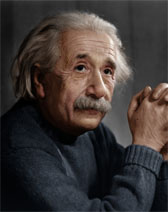
Albert Einstein
Born on March 14, 1879
Died on April 18, 1955
Age at death: 76
Profession: Theoretical Physicist
Place of Birth: Württemberg, Germany
Place of Death: Princeton, United States
Albert Einstein is one of the most influential scientists in the formation of modern physics. One of his most well-known theories is the Theory of Relativity, which caused major debates during its time and fundamentally reshaped the concepts of space and time. He was awarded honorary doctorates in the fields of physics, medicine, and philosophy by many universities across Europe and America. In 1921, Einstein received the Nobel Prize in Physics and was honored with numerous awards and medals, including the Copley Medal (1925) and the Franklin Medal (1935). In addition, he was named “Person of the Century” in a poll conducted by Time magazine.
Albert Einstein was born on March 14, 1879, in Württemberg, Germany. In June 1880, his family moved to Munich. His father Hermann Einstein and his uncle Jakob Einstein founded an electrical engineering company called Einstein & Cie there. Apart from beginning to speak later than usual, Einstein had a relatively normal childhood. In 1884, he received private tutoring, and in 1885 he began taking violin lessons. Despite being Jewish, he started his education the same year at a Catholic school in Munich. In 1888, he continued his studies at the Luitpold Gymnasium in the same city. He did not enjoy the rigid structure of formal education. In 1894, due to his family’s bankruptcy, they moved to Italy.
Einstein applied to what is now known as ETH Zürich (Swiss Federal Polytechnic Institute), but after failing the entrance examination, he continued his education in Aarau, Switzerland. He realized that he would not become an electrical engineer as his father had hoped. Two years later, in 1896, he enrolled at the Swiss Federal Polytechnic Institute to study mathematics and physics with the aim of becoming a teacher. During this period, he studied James Clerk Maxwell’s Electromagnetic Theory. At the institute, he met Mileva Marić, the only female student at the school. He introduced her to his family with the intention of marriage, but his mother opposed the union because Mileva was older and not Jewish. When Mileva became pregnant out of wedlock, they were forced to give their daughter up for adoption.
Albert Einstein graduated in June 1900. On February 21, 1901, he applied for Swiss citizenship and was accepted. From May 1901 to July 1902, he worked as a private tutor in Winterthur and Schaffhausen. Due to his young age, his applications for teaching positions were repeatedly rejected. He then moved to Bern, the capital of Switzerland, where he continued to give lessons in mathematics and physics to earn a living. During this time, he joined the Bern-based Akademie Olympia, where he had the opportunity to meet many scientists, an experience that became a significant step in his career. Shortly afterward, he began working as a technical assistant at the Swiss Patent Office. There, Einstein examined inventions submitted for patents, inspected electromagnetic devices, and analyzed their weaknesses and differences, often redesigning them to such an extent that they nearly became his own creations.
On January 6, 1903, despite strong opposition from their families, Albert Einstein married Mileva Marić, whom he had met during his school years. Sharing many intellectual interests with Mileva, who was also a mathematician, he built a family life alongside his scientific pursuits. In 1904, their first son Hans Albert Einstein was born, followed by their second son Eduard Einstein in 1910. In later years, Eduard was diagnosed with schizophrenia and was hospitalized in a psychiatric institution in Zürich, where he eventually passed away. In his later life, Albert Einstein served as a professor at the University of California.
By 1903, Albert Einstein had begun to advance in his position at the Swiss Patent Office and had gained significant expertise in machine technology. At the same time, he was studying Max Planck’s quantum theory. In 1905, he submitted his doctoral dissertation titled A New Determination of Molecular Dimensions at the University of Zürich and earned his doctorate. That same year, he began publishing the groundbreaking papers that laid the foundations of modern physics. Known collectively as the Annus Mirabilis Papers, these works sparked widespread debate in scientific circles. Three of these papers—on Brownian Motion, the Photoelectric Effect, and Special Relativity—were nominated for the Nobel Prize.
After extensive deliberations within the Nobel Committee, Albert Einstein was awarded the 1921 Nobel Prize in Physics for his work titled The Photoelectric Effect. In this study, he explored quantum physics and developed his hypothesis on light particles, or photons. He used alkali metals with loosely bound outer electrons to demonstrate how electrons could be ejected from a surface and formulated the equation “hv = k + w” to calculate photon energy. Another key paper, On the Electrodynamics of Moving Bodies, explained the principles governing the motion of objects at constant velocities in different reference frames. This was followed by Does the Inertia of a Body Depend upon its Energy Content?, in which he introduced the famous equation “E = m.c².” In 1906, he published his final major work of this period, Planck’s Theory of Radiation and the Theory of Specific Heat.
|
In 1908, Albert Einstein was appointed as a lecturer in Bern. By 1909, he began working as a professor at the University of Zürich. After spending a period teaching at Charles University in Prague, he returned to his position in Zürich in 1912. Following the outbreak of the First World War in 1914, he continued his academic career in Berlin as a professor at a local university. During this period, he became a member of the Prussian Academy of Sciences and applied for Prussian citizenship. From 1914 until 1933, he served as the director of the Kaiser Wilhelm Institute for Physics. In addition, between 1920 and 1946, he continued his studies at Leiden University with the title of extraordinary professor.
In 1917, Albert Einstein published his paper titled On the Quantum Mechanics of Radiation. In 1919, he divorced Mileva Marić and later married his cousin Elsa Löwenthal. Elsa remained by Einstein’s side during his later years, but the couple had no children. While serving at the Prussian Academy of Sciences in 1915, Einstein formulated the General Theory of Relativity. Drawing upon Isaac Newton’s laws of gravitation, he developed his own theory. Due to the conditions of the First World War, his publications could not initially reach audiences outside Germany. Einstein’s new theory was brought to wider attention by Hendrik Antoon Lorentz and Paul Ehrenfest. Many astronomers in England initially found the theory unconvincing. However, observations made during the solar eclipse of 1917 and the analysis of eclipse photographs in the following year demonstrated the validity of the theory. Einstein argued that mass geometrically curves space-time, causing the light from distant stars to bend, and that this curvature should be concave. This theory created a major impact within the scientific world.
In 1921, Albert Einstein traveled to New York to work further on his theories. In 1933, due to the racist policies of Adolf Hitler, he renounced his German citizenship and emigrated to the United States, where he later became a citizen. In the United States, he continued his academic life and research as a professor at the Institute for Advanced Study at Princeton University. He retired from Princeton University in 1945. In 1926, he also collaborated with Leo Szilard on a refrigerator project designed to operate without producing poisonous gases.
In 1933, after the National Socialist Party came to power in Germany and restrictive laws prevented many scientists from continuing their work, Albert Einstein wrote a letter to Mustafa Kemal ATATÜRK on behalf of forty scientists, requesting that they be allowed to continue their studies in Turkey. Atatürk accepted this request and provided them with the opportunity to work at Istanbul University.
During this period, Albert Einstein was offered the position of Prime Minister of Israel, but he declined the offer. Together with Chaim Weizmann, he contributed to the establishment of the Hebrew University of Jerusalem.
In 1945, Albert Einstein wrote a letter to Franklin D. Roosevelt warning that nuclear weapons could be developed. In later years, he repeatedly expressed deep regret for his role in alerting the world to the possibility of nuclear weapons and for their subsequent development and use. For the remainder of his life, he maintained a strong stance against the use of atomic bombs and openly voiced his discomfort with nuclear armament.
In 1948, Albert Einstein served on the committee of Brandeis University. On April 18, 1955, he died at the age of 76 due to internal bleeding. His work titled Generalized Theory of Gravitation remained unfinished.
After his death, the autopsy was performed by Dr. Thomas Stoltz Harvey, who noticed unusual features in Einstein’s brain. He discovered that Einstein’s parietal lobe was approximately 15 percent larger than that of an average human. This region of the brain is associated with mathematical and visual abilities. Additionally, it was observed that Einstein’s brain was about 73 percent more folded than that of a typical human brain.
Albert Einstein’s scientific works, in chronological order, include: Special Theory of Relativity (1905), Relativity (English translations in 1920 and 1950), General Theory of Relativity (1916), Investigations on the Theory of Brownian Motion (1926), and The Evolution of Physics (1938). Among his non-scientific works, the most notable are Zionism (1930), Why War? (1933), and My Philosophy (1934).
Source: Biyografiler.com
Albert Einstein Photos


Frequently asked questions about Albert Einstein
Who is Albert Einstein?, Albert Einstein biography, Albert Einstein life story, Albert Einstein age, Albert Einstein facts, Albert Einstein birthplace, Albert Einstein photos, Albert Einstein videos, Albert Einstein career
Related Biographies

Lamine Yamal
Professional footballer

Kylian Mbappe
Professional footballer

Erling Haaland
Professional footballer

Sam Altman
Entrepreneur, Investor, CEO

Bad Bunny
Rapper, Songwriter

Brad Pitt
Actor


Hongjoong
Singer, Rapper, Songwriter, Composer

Ludacris
Rapper, Actor

Kwon Eunbi
Singer

Sarah Wayne Callies
Actress, Screenwriter, Producer, Director

LaTavia Roberson
Singer, Actress, Entrepreneur
Erling Haaland
Professional footballer

Tim Berners Lee
Computer Scientist, Professor

Amber Heard
Actress, Model

Tim Roth
Actor, Director

Vladimir Putin
Politician, , Head of State
Brad Pitt
Actor