
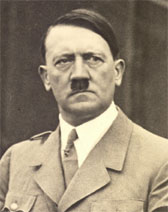
Adolf Hitler
Leader of Nazi Germany and Architect of the Third Reich
Born on April 20, 1889
Died on April 30, 1945
Age at death: 56
Profession: Politician, Dictator
Place of Birth: Braunau am Inn, Upper Austria, Austria-Hungary
Place of Death: Berlin, Germany
Adolf Hitler was an Austrian-born head of state and politician. As the leader of the National Socialist German Workers’ Party (NSDAP), commonly known as the Nazi Party, he became Chancellor of Germany in 1933. In 1934, he proclaimed himself Führer (leader) of Germany and, until his death in 1945, succeeded in mobilizing large segments of the German population behind him. Hitler believed in the supremacy of the German race and sought to unite all German-speaking peoples under a single state. In pursuit of this ideology, he orchestrated the mass murder of millions of Jews and members of other minority groups.
Adolf Hitler was born on April 20, 1889, in the small border town of Braunau am Inn in Upper Austria, near the German border. He was the third child of Alois Hitler (1837–1903) and Klara Pölzl (1860–1907). His mother Klara, a housewife, was Alois Hitler’s third wife and also his second cousin; their marriage required special permission from the church. The couple’s first two children, Gustav and Ida, died in infancy. Adolf’s younger brother Edmund survived only until the age of six. On January 21, 1896, his sister Paula Hitler was born.
Hitler’s father Alois, a customs official, also had two children—Alois Jr. and Angela—from his second marriage. Born out of wedlock, Alois had carried his mother’s surname, Schicklgruber, until the age of thirty-nine. After a parish priest verified that his stepfather was Johann Georg Hiedler (with Johann Nepomuk Hiedler as another possible candidate), Alois adopted the surname “Hiedler,” which later evolved into “Hitler.” Adolf Hitler would later be mocked by political opponents who claimed his real surname was Schicklgruber; during World War II, Allied propaganda leaflets bearing the slogan “Heil Schicklgruber” were even dropped over German cities.
Legally born with the surname Hitler, Adolf’s grandmother was named Johanna Hiedler. The name Adolf derives from Old German, meaning “noble wolf.” Within the family, he was called “Adi.” From the early 1920s until the collapse of the Third Reich, Hitler used the nickname “Wolf” among close associates, a name reflected in locations such as Wolfsschanze in East Prussia, Wolfsschlucht in France, and Werwolf in Ukraine.
Due to his father’s frequent job transfers, Hitler attended several primary schools, moving from Braunau to Passau, then Lambach, Leonding, and Linz. He was considered a successful pupil, particularly excelling in history and geography.
“I showed the greatest interest in history and geography. It was at this time that I became a ‘nationalist’ and learned to grasp the true meaning of history.”
At secondary school in Linz, Hitler had to repeat his first year. Contrary to his father’s wish that he pursue a civil service career, he resisted and aspired to become an artist.
“My speaking ability was not appreciated by my father. My family was worried about my behavior.”
Confident in his drawing skills, Hitler continued to pursue art. Before World War I, he had produced more than two thousand drawings and paintings.
Hitler’s father died of a stroke on January 3, 1903. Three years later, Adolf left school and moved into an orphan boarding house, supported by his mother, and began living a bohemian lifestyle.
“My father died suddenly when I was thirteen years old. A stroke ended his life.”
Hitler became seriously ill and, on medical advice, withdrew from school for nearly a year, during which he continued drawing.
“My lungs were badly diseased. The doctor advised my mother to keep me away from school for at least a year.”
In 1907, he applied to the Academy of Fine Arts Vienna but was rejected on the grounds that he lacked sufficient artistic talent and was advised to pursue architecture, which required formal qualifications he did not possess. That same year, on December 21, his mother died of advanced breast cancer.
“I was bound to my father by respect, and I loved my mother.”
After a second rejection from the academy in 1908, Hitler fell into poverty. He gave his share of the orphan’s pension to his sister Paula and, by 1909, was living in homeless shelters. He survived by selling postcard-style landscape paintings to shops and tourists and later moved into a dormitory for working poor men.
During his years in Vienna, Hitler developed antisemitic views, influenced by writers such as Lanz von Liebenfels and political figures including Karl Lueger and Georg Ritter von Schönerer. He later described this ideological transformation in his book Mein Kampf.
In May 1912, Hitler moved to Munich, which he regarded as the heart of true German culture.
“In the spring of 1912, I went to Munich. The city seemed familiar to me, as if I had lived there for years.”
When World War I broke out in August 1914, Hitler volunteered for the Bavarian Army after receiving permission from King Ludwig III of Bavaria. He served as a messenger with the 16th Bavarian Reserve Infantry Regiment in France and Belgium. For bravery, he was awarded the Iron Cross Second Class in December 1914 and the Iron Cross First Class in August 1918.
Despite his service, Hitler was never promoted beyond corporal, reportedly due to perceived leadership limitations or his lack of German citizenship. He was wounded in 1916 and temporarily blinded by a gas attack in October 1918.
The German surrender in November 1918 deeply shocked Hitler. He embraced the “stab-in-the-back” myth, blaming politicians, Marxists, and Jews for Germany’s defeat and the harsh terms of the Treaty of Versailles.
After the war, Hitler remained in Munich and worked for the Reichswehr as a political instructor. In 1919, he joined the German Workers’ Party (DAP), led by Anton Drexler, and soon became its most powerful speaker. Influenced by Dietrich Eckart, Hitler assumed leadership of the party in 1921, renaming it the National Socialist German Workers’ Party (NSDAP).
In 1923, Hitler attempted to seize power in the failed Beer Hall Putsch. He was sentenced to five years in prison but served less than one, during which he wrote Mein Kampf. Following his release, he pursued power through legal means.
Exploiting the economic crisis after the Great Depression, the Nazi Party gained mass support. In January 1933, President Paul von Hindenburg appointed Hitler Chancellor of Germany. After the Reichstag Fire in February 1933, Hitler secured emergency powers and passed the Enabling Act, granting him dictatorial authority.
By 1934, Hitler had consolidated absolute power, proclaiming himself Führer. He initiated massive rearmament programs, infrastructure projects, and aggressive expansionist policies. His regime enacted racial laws and carried out the Holocaust, resulting in the murder of approximately six million Jews and hundreds of thousands of Roma, disabled individuals, and others.
Seeking to unite all German-speaking peoples, Hitler annexed Austria, occupied Czechoslovakia, and invaded Poland in 1939, triggering World War II. Initial victories were followed by catastrophic defeats, especially after invading the Soviet Union and after the United States entered the war.
By April 1945, Soviet forces had encircled Berlin. Refusing evacuation, Hitler remained in the Führerbunker. On April 30, 1945, he committed suicide by gunshot while also ingesting cyanide. His wife Eva Braun, whom he had married the previous day, also took her own life.
Hitler’s body was burned by aides according to his wishes. Soviet forces later identified the remains through dental records. With Germany’s defeat and the collapse of the Nazi regime, Hitler and Nazism became universally condemned symbols of war, genocide, and totalitarian destruction.
Source: Biyografiler.com
Adolf Hitler Photos


Frequently asked questions about Adolf Hitler
Who is Adolf Hitler?, Adolf Hitler biography, Adolf Hitler life story, Adolf Hitler age, Adolf Hitler facts, Adolf Hitler birthplace, Adolf Hitler photos, Adolf Hitler videos, Adolf Hitler career
Related Biographies

Lamine Yamal
Professional footballer

Erling Haaland
Professional footballer

Austin Abrams
Actor

Keanu Reeves
Actor

Kylian Mbappe
Professional footballer

Bad Bunny
Rapper, Songwriter


Hongjoong
Singer, Rapper, Songwriter, Composer

Ludacris
Rapper, Actor

Kwon Eunbi
Singer

Sarah Wayne Callies
Actress, Screenwriter, Producer, Director

LaTavia Roberson
Singer, Actress, Entrepreneur
Erling Haaland
Professional footballer
Lamine Yamal
Professional footballer

Sadio Mane
Professional footballer
Keanu Reeves
Actor

Ma Huateng
Entrepreneur, Inventor

Giorgia Meloni
Politician, Journalist