
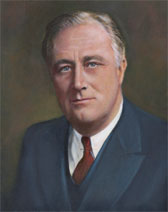
Franklin D. Roosevelt
Iconic Leader of the New Deal and World War II America
Born on January 30, 1882
Died on April 12, 1945
Age at death: 63
Profession: Politician, Lawyer, Statesman, Former President
Place of Birth: Hyde Park, New York, United States
Place of Death: Warm Springs, Georgia, United States
Franklin Delano Roosevelt was the 32nd President of the United States and the only president elected to office four times. Serving from 1933 to 1945, he led the nation through two of the greatest crises in its history: the Great Depression and World War II. He is widely regarded as one of the three greatest American presidents of all time, alongside Abraham Lincoln and George Washington.
Franklin Delano Roosevelt was born on January 30, 1882, in Hyde Park, New York. His mother, Sara Ann Delano, and his father, James Roosevelt, came from wealthy and aristocratic New York families; his father was of Dutch descent, while his mother had French roots. He was their only child. The 26th President of the United States, Theodore Roosevelt, belonged to the same extended family and was also the uncle of Roosevelt’s wife, Eleanor Roosevelt.
Roosevelt grew up in a highly privileged environment. His mother had a more dominant personality than his father. Frequent trips to Europe allowed him to become fluent in German and French. He developed interests in sports such as rowing, polo, and tennis.
At the age of 14, Roosevelt enrolled at the Groton School, a prestigious boarding school in Massachusetts. He was deeply influenced by the school’s headmaster, Endicott Peabody, who emphasized public service and helping those in need. In 1900, he entered Harvard University and graduated in 1904. During his undergraduate years, he lived in Adams House and was a member of the Alpha Delta Phi fraternity. While studying at Harvard, he witnessed his cousin Theodore Roosevelt assume the presidency, an experience that strongly shaped his views on leadership and inspired him to adopt him as a role model.
In 1905, Roosevelt entered Columbia Law School but left in 1907 after passing the New York State Bar examination. He began practicing law in New York and, in 1908, joined a prestigious Wall Street firm, specializing in corporate law.
During World War I, Franklin Delano Roosevelt served in various civilian roles within the U.S. Navy. From 1913 to 1917, he worked extensively on naval development. In March 1913, he was appointed Assistant Secretary of the Navy and played a key role in establishing the United States Naval Reserve. In 1918, he traveled to England and France to inspect American naval bases, where he met Winston Churchill. After the war ended in November 1918, he was responsible for overseeing demobilization, although he strongly opposed the full dismantling of the navy. He resigned from his naval post in June 1920.
Roosevelt entered elective politics in 1910 when he joined the New York State Senate, a body that had not elected a Democrat since 1884. He officially launched his political career on January 1, 1911, becoming the leader of a reformist faction opposing the long-dominant Democratic establishment. He quickly gained popularity among New York Democrats, was re-elected on November 5, 1912, and resigned from the Senate on March 17, 1913.
In 1913, President Woodrow Wilson appointed Roosevelt as Assistant Secretary of the Navy, where he served under Secretary Josephus Daniels. During this period, the United States intervened in Central America and the Caribbean. In his speeches during the 1920 vice-presidential campaign, Roosevelt claimed significant influence over U.S. policy in Latin America and even stated that he had personally drafted the constitution imposed on Haiti in 1915.
In 1920, Roosevelt was selected as the Democratic candidate for Vice President of the United States, but the ticket lost the election.
In 1921, Franklin Delano Roosevelt contracted poliomyelitis during a widespread epidemic. Although he survived, the illness left him permanently paralyzed from the waist down, making him the only physically disabled president in U.S. history. He could stand with assistance and deliver speeches but relied on a wheelchair for mobility. In 1926, he purchased property in Georgia and transformed it into a hydrotherapy rehabilitation center for polio patients, where he also received treatment. Later scientific studies conducted in 2003 suggested that his condition may have been Guillain-Barré syndrome rather than polio.
By 1928, Roosevelt believed he had recovered sufficiently to return to politics. He maintained strong ties with the Democratic Party during his illness and developed a close friendship with the party’s 1928 presidential nominee, Alfred Smith. That same year, Roosevelt was elected Governor of New York. After serving four years as governor, he won the 1932 election and became the 32nd President of the United States.
Roosevelt assumed the presidency during one of the darkest periods in American history. The country was in the grip of the Great Depression, with unemployment reaching 25 percent and millions left homeless. He introduced a comprehensive reform agenda known as the New Deal, which aimed to provide relief, recovery, and reform. By the late 1930s, the American economy had begun to recover and grow again.
The first 100 days of Roosevelt’s presidency focused on immediate relief and restoring public confidence. On his inauguration day, the nation was experiencing a severe banking panic. It was during this time that he delivered his famous line, “The only thing we have to fear is fear itself.” Banks reopened the following day, marking a key step in stabilizing the financial system. Although economic growth resumed, unemployment remained high, and tax revenues were significantly increased, especially during World War II.
On February 15, 1933, an assassination attempt was made against Roosevelt by Giuseppe Zangara. Although Roosevelt was unharmed, Chicago Mayor Anton Cermak was fatally wounded.
In foreign policy, Roosevelt sought to reduce American isolationism. He promoted good neighbor relations with Latin America, withdrew U.S. forces from Haiti, and signed new agreements with Cuba and Panama. In 1936, he was re-elected for a second term. During this period, the rise of Adolf Hitler in Germany heightened fears of another global conflict.
Despite U.S. neutrality laws, Roosevelt increasingly supported Britain and France after the outbreak of World War II in 1939. He developed a close personal and political relationship with Winston Churchill. In August 1941, the two leaders met aboard a ship and signed the Atlantic Charter, outlining shared principles for the postwar world.
Roosevelt gained the support of minorities, including African Americans and Jewish communities. He enacted measures to ensure minority access to wartime employment and promoted greater inclusion of African Americans in the military. However, he was later criticized for not doing enough to prevent the Holocaust during World War II.
Following Japan’s attack on Pearl Harbor on December 7, 1941, the United States formally entered World War II. Franklin Delano Roosevelt led the nation for nearly the entire duration of the war, guiding the Allied effort against Germany, Italy, and Japan. In the final year of the conflict, as Allied victory appeared increasingly certain, he fell gravely ill and died in office on April 12, 1945. He was succeeded by Vice President Harry S. Truman.
According to a 1999 survey of historians, Franklin Delano Roosevelt, along with Abraham Lincoln and George Washington, is ranked among the three greatest U.S. presidents in history. He is remembered for rescuing the nation from economic collapse, restoring public confidence, and elevating the United States to a position of global leadership. His former home in Hyde Park now serves as a national museum, and countless parks, streets, and schools across the country bear his name.
Source: Biyografiler.com
Frequently asked questions about Franklin D. Roosevelt
Who is Franklin D. Roosevelt?, Franklin D. Roosevelt biography, Franklin D. Roosevelt life story, Franklin D. Roosevelt age, Franklin D. Roosevelt facts, Franklin D. Roosevelt birthplace, Franklin D. Roosevelt photos, Franklin D. Roosevelt videos, Franklin D. Roosevelt career
Related Biographies

Lamine Yamal
Professional footballer

Kylian Mbappe
Professional footballer

Erling Haaland
Professional footballer

Sam Altman
Entrepreneur, Investor, CEO

Bad Bunny
Rapper, Songwriter

Brad Pitt
Actor


Hongjoong
Singer, Rapper, Songwriter, Composer

Ludacris
Rapper, Actor

Kwon Eunbi
Singer

Sarah Wayne Callies
Actress, Screenwriter, Producer, Director

LaTavia Roberson
Singer, Actress, Entrepreneur
Erling Haaland
Professional footballer

Tim Berners Lee
Computer Scientist, Professor

Amber Heard
Actress, Model
Brad Pitt
Actor

Tim Roth
Actor, Director
Kylian Mbappe
Professional footballer