
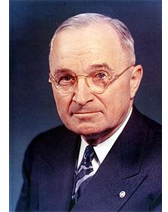
Harry S. Truman
The President Who Ended World War II | 33rd President of the United States (1945–1953)
Born on May 8, 1884
Died on December 26, 1972
Age at death: 88
Profession: Politician, Military Officer, Former President
Place of Birth: Lamar, Missouri, United States
Place of Death: Kansas City, Missouri, United States
Harry S. Truman was born on May 8, 1884, in Lamar, Missouri, United States, as the son of a farming family. The “S” in his name did not stand for any given name; it symbolized the names of both of his grandfathers, Anderson Shippe Truman and Solomon Young. After graduating from high school in 1901, he was unable to pursue higher education due to financial difficulties. Because of poor eyesight, he was not accepted into the United States Military Academy at West Point.
Truman worked briefly as a banker and later managed his family’s farm near Independence between 1906 and 1917. Over the years, he held various jobs, including post office administrator, warehouse clerk, National Guard service member, and mining and oil business worker. In none of these roles did he achieve the success he hoped for, often leaving or being dismissed.
During World War I, Truman enlisted in the army and rose to the rank of captain on April 6, 1917, due to his service in France. After the war, he entered the retail business and opened a men’s clothing store, but the venture failed, forcing him to close the shop. At this low point, his friend Thomas Pendergast, a political boss in Jackson County, helped him enter politics. In 1920, Truman joined the Democratic Party, marking the beginning of his political career.
In 1922, Truman was elected as a county court judge. Between 1924 and 1926, he attended night classes at Kansas City Law School. In 1926, he was re-elected and became presiding judge of the county court.
When his term ended in 1934, Truman seized the opportunity to run for the U.S. Senate from Missouri and was elected in 1935 as a Democratic senator. He supported President Franklin D. Roosevelt’s New Deal economic program and served on several Senate committees. In 1939, he was re-elected to the Senate.
With the onset of World War II, Truman rose to national prominence as head of a Senate committee investigating the efficiency of weapons production and military logistics. His efforts exposed corruption and reduced waste, earning him widespread public respect. By 1944, he had become a national figure, and after replacing Henry Wallace, he was selected as Vice President. In June 1944, Roosevelt appointed him Vice President, a role he held for only 82 days.
Following the death of President Franklin D. Roosevelt on April 12, 1945, Harry S. Truman became the 33rd President of the United States.
Upon assuming office, Truman declared that U.S. domestic and foreign policies would continue along Roosevelt’s path. On June 26, 1945, he presided over the San Francisco Conference that formally established the United Nations. In July 1945, he attended the Potsdam Conference, convened to address postwar issues following Germany’s surrender, and on August 2, 1945, he signed the peace agreement on behalf of the United States.
In an effort to force Japan’s surrender, Truman authorized the atomic bombings of Hiroshima on August 6, 1945, and Nagasaki on August 9, 1945, resulting in the deaths and injuries of hundreds of thousands of civilians and bringing the war with Japan to an end. On August 15, 1945, Emperor Hirohito announced Japan’s defeat by radio. On September 2, 1945, Japan signed the unconditional surrender documents aboard the U.S. Navy’s battleship USS Missouri.
After the war, the Soviet Union emerged as the dominant power in Europe, ending Allied cooperation and drawing Western Europe under the protection of the United States, marking the beginning of the Cold War.
In February 1947, Great Britain informed the United States that it could no longer provide economic aid to Turkey and Greece due to its weakened economy. This development gave Truman the opportunity to implement his containment policy against the Soviet Union. In his March 12, 1947 address to Congress, later known as the “Truman Doctrine,” he emphasized the strategic importance of Turkey and Greece and requested $400 million in aid to protect them against Soviet pressure.
Together with Secretary of State George C. Marshall, Truman developed a comprehensive economic recovery plan for postwar Europe, later called the Marshall Plan. Approved by Congress and implemented in 1948, the plan allocated $300 million to Greece and $100 million to Turkey.
Truman won the 1948 presidential election and began his second term in January 1949. He introduced a 29-point program known as the Fair Deal, intended as a continuation of the New Deal, though only parts of it were enacted. During this period, anti-communist movements intensified in the United States. Despite Truman’s veto, the McCarran Internal Security Act became law in 1950, leading to the closure of the U.S. Communist Party and widespread investigations under Senator Joseph McCarthy.
In 1949, Truman played a key role in the establishment of NATO. The same year, the communist revolution in China and the Soviet Union’s first atomic bomb test prompted Truman to approve the development of the hydrogen bomb in 1950.
Following the outbreak of the Korean War in 1950, Truman sent U.S. forces under General Douglas MacArthur to assist South Korea, sparking intense controversy. When MacArthur proposed expanding the war into China, Truman dismissed him from command. Fifteen United Nations member states joined the conflict alongside the United States, including Turkey, which contributed over 5,000 troops, making it the fourth-largest contingent.
Exhausted by political pressures, Truman announced that he would not seek re-election in the 1952 presidential race. In September 1951, he signed the ANZUS Pact with Australia and New Zealand.
Harry S. Truman served as President of the United States from April 12, 1945, to January 20, 1953. After leaving office, he transferred power to Republican President Dwight David Eisenhower and retired to his farm in Independence, where he wrote his memoirs.
Truman married Elizabeth Virginia “Bess” Wallace in 1919. They had one daughter, Margaret (1924–2008).
Harry S. Truman died on December 26, 1972, at the age of 88, in Kansas City, Missouri, United States.
Quotes by Harry S. Truman:
Negative people create difficulties from opportunities; positive people create opportunities from difficulties.
Should a fox be made the guardian just because it knows the henhouse well?
Source: Biyografiler.com
Frequently asked questions about Harry S. Truman
Who is Harry S. Truman?, Harry S. Truman biography, Harry S. Truman life story, Harry S. Truman age, Harry S. Truman facts, Harry S. Truman birthplace, Harry S. Truman photos, Harry S. Truman videos, Harry S. Truman career
Related Biographies

Lamine Yamal
Professional footballer

Erling Haaland
Professional footballer

Kylian Mbappe
Professional footballer

Keanu Reeves
Actor

Austin Abrams
Actor

Bad Bunny
Rapper, Songwriter


Hongjoong
Singer, Rapper, Songwriter, Composer

Ludacris
Rapper, Actor

Kwon Eunbi
Singer

Sarah Wayne Callies
Actress, Screenwriter, Producer, Director

LaTavia Roberson
Singer, Actress, Entrepreneur
Keanu Reeves
Actor

Leonardo DiCaprio
Actor
Erling Haaland
Professional footballer
Lamine Yamal
Professional footballer
Austin Abrams
Actor

John F. Kennedy
Politician, Statesman