
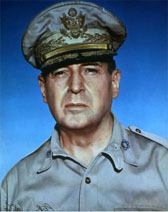
Douglas MacArthur
Supreme Allied Commander in the Pacific and one of the most influential military leaders of the 20th century.
Born on January 26, 1880
Died on April 5, 1964
Age at death: 84
Profession: Military Commander
Place of Birth: Little Rock, Arkansas, United States
Place of Death: Washington, D.C., United States
Douglas MacArthur was an American five-star general, military strategist, and statesman whose career spanned more than half a century and three defining conflicts of the 20th century. He served as Supreme Commander of Allied Forces in the Southwest Pacific during World War II and later as Supreme Commander for the Allied Powers in occupied Japan. On 2 September 1945, aboard the battleship USS Missouri, he formally accepted Japan’s unconditional surrender, symbolically closing the Second World War.
Early Life and Family Background
Douglas MacArthur was born on 26 January 1880 in Little Rock, Arkansas, as the third son of Arthur MacArthur Jr. and Mary Hardy MacArthur. His father was a distinguished general who served as military governor of the Philippines, embedding military discipline and national service into Douglas’s upbringing from childhood.
Raised largely on army posts in the United States and abroad, MacArthur grew up in a rigid military environment. His mother was a powerful influence on his ambitions, instilling in him a strong sense of destiny and leadership that would define his entire life.
Education and Early Military Career
In 1903, Douglas MacArthur graduated first in his class from the United States Military Academy at West Point, an achievement that immediately marked him as one of the most promising officers of his generation.
His early service took him to the Philippines in 1904 and to Korea and other parts of East Asia in 1905, where he gained early insight into the geopolitical importance of the Pacific region.
World War I and Rise to Prominence
During World War I, Douglas MacArthur played a central role in forming the famed 42nd Infantry Division, known as the “Rainbow Division.” Deployed to France in 1917 as a colonel, he led troops in some of the fiercest fighting on the Western Front.
His leadership during combat operations and the subsequent Allied occupation of the Rhineland brought rapid promotion. In 1918, he was promoted to general, becoming one of the youngest officers to reach that rank.
Interwar Years and Chief of Staff
Between 1919 and 1922, Douglas MacArthur served as Superintendent of the United States Military Academy at West Point, where he introduced major reforms aimed at modernizing military education.
From 1922 to 1930, he held senior posts in both the United States and the Philippines. In 1925, he became a major general. In 1930, President Herbert Hoover appointed him Chief of Staff of the United States Army, making him the youngest officer ever to hold that position at age 50.
His tenure was controversial. In 1932, when thousands of World War I veterans marched on Washington demanding early payment of bonuses, MacArthur led troops to forcibly disperse the protesters. Acting under orders from Hoover and accompanied by then–Major Dwight D. Eisenhower, he cleared the capital, an action that drew lasting criticism.
International Encounters and the Philippines
On 27 September 1932, Douglas MacArthur met Mustafa Kemal ATATÜRK at Dolmabahçe Palace in Istanbul, a meeting reflecting mutual respect between two prominent military leaders of the era.
In 1935, MacArthur was sent to the Philippines as a military adviser to help build a national defense force. Although he officially retired from the U.S. Army in 1937, he continued advising the Philippine Army.
World War II and the Pacific Campaign
With the outbreak of World War II in the Pacific, Douglas MacArthur was recalled to active duty in July 1941 and appointed commander of U.S. Army Forces in the Far East.
Following Japan’s invasion of the Philippines, Allied forces withdrew to the Bataan Peninsula, resisting superior Japanese forces for three months. On orders from President Franklin D. Roosevelt, MacArthur was evacuated to Australia in 1942. As he departed, he issued his famous promise: “I shall return.” That same year, he received the Medal of Honor and was appointed Supreme Commander of the Southwest Pacific Area.
Under his command, Allied forces halted Japanese advances at Port Moresby, reclaimed New Guinea, advanced through the Solomon and Admiralty Islands, neutralized the Japanese base at Rabaul, and returned decisively to the Philippines at Leyte in 1944. He fulfilled his promise by liberating Luzon, Manila, and Corregidor in 1945, earning promotion to five-star General of the Army.
Japanese Surrender and Occupation
On 2 September 1945, Douglas MacArthur, as Supreme Commander for the Allied Powers, accepted Japan’s surrender aboard the battleship USS Missouri in Tokyo Bay.
He then governed occupied Japan, overseeing sweeping political, social, and economic reforms. Under his leadership, Japan adopted democratic institutions, restructured industry, and transformed its education system. Through discipline and pragmatism, MacArthur earned the respect of Emperor Hirohito and much of the Japanese public.
Korean War and Dismissal
When North Korea invaded South Korea in 1950, Douglas MacArthur was appointed Commander of United Nations forces by President Harry S. Truman. He executed the bold Inchon Landing and pushed UN forces beyond the 38th parallel toward the Yalu River.
China’s intervention forced a retreat. MacArthur publicly advocated expanding the war into China and even proposed the use of atomic weapons—positions that conflicted with Truman’s policy of limited war. In 1951, Truman removed MacArthur from command and appointed Matthew Ridgway as his successor.
Return to the United States and Farewell Address
After fifteen years abroad, Douglas MacArthur returned to the United States to unprecedented public acclaim. Massive parades were held across the country, most notably in New York City, where an estimated 7.5 million people lined Manhattan’s streets in one of the largest ticker-tape parades in history.
Addressing the U.S. Congress upon his retirement, MacArthur delivered one of the most famous farewell speeches in American military history:
“Today marks my final roll call with the Army. I have grown up and spent the better part of my life in this service. When I joined, all the dreams and hopes of my youth were fulfilled. After long years of service, there comes to mind a refrain of one of the most popular barrack ballads of the Army. It proclaims most proudly that ‘old soldiers never die; they just fade away.’And like the old soldier of that ballad, I now close my military career and just fade away — an old soldier who tried to do his duty as God gave him the light to see that duty.
Goodbye.”
Later Life and Death
Although conservative circles attempted to draft him as a Republican presidential candidate in 1952, MacArthur declined. That election was ultimately won by his longtime colleague Dwight D. Eisenhower.
In later years, MacArthur served as chairman of the board of Remington Rand Inc., lived quietly in New York, and published his memoirs, Reminiscences, in 1963. Notably, throughout his military career, he never personally carried a firearm.
Douglas MacArthur died on 5 April 1964 in Washington, D.C., at the age of 84. His career encompassed World War I, World War II, and the Korean War, leaving a legacy defined by bold strategy, controversy, and enduring global influence.
Wars Participated
World War I
World War II
Korean War
Source: Biyografiler.com
Frequently asked questions about Douglas MacArthur
Who is Douglas MacArthur?, Douglas MacArthur biography, Douglas MacArthur life story, Douglas MacArthur age, Douglas MacArthur facts, Douglas MacArthur birthplace, Douglas MacArthur photos, Douglas MacArthur videos, Douglas MacArthur career
Related Biographies

Lamine Yamal
Professional footballer

Erling Haaland
Professional footballer

Austin Abrams
Actor

Keanu Reeves
Actor

Kylian Mbappe
Professional footballer

Bad Bunny
Rapper, Songwriter


Hongjoong
Singer, Rapper, Songwriter, Composer

Ludacris
Rapper, Actor

Kwon Eunbi
Singer

Sarah Wayne Callies
Actress, Screenwriter, Producer, Director

LaTavia Roberson
Singer, Actress, Entrepreneur
Kylian Mbappe
Professional footballer
Lamine Yamal
Professional footballer

Luiz Inacio Lula da Silva
Politician, President

Nicki Minaj
Rapper, Singer, Songwriter, Actress

Zhang Yiming
Entrepreneur, Software Developer

Javier Milei
Economist, Politician, President