
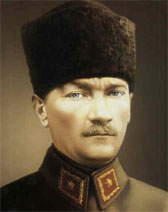
Mustafa Kemal ATATÜRK
Founder of the Republic of Turkey and a visionary reformer
Born on May 19, 1881
Age: 145
Profession: Statesman, Military Commander
Place of Birth:
Atatürk will live eternally in the history and hearts of the Turks; he is immortal.
Atatürk’s Origins
The origins of Atatürk, the founder of our Republic, heroic soldier, and great statesman, trace back to the Karaman Beylik. His father’s family descended from Turkmen tribes known as the “Kızıl-Oğuz” or “Kocacık Yörüks,” who played an important role in the Turkification of Anatolia. They were among the Yörük tribes of the Karaman Beylik that was fragmented during the reign of Sultan Mehmed the Conqueror and were relocated from Karaman's Taşkale village to Rumelia. Atatürk’s great-grandfather, Kırmızı Hafız Efendi, belonged to families known as “Gulalar” on his mother’s side and “Pınarlar” on his father’s side. In 1850, Hafız Ahmet Efendi arrived in the city of Manastır together with his brother Hafız Mehmet Emin for trade purposes and later settled in Selanik.
The maternal origins of Atatürk trace back to the Yörüks known as “Evlad-ı Fatihan,” who were brought from Central Anatolia and settled in the Sarıgöl district of western Macedonia, later migrating to the Lankaza (Lagaza) region of Selanik. Atatürk’s grandmother was named Ayşe, and his grandfather was Sofi-Zade Feyzullah Efendi, who had two children named Hasan and Hüseyin. Zübeyde Hanım was referred to as Zübeyde Molla due to her literacy at a time when it was uncommon for women to attend school.
Atatürk’s father, Ali Rıza Bey, was born in the Kocacık township of the Debre-i Bala sanjak of the Manastır province. Ali Rıza Bey served for a time as a clerk at the Selanik Foundations Administration, became a first lieutenant in the Selanik Asakir-i Milliye Battalion in 1876, fought in the Ottoman-Russian War of 1877, and later entered commercial life. While working as an official in the Customs Protection Organization, he married Zübeyde Hanım in 1871, after which their first child, Fatma, was born. This was followed by Ahmet (1874), Ömer (1875), Mustafa (Mustafa Kemal Atatürk) (1881), Makbule (Makbule Atadan) (1885), and Naciye (1889). However, Fatma at age four, Ahmet at age nine, and Ömer at just eight years old lost their lives due to the diphtheria (kuşpalazı) epidemic that swept through Rumelia at the time. Naciye was also lost at a young age in 1901 due to tuberculosis.
(Details regarding Atatürk’s family tree are provided in the work titled Tarihte Bozkır ve Çevresi Yelbeği by Captain Bakir Tosun.)
Atatürk’s Birth
Mustafa Kemal Atatürk was born in 1881 in a house located on Islahhane Street in the Koca Kasım Pasha Neighborhood of Selanik. Ali Rıza Bey gave his newborn son the name Mustafa, the same name as his own brother, whom he had accidentally dropped from a cradle during childhood, causing his death—an incident he never forgot.
A blond-haired, blue-eyed baby, Mustafa was born in the year 1296 according to the Rumi calendar, yet there was no definitive information regarding the exact day and month of his birth. However, according to records, Zübeyde Hanım stated that she gave birth to her son during the “Erbain Cold Days” and that the date she remembered was 23 December. Due to the difference between calendars, this corresponds to 4 January 1881.
According to information obtained from Selanik archival documents, the house in which Atatürk was born—now a museum—was built before 1870 by a Rhodesian teacher named Hacı Mehmed, and was later sold first to İbrahim Zühdü, and subsequently to Abdullah Ağa and his wife Ümmü Gülsüm.
Ali Rıza Bey resided with his wife Zübeyde Hanım and their children in his father’s house located in the Subaşı Neighborhood until 1878, after which he rented and moved into the house where Atatürk would later be born. In 1880, Ali Rıza Bey was kidnapped by a notorious Greek bandit, and hope for his survival was lost. He was eventually released after a substantial ransom was paid.
The house where Atatürk was born was a classic three-story residence surrounded by high walls, featuring separate harem and selamlık sections. According to period documents, it consisted of one upper-story room, a divan room, a mezzanine, two ground-floor rooms, a fountain, and a courtyard. Its exterior was painted pink, with iron bars on the lower windows and wooden lattices on the upper ones. Atatürk was born in the fireplace-equipped room on the left side of the second floor.
On 29 October 1933, on the occasion of the Tenth Anniversary of the Republic, the Municipality of Selanik placed a marble plaque on the right corner of the double-winged entrance door of the house where Atatürk was born, as a symbol of Turkish–Greek friendship and a memento of the Balkan Conference. The plaque bore the following inscription in Turkish, Greek, and French: “The great renovator of the Turkish nation and the proponent of Balkan unity, GAZI MUSTAFA KEMAL, was born here. This plaque was placed on the occasion of the tenth anniversary of the Republic of Turkey.” Today, the house where Atatürk was born is located at number 75 on Apostolu Pavlu Street in Selanik’s Aya Dimitriya Neighborhood, adjacent to the Turkish Consulate.
Atatürk’s Childhood and Education
Atatürk came from a modest family. This characteristic would later greatly benefit his ability to understand the pulse of the people and to sense public tendencies. Those close to him stated that he took pride in being a child of the people. Atatürk was four years old when his sister Makbule Atadan was born. Due to the early deaths of his other siblings, Atatürk never had the chance to know them, and therefore the information recorded about his childhood years is limited. When Atatürk reached school age, a disagreement emerged between his parents regarding his education. Zübeyde Hanım, who was devoted to tradition and came from a religious family like Hacı Sofi, insisted that Atatürk attend the Mahalle Mektebi, which provided religious-based education, during a period when the education system was still unsettled. Ali Rıza Bey, who held enlightened views, preferred the newly established Şemsi Efendi Primary School, which was founded with a relatively modern educational approach for its time. The school’s founder, Şemsi Efendi, after whom the school was named, was an enlightened educator who implemented the phonetic method instead of rote memorization and also opened a section for female students. In 1873, Mithat Paşa, who began serving as governor in Selanik, awarded Şemsi Efendi a sultan’s medal in recognition of his achievements.
With Ali Rıza Bey’s proposal, the dilemma regarding schooling was resolved. Accordingly, Atatürk would first begin at the neighborhood school with hymns and a religious ceremony, and a few days later transfer to Şemsi Efendi School. Unlike neighborhood schools of the time, Şemsi Efendi School employed new teaching methods and used modern tools such as blackboards, chalk, erasers, teacher’s desks, and instructional boards designed to facilitate reading. Receiving education at this school, which followed pedagogical principles, had a significant impact on Atatürk’s development. With his intelligence and exceptional abilities, he quickly earned the affection of his classmates and teachers, and he also stood out for his outstanding success in mathematics.
Meanwhile, Ali Rıza Bey, who had left his position as a customs officer and entered the timber trade followed by the salt business, withdrew from commercial life due to attacks by Greek bandits and losses caused by salt melting. Unable to return to public service, Ali Rıza Bey fell ill after some time and passed away in 1888. At the time of his father’s death, Atatürk was seven years old, and his sister Makbule was only three.
Following his father’s death, Atatürk and his family were forced to leave school behind and faced difficult times. When she lost her husband, Zübeyde Hanım was pregnant with her daughter Naciye and gave birth in 1889. Due to her insufficient financial means, Zübeyde Hanım took her children and settled at the farm of her brother Hüseyin Ağa, who was engaged in agriculture in Langaza. In 1901, Atatürk’s sister Naciye contracted tuberculosis and passed away at a young age. Deeply affected by the loss of his father and shortly thereafter his sister, Atatürk assumed increased responsibilities as the man of the family while living on his uncle’s farm. During this period, he lived closely with nature, and by assisting his uncle in farm work, he developed practical skills. However, Zübeyde Hanım was distressed that her son’s education had been interrupted. When the instruction he received from the mosque imam and a private tutor proved insufficient, she sent Atatürk to live with his aunt in Selanik so that he could receive a proper education.
Meanwhile, not wishing to burden her brother further and struggling to live on a small pension, Zübeyde Hanım married Selanik Customs Director Ragıp Bey. Ragıp Bey had four children from his previous marriage. This marriage angered Atatürk, who felt that his father’s memory had not been respected. Unable to come to terms with his mother’s second marriage, Atatürk refrained from contacting her for a long time. However, this disappointment strengthened his determination to work. The loss of his father at an early age also enabled him to gain the strength to stand on his own feet and to struggle successfully in life. Prof. Dr. Şerafettin Turan included the following observations on this matter in his biography of Mustafa Kemal Atatürk:
 |  |  |
| Zübeyde Hanım’s second marriage to Ragıp Bey also created a noticeable issue between mother and son. Ragıp Bey had migrated to Selanik from Yenişehir in Thessaly. Having lost his wife, he was widowed with four children. He had two sons named Süreyya and Hakkı, and two daughters, one of whom was named Rukiye. When he married Zübeyde Hanım, a psychological—if not practical—issue of a stepfather and stepsiblings emerged for Mustafa and Makbule. Makbule adapted to this new life without delay, but Mustafa did not wish to live under the same roof as a stepfather. In the later years of his life, Atatürk spoke positively of his stepfather, stating, “He treated me with great respect and behaved toward me as a great man,” yet he explained his departure from the house to Afet İnan as the rebellion of a child who had lost his father, saying: “I appreciated my mother forming such a family bond. However, my childhood emotion consisted solely of rebellion.” |
Selanik Military Junior High School
After moving to live with his aunt in Selanik, Atatürk enrolled at the Mülkiye İdadisi. However, when he was beaten with a stick by Kaymak Hafız, who taught Arabic at the school, his grandmother—who already did not want him to attend that school—immediately withdrew him. At that time, the son of their neighbors, whose school uniform Atatürk greatly admired, was attending the Military Junior High School. Inspired by him, and despite his mother’s opposition to his becoming a soldier, Atatürk secretly took the entrance examination for the Selanik Military Junior High School. Upon learning that he had passed the exam, Atatürk once again secretly enrolled in the school in 1893. At Selanik Military Junior High School, Atatürk was highly successful; he served as class president and attracted the attention of his mathematics teacher, Captain Mustafa Efendi, with his superior intelligence. Deeply impressed by his young student’s abilities, Captain Mustafa Efendi added the name Kemal, meaning “maturity and perfection in knowledge and virtue,” to make his name distinctive. From that day on, young Mustafa became Mustafa Kemal. While studying at Selanik Military Junior High School, Atatürk was frequently assigned to teach mathematics classes in place of Captain Mustafa Efendi whenever he was absent. Regarding this, the great leader would later say:
| | |
| At the junior high school, I developed the greatest interest in mathematics. In a short time, I acquired as much, if not more, knowledge than the teacher who taught us this subject. I worked on problems beyond the curriculum and prepared written questions. The mathematics teacher would respond to them in writing. |
According to an article dated 10 November 1971 by A. Dilaçar, Chief Specialist of the Turkish Language Association, concerning Atatürk’s outstanding success in mathematics, Atatürk personally wrote a book titled “Geometry” during the winter of 1936–1937, shortly after the Third Turkish Language Congress (24–31 August 1936), approximately one and a half years before his death. The book was published in 1937 by the Ministry of Culture to serve as a guide for mathematics teachers and authors writing on the subject. In his work titled “Geometry,” Atatürk became the originator of many geometry and mathematics terms such as dimension, space, surface, plane, diameter, radius, secant section, arc, circle, tangent, angle, angle bisector, alternate interior angle, alternate exterior angle, base, oblique, broken, plumb, horizontal, vertical, corresponding, position, triangle, quadrilateral, pentagon, diagonal, equilateral, isosceles, parallelogram, lateral, trapezoid, plus, minus, multiply, divide, equal, sum, ratio, proportion, derivative, area, hypothesis, and introduced these terms into Turkish mathematical science.
Later, the renowned historian of science Ord. Prof. Dr. Aydın Sayılı described Atatürk’s “Geometry” book as “a small yet monumental work.” Atatürk explained every definition and concept in the work clearly and completely, addressing all components and illustrating them with examples. Nearly all of the mathematical terms he coined and the geometric definitions he formulated have been used unchanged to this day. Only a few of the terms he introduced were later modified slightly.
Atatürk graduated from Selanik Military Junior High School with outstanding success in 1898. Having reached the stage where he needed to continue his education at a military high school, Atatürk considered going to İstanbul. However, upon the recommendation of Hasan Bey, one of the examiners, he enrolled in the Manastır Military High School.
Manastır Military High School
Growing up in Selanik, the most developed city of Macedonia, in an environment open to new ideas, Atatürk gained the opportunity to improve himself and acquired a broad vision in this city where different religions and ethnicities lived together in a colorful social structure.
During his education at Manastır Military High School, his friend Ömer Naci played a role in fostering Atatürk’s interest in literature. Becoming deeply engaged with poetry and oratory, Atatürk was profoundly influenced by Namık Kemal and his works. His composition teacher, Mehmet Asım Bey, noticed Atatürk’s inclination toward poetry and literature and advised him to focus on a military career. However, oratory always remained highly important to Atatürk, and his passion for writing continued. He would later state the following on this subject:
| | |
| I did not forget the prohibition imposed by my high school teacher regarding writing poetry. However, the desire to speak and write eloquently remained. During breaks, we practiced oratory. We would hold watches in our hands and organize contests and debates, saying, “You will speak for this many minutes, and I will speak for that many minutes.” |
His French teacher, Captain Naküyiddin Yücekök Bey, also took a close interest in Atatürk. Believing that a staff officer must learn a foreign language, and recognizing Atatürk as a successful student, he placed great importance on French lessons. However, since Atatürk’s French was weaker compared to his other subjects, he addressed this by attending private courses at College des Frères de la Salle in Selanik during school holidays to improve his language skills. With the support of his close friend Fethi Okyar, he became acquainted with philosophers such as Voltaire and J.J. Rousseau, pioneers of the French Revolution, thereby expanding his knowledge of history and politics. During this period, he also met friends with whom he would later maintain lifelong cooperation, including Nuri Conker, Salih Bozok, and Fuat Bulca. One of the subjects that influenced Atatürk most deeply was history. His history teacher, Senior Captain Mehmet Tevfik Bey (5th Term Member of Parliament for Diyarbakır), opened new horizons for him with a comprehensive historical vision. The love for history that began during his high school years continued throughout his life.
One of the events that affected Atatürk most during his education at Manastır Military High School was the Turkish-Greek War of 1897. Although the Turkish Army achieved a brilliant victory on the battlefield, the unfavorable outcome at the peace table deeply troubled Atatürk and filled him with an intense love for the homeland. He even attempted, together with a friend, to volunteer for the war, but was unable to realize this aspiration. Nevertheless, this boundless patriotism that could not be contained within him would persist throughout his life. One of the most outstanding students of Manastır Military High School, Atatürk worked tirelessly during his time there, consciously preparing himself for the future. Ultimately, in November 1898, he completed his education with full marks in all subjects, graduating with honors as second in a class of 54 students.
According to his school records, Atatürk possessed exceptional talent but had a character that made it difficult to establish close familiarity with him. Throughout his high school education, he was patriotic, continuously striving to improve himself in every field, filled with a passion for progress, hardworking, determined, supremely self-confident, distinguished, and well-dressed. Constantly following world affairs and current events, and being highly successful in social life alongside his diligence, Atatürk was someone who benefited from life’s pleasures while also working relentlessly to achieve success.
Istanbul Military Academy and War College
Atatürk arrived in Istanbul and began his education at the War School on 13 March 1899. His epaulet number was 1283. Two months after enrolling, he distinguished himself among his peers and became a class sergeant. During this period, he met lifelong friends Ali Fuat Cebesoy and Asım Gündüz.
Atatürk spent his first year at the War School immersed in youthful aspirations and the striking atmosphere of Istanbul, which he deeply loved. After successfully passing his examinations, he advanced to the second year. Although he devoted considerable attention to social life during his first year, he achieved notable success. In his second and third years, he focused much more intensely on his studies, as ranking highly at the War School was crucial. Admission to the staff officer class was possible only through exceptional academic performance. In his third year, Atatürk ranked 8th among 459 students and earned the right to become a staff officer. His registry number was 1317-P.8 (1901-P.8).
Mustafa Kemal began his education at the War Academy with the rank of lieutenant on 10 January 1902. There were 43 students in his class, including graduates from the artillery and cavalry schools.
While Mustafa Kemal was studying at the War Academy, Osman Nizami Pasha was the first to recognize his outstanding qualities. Speaking to Atatürk at the home of İsmail Fazıl Pasha, the father of Ali Fuat, he said:
| | |
My son Mustafa Kemal Efendi, I see that İsmail Fazıl Pasha was not mistaken in appreciating you. I now share his opinion. You will not merely enter ordinary life as a staff officer like us. Your sharp intelligence and high ability will have a profound impact on the future of the country. Do not take these words as a compliment; I observe in you the exceptional intelligence and talent that great men who have shaped the destiny of nations displayed even in their youth. I hope I am not mistaken. |
The days to come would prove Osman Nizami Pasha right.
The instructors at the War Academy were well-educated, multilingual, and distinguished. According to his classmate Asım Gündüz, Atatürk took lessons from a French lady to improve his French. During this period, he had French newspapers and Young Turk publications from Paris brought to Istanbul and sought to influence his friends. Atatürk later stated that his political ideas began to mature during his years at the War School. While striving continuously for academic excellence, he also reflected deeply on the fate of his country, having realized that serious mistakes were being made in national politics. Wanting everyone to be aware of these issues, Atatürk resumed publishing a handwritten newspaper that he and his friends had first produced at the War School. Prepared in a rarely used classroom, the newspaper was circulated hand to hand. Regarding this, he stated:
| | |
We felt the urge to explain our discovery—that there were serious flaws in the administration and politics of the country—to the thousands of students at the War School. We established a handwritten newspaper at the school. We had a small organization within the class, and I was part of the administrative board. I wrote most of the articles myself. |
After a while, the situation was discovered by the Minister of Education, Zülüflü İsmail Pasha. The academy commander conducted a sudden inspection and caught the students in the act. He refrained from initiating disciplinary proceedings and instead issued a stern warning. However, Atatürk and his friends did not cease their activities. They rented a house and continued publishing the newspaper, but were eventually betrayed by an informant and arrested. Although the incident did not end their military careers, it resulted in several months of imprisonment. Following their release, Mustafa Kemal graduated from the War Academy on 11 January 1905 as fifth in his class based on the cumulative grades of three years.
During his years at the War Academy, Atatürk improved his foreign language skills, followed the ideas of Namık Kemal, and disseminated them within the school. Throughout his military education, he engaged with subjects uncommon for military students of the time, such as foreign languages, poetry, dance, and oratory.
First Military Experiences
For his first assignment, Atatürk was sent to Damascus. Serving as a company commander in the 30th Cavalry Regiment between 1905 and 1907, he rented a house and lived with his friend Lütfi Ümit Bey, who was a company commander in the 29th Cavalry Regiment. Kılıç Ali later recounted an incident from that period as follows:
| | |
… After some time, one day they learned that their regiments had departed for the Havran region without informing them. Both were astonished and could not make sense of their units moving without notice. Mustafa Kemal became extremely angered by this negligence. When his complaint to the regimental commander yielded no result, he decided to appeal directly to the army commander. However, he did not receive the expected sensitivity there either. Determined to resolve the matter through action, he set out and asked his friend Lütfi Müfit Bey to follow him. Despite the commanders’ disregard and reluctance, they joined the operation. It later emerged that the cavalry unit’s mission also involved collecting ten years’ worth of taxes. During this tax collection, Atatürk described with revulsion the suffering, injustices, and abuses inflicted upon the villagers, and characterized the mission as “banditry.” One day, an officer offered Lütfi Müfit Bey gold coins in exchange for overlooking the corruption. Müfit Bey refused and informed Mustafa Kemal. Mustafa Kemal then asked him: “Müfit, do you want to be a man of today, or a man of tomorrow?” Müfit Bey replied immediately, “Of course I want to be a man of tomorrow.” This response pleased Atatürk greatly, and he would often recount it, saying: “Of course he could not and did not accept the offered money, because he wanted to be a man of tomorrow, not of today.” |
This account by Kılıç Ali demonstrates Atatürk’s firm opposition to bribery, his unwavering commitment to integrity, his intolerance of injustice, and his constant concern for the future of his country. Beyond viewing corruption as a matter of honor, he evaluated it within a broader historical and future-oriented perspective.
Atatürk completed his first military assignment in Damascus in 1907 with the rank of Kolağası (Senior Captain). He was then appointed to the Third Army in Manastır and served as Chief of Staff of the Action Army that entered Istanbul on 19 April 1909. In 1910, he was sent to France and participated in the Picardie Maneuvers.
Period of Command (1911 – 1919)
In 1911, following the Italian attack on Tripoli, which marked the beginning of the Italo-Turkish War, Atatürk served with a group of friends in the regions of Tobruk and Derna. After winning the Battle of Tobruk against the Italians on 22 December 1911, he was appointed Commander of Derna on 6 March 1912.
When the Balkan War began in October 1912, Atatürk joined the fighting with units in Gallipoli and Bolayır, rendering significant service in the recapture of Didymoteicho and Edirne. In 1913, he was appointed Military Attaché in Sofia, and in 1914 he was promoted to the rank of Lieutenant Colonel. It is said that he experienced his first love in Sofia with a Bulgarian woman.
In 1914, World War I broke out, and the Ottoman Empire was compelled to enter the war. Atatürk was assigned in Tekirdağ to establish the 19th Division. After the British and French fleets attempting to pass through the Dardanelles] suffered heavy losses on 18 March 1915, they decided to land troops on the Gallipoli Peninsula. On 25 April 1915, enemy forces under the command of Otto Liman von Sanders landed at Arıburnu, but were halted at Conkbayırı by the 19th Division commanded by Atatürk. For his heroic defense at Gallipoli, which gave rise to the phrase “Çanakkale is impassable!,” Atatürk was promoted to Colonel.
The British launched another assault at Arıburnu on 6–7 August 1915. As Commander of the Anafartalar Group, Atatürk won the Battle of Anafartalar on 9–10 August. This victory was followed by successes at Kireçtepe on 17 August and the Second Battle of Anafartalar on 21 August.
After the Gallipoli Campaign, Atatürk served in Edirne and Diyarbakır in 1916. On 1 April 1916, he was promoted to Major General and succeeded in recapturing Muş and Bitlis from Russian forces. After brief assignments in Damascus and Aleppo, Atatürk traveled to Istanbul in 1917, accompanied Crown Prince Mehmed VI Vahdettin on an inspection tour to Germany, and later sought medical treatment in Vienna and Karlovy Vary. On 15 August 1918, he returned to Aleppo as Commander of the 7th Army, fighting bravely against British forces. One day after the signing of the Armistice of Mudros, on 31 October 1918, he was appointed Commander of the Yıldırım Armies Group. Following the dissolution of this army, he arrived in Istanbul on 13 November 1918 and began working at the Ministry of War.
Years of the War of Independence (1919 – 1923)
After the Armistice of Mudros, when the Allied Powers began occupying Anatolia, Atatürk departed for Samsun on 19 May 1919 as Inspector of the 9th Army. With the circular he issued in Amasya on 22 June 1919, he declared that “the nation’s independence will be saved by the determination and resolve of the nation itself,” and presided over the Erzurum Congress and the Sivas Congress. Prior to the Erzurum Congress held between 23 July and 7 August 1919, he resigned from the Ottoman Army and became the leader of the Kuvayi Milliye. The term Kuvayi Milliye, of Arabic origin, meant national liberation forces. Atatürk defined Kuvayi Milliye as follows:
| | |
The government center was surrounded by the fierce grip of the enemy, politically and militarily. Under such circumstances, the instruments of the state and the nation could not fulfill their fundamental duties. Even the army, while retaining its name, was deprived of performing its essential mission. Therefore, the fundamental duty of defending and protecting the homeland was left directly to the nation itself… This is what we call Kuvayi Milliye. |
During the period of the Kuvayi Milliye, Atatürk was registered as an honorary citizen of Erzurum, which provided him with his first population record and identity document. Between 4 and 11 September 1919, he convened the Sivas Congress to determine the course to be followed for the salvation of the homeland.
Welcomed with great enthusiasm in Ankara on 27 December 1919, Atatürk opened the Grand National Assembly of Turkey on 23 April 1920 with the declaration “Sovereignty unconditionally belongs to the nation.” The GNAT represented a crucial step toward uniting national forces under a single authority and establishing the Republic of Turkey. Elected as the deputy of Erzurum, Atatürk was chosen as President of the Assembly and Head of Government. The Assembly enacted and implemented the necessary legislation to ensure the successful conclusion of the War of Independence.
The Greek occupation of İzmir on 15 May 1919 marked the beginning of the Turkish national struggle, initiated by the first bullet fired by Hasan Tahsin. Following the signing of the Treaty of Sèvres on 10 August 1920, which aimed to partition the Ottoman Empire, the struggle was initially waged by national forces known as the Kuvayi Milliye. However, a regular army was required for success against imperialist occupying powers. The Grand National Assembly of Turkey established a regular army and achieved integration between the Kuvayi Milliye and the army, leading to victory.
The major stages of the Turkish National War of Independence under the leadership of Mustafa Kemal were as follows:
• Liberation of Sarıkamış (20 September 1920), Kars (30 October 1920), and Gümrü (7 November 1920)
• Defenses of Çukurova, Gaziantep, Kahramanmaraş, and Şanlıurfa (1919–1921)
• First Battle of İnönü (6–10 January 1921)
• Second Battle of İnönü (23 March–1 April 1921)
• Kütahya–Eskişehir Battles (10–24 July 1921)
• Battle of Sakarya (23 August–13 September 1921)
• Great Offensive, Battle of the Commander-in-Chief, and Pursuit Operations (26 August–9 September 1922)
Following the Battle of Sakarya, on 19 September 1921, the Grand National Assembly of Turkey awarded Atatürk the rank of Field Marshal and the title of Gazi. The War of Independence concluded with the signing of the Treaty of Lausanne on 24 July 1923 in Lausanne, Switzerland. With this treaty, the Treaty of Sèvres was annulled, and the Republic of Turkey was founded upon the foundations of the Treaty of Lausanne. Regarding this achievement, the New York Times wrote:
| | |
Atatürk won Lausanne; it was the first victory of old Asia against Europe in the last two hundred years. |
With the opening of the GNAT in Ankara on 23 April 1920, the greatest step toward the establishment of the Republic of Turkey was taken. The successful management of the War of Independence by the Assembly accelerated the founding of the new Turkish state. On 1 November 1922, the Caliphate and the Sultanate were separated; the Sultanate was abolished, followed by the abolition of the Caliphate on 3 March 1924. Transforming the liberation movement he initiated in September 1923 into a political movement, Atatürk founded Turkey’s first political party, the People’s Party, later named the Republican People’s Party. On 29 October 1923, the Republic was officially proclaimed, and Atatürk was unanimously elected as the first President. On 30 October 1923, İsmet İnönü formed the first government of the Republic of Turkey.
Presidential Period (1923–1938)
As the first President of Turkey, Atatürk was elected President by the TBMM a total of three consecutive times, in 1927, 1931, and 1935, in accordance with the constitutional requirement of presidential elections held every four years.
Between 15–20 October 1927, Atatürk delivered his monumental work Nutuk (The Great Speech), in which he recounted the War of Independence and the founding of the Republic. On 29 October 1933, he delivered the Tenth Anniversary Speech. Nutuk explained against whom, why, and how the national struggle had been carried out, and provided vital guidance on what needed to be done after the establishment of the Republic. It was an exceptionally valuable address for Turkey.
With Law No. 2587, on 24 November 1934, in recognition of his services to the country, the victories he achieved, and his status as the father of the Turks, the surname Atatürk was bestowed upon Mustafa Kemal. In the 1930s, former Greek Prime Minister Venizelos nominated Atatürk for the Nobel Peace Prize.
The Insidious Disease: Cirrhosis
Extremely meticulous in matters of national interest and state affairs and accepting no excuses, Atatürk was unable to devote sufficient attention to his own health due to his intense workload. He was indifferent to the potential harm his lifestyle could cause to his health, always placing his country’s interests above all else. He stayed up very late at night and, when circumstances demanded, worked continuously for days without sleep. While dictating the Great Speech, even as some of those assisting him fainted from exhaustion, he continued without interruption. A passionate reader, Atatürk could read for hours on end, regardless of a book’s length, and would not put it down until finished. However, signs of declining health began to emerge in 1937.
In his youth, while studying at the Manastır Military High School, Atatürk had suffered a severe case of malaria. As recounted in the memoirs of Salih Bozok, he received treatment in Alexandria after falling from a horse on his way to Tripoli. During the Derna battles, he sustained an eye injury and was treated in Vienna. A kidney condition that began during the Great War persisted for long periods, leading him to seek treatment at the Karlsbad spas in Austria in 1918. During the years of the National Struggle, he continued to experience kidney pain, and it is known that three of his ribs were broken prior to the Battle of Sakarya. In 1924 and 1927, during his presidency, he suffered heart ailments but recovered following treatment. Despite contracting a severe lung illness with high fever due to a cold in 1936, Atatürk managed to appear quite healthy, defying the years despite the harsh effects of war and struggle. Nevertheless, these arduous experiences had taken a heavy toll. From early 1937 onward, his health began to deteriorate noticeably. Yet Atatürk paid insufficient attention to these symptoms, contenting himself with temporary measures as he continued to prioritize national interests over his own well-being.
The first diagnosis of Atatürk’s illness was made by Dr. Nihat Reşat Belger, Director of the Yalova Thermal Springs. When Dr. Belger examined him on 22 January 1938, he diagnosed enlargement and hardening of the liver. Because Atatürk enjoyed alcohol, his liver had suffered significant damage. For a definitive diagnosis, his personal physician Prof. Dr. Neşet Ömer İrdelp was summoned, but his assessment was no different. Atatürk had developed cirrhosis, requiring strict dieting and rest.
After resting for a few days, Atatürk traveled to Bursa on 1 February to open the Gemlik Artificial Silk Factory, and on 2 February to inaugurate the Merinos Factory. After attending the factory openings and the gala held in his honor, he returned exhausted to the Dolmabahçe Palace. He contracted pneumonia but recovered after ten days of treatment.
On 25 February 1938, Atatürk attended the Balkan Pact meeting in Ankara, holding lengthy discussions with Balkan statesmen. However, the intensity of these efforts continued to exhaust him. As his condition worsened, a medical consultation was convened by Turkish doctors on 6 March 1938, and the renowned specialist Prof. Dr. Fiessinger was invited from France. On 28 March 1938, Fiessinger confirmed the diagnosis of cirrhosis. It was said that he told Atatürk: “Great commander, you have fought great wars and emerged victorious. But in this matter, I am the commander. You will obey me and assist me.” Atatürk appreciated this remark and attempted to follow Fiessinger’s advice.
For the first time, on 30 March 1938, the government issued an official communiqué regarding President Atatürk’s illness, stating that Fiessinger’s examination revealed no cause for serious concern.
Nevertheless, Atatürk was determined to continue fulfilling his presidential duties without interruption, particularly to resolve the Hatay issue. He was troubled by France's indifferent stance on the matter. To demonstrate Turkey’s firm resolve, he attended a military parade in Mersin on 20 May and inspected military units in Adana on 24 May. Upon returning to Ankara, he was exhausted. After remaining there for only one day, he departed for Istanbul on 26 May. Following this journey, the Great Leader would never see Ankara again.
It was hoped that the sea air would benefit him, and to both host foreign heads of state and allow him to rest, the yacht Savarona was purchased. As the yacht Ertuğrul, previously used to host world leaders, had become outdated, a new presidential yacht was sought. After evaluation, the Savarona—originally commissioned by Emily Roebling Cadwallader, daughter of engineer John Roebling who built the Brooklyn Bridge—was acquired. After renovations, the yacht arrived in Istanbul during Atatürk’s terminal illness. During the six weeks he spent aboard Savarona, he chaired cabinet meetings and hosted important guests and heads of state, including the King of Romania, Carol II.
A medical examination on 29 May revealed fluid accumulation in his abdomen. On 1 June, Atatürk moved aboard the Savarona and remained there until 25 July 1938. However, the yacht became stifling in the summer heat, worsening his condition. Prof. Fiessinger returned to Istanbul for a second time on 8 July. Despite Fiessinger’s strict recommendation of absolute rest, Atatürk presided over a Cabinet meeting aboard Savarona for hours on 9 July. Fiessinger returned for a third time on 16 July, observing that Atatürk’s condition was becoming critical. On the night of 24/25 July, Atatürk was transferred to the Dolmabahçe Palace.
Despite his illness, Atatürk continued to receive the Prime Minister, ministers, ambassadors, and commanders at the Dolmabahçe Palace, closely monitoring national affairs. On 3 September 1938, he celebrated the establishment of the Hatay State as “a success of the Republic of Turkey.” As his health deteriorated, he wrote his will on 5 September. On 6 September, Prof. Fiessinger returned for the fourth time, relieving Atatürk by draining fluid from his abdomen. A report issued on 11 September prescribed absolute rest, limiting visits and requiring bed rest.
In the following days, fluid accumulation increased, accompanied by fatigue and weakness. The insidious illness continued to progress. The first severe coma began on the evening of 16 October and lasted until 19 October. Until 23 October, the Presidential Secretariat issued twice-daily health bulletins. Regaining consciousness on 20 October, Atatürk wished to travel to Ankara to attend the 15th anniversary celebrations of the Republic he had founded and to reunite with his people, but this did not materialize. On 29 October, he addressed the army born of his own spirit with the following message:
| | |
Heroic Turkish Army, whose victories and history begin with the history of humanity, and which has always carried the light of civilization alongside victory… My great nation and I have full faith and confidence that you are always ready to fulfill your duty of protecting the honor and dignity of the Turkish homeland and the Turkish community against all internal and external threats. |
On 1 November 1938, the opening address of the TBMM was delivered by Celâl Bayar on behalf of Atatürk. Atatürk last met with his close associates on 6 November. After a third abdominal puncture on 7 November, he fell into a severe coma again on 8 November. The coma intensified from around 7 p.m. The Presidential Secretariat announced at midnight on 9 November 1938 that his general condition had become critical.
On Thursday, 10 November, the entire Republic of Turkey and the world were plunged into indescribable mourning. Beloved Atatürk passed away at 9:05 a.m., amid the tears of the physicians striving to save him.
The government announced the painful news to the Turkish nation with the following statement:
| | |
…The Turkish Nation has lost its Great Leader, a great son of humanity. We extend our deepest condolences to our nation for this immeasurable loss… His immortal legacy is the Republic of Turkey… The Great Leader Atatürk, whose departure we mourn today, always trusted the Turkish Nation… The eternal Turkish Nation will preserve his works forever. Turkish youth will always protect the Republic of Turkey, his precious legacy, and follow in his footsteps. Kemal Atatürk will live forever in the history and hearts of the Turks… |
The news caused immense sorrow throughout the country and resonated worldwide. On 16 November, the coffin of Turkey’s national hero was placed on a catafalque at the Dolmabahçe Palace and opened to public visitation. The people, writhing in boundless grief, paid tribute to their savior with tears and sobs, forming a human tide.
Following the funeral prayer on 19 November, the coffin of the Great Leader Atatürk was carried by twelve generals onto a gun carriage, transferred first to the Zafer torpedo boat, and then to the Yavuz battleship. Saluted with 101 cannon shots, Yavuz transported the honored remains to İzmit, where they were placed on a special train. Greeted with tears along the route, the train arrived at Ankara station on 20 November, welcomed by the new President İsmet İnönü and government officials. Ankara saluted its eternal leader with 101 cannon shots. The coffin was then placed on a catafalque prepared at the TBMM. Citizens, led by the President, passed respectfully before it as comrades-in-arms and soldiers stood guard. On 21 November, in a grand ceremony, Atatürk’s remains were placed in a temporary tomb at the Ethnography Museum. The scene was striking: the leader who had raised the banner of national independence and inspired oppressed nations was now honored by representatives from across the world. Fascists, democrats, Nazis, and radical Islamists stood side by side in respectful procession. The Turkish people bid farewell to their Father amid endless sorrow.
Expressing the nation’s grief, gratitude, and devotion to its eternal leader, İsmet İnönü, unanimously elected President on 11 November, issued a statement dated 21 November 1938:
| | |
…Founder of our state and devoted servant of our nation; distinguished embodiment of the ideal of humanity; unparalleled hero Atatürk; the homeland is grateful to you. Together with the Turkish Nation, to which I devoted my entire life, we bow before you in reverence… |
Atatürk’s remains rested in this temporary tomb for fifteen years until the construction of Anıtkabir, and on 10 November 1953, they were transferred with a grand ceremony to his eternal resting place at Anıtkabir.
He will live forever in the history and hearts of the Turks; he is immortal. As a commander, he won many wars; as a leader, he inspired the masses; as a statesman, he demonstrated successful governance; and finally, as a revolutionary, he transformed the social, cultural, economic, political, and legal structure of an entire society from its roots. He stands as one of the greatest figures in world history. History will remember him among the most honorable sons of the Turkish nation and the greatest leaders of humanity.
Atatürk’s Private Life
On 11 September 1922, on the second day of the Turkish army’s entry into İzmir, Latife Uşşaki, having heard that Atatürk had arrived in the city, went to the headquarters every day in order to meet him; however, she was not allowed to see Atatürk. One day, taking advantage of the guard’s momentary distraction, Latife Hanım entered inside and found the opportunity to speak with Atatürk.
At that time, due to the many fires that had broken out in İzmir, she suggested to Atatürk that he move his headquarters to her father’s mansion in Göztepe, believing it would be safer. The Uşşaki family hosted Atatürk in their mansion for 20 days. During this period, Atatürk and Latife Hanım became friends and later continued corresponding. However, during Atatürk’s stay at the mansion, Latife Hanım had fallen in love with him and expressed this indirectly. Although she was rarely seen around, she placed a red rose on Atatürk’s pillow every night.
Born in 1898, Latife Uşşaki was the daughter of Muammer Bey of the prominent İzmir family Uşakizade (later Uşşaklı). After graduating from İzmir High School, she studied law at the Sorbonne University in Paris. After receiving language education in London, she returned to her family in İzmir before the War of Independence had ended.
Atatürk was deeply impressed by Latife Uşşaki’s education and intelligence. However, there was another woman in Atatürk’s life to whom he was deeply attached with great love: Fikriye Hanım. The paths of Atatürk and Fikriye crossed due to Zübeyde Hanım’s second marriage. Fikriye was the daughter of the sister of Atatürk’s stepfather, Ragıp Bey; in other words, she was his step-cousin. After Atatürk became a captain, he met Fikriye during his occasional visits to his family home. Fikriye had previously been married to a wealthy Egyptian man, later divorced, and then returned to İstanbul to live in Zübeyde Hanım’s house. Although Zübeyde Hanım loved Fikriye very much, Atatürk’s sister Makbule did not like her.
Fikriye Hanım, who was estimated to be only one or two years older than Atatürk, did not leave him alone during the War of Independence; she took care of him, and they lived together in Çankaya. As Atatürk was organizing the Kuvayi Milliye and striving to save the homeland, he needed a trustworthy female assistant to help with his daily affairs. Although his aide Bekir Çavuş served him, it was essential that a woman’s touch be involved in all these matters, and the most suitable person was Fikriye Hanım. Called to Ankara for this purpose, Fikriye was soon embraced by all of Çankaya. During the national struggle, Fikriye Hanım helped ensure that Atatürk, who worked in his room until dawn, never went without coffee, and she soon fell in love with this charismatic leader. Salih Bozok would later describe Fikriye Hanım in his book as slightly above average height, slender, with black eyebrows and black eyes, a bright face, and more alluring than conventionally beautiful, and he would say the following about her:
| | |
In my personal opinion, judging by the photographs I have seen, she was quite a beautiful and passionate woman. It gives me a feeling as if she were an Aries or a Taurus. |
During this period, Atatürk met Latife Hanım when he went to İzmir for the celebrations held due to the Turkish army’s entry into İzmir. When Fikriye Hanım saw Atatürk and Latife Hanım together in the newspapers, an extremely agonizing period began for her. Both her tireless work in Çankaya during the years of the National Struggle and Atatürk’s meeting with Latife Hanım had worn her down severely; soon after, she would contract tuberculosis.
Atatürk wanted Fikriye Hanım to recover as soon as possible and sent her to a sanatorium in Munich for treatment.
Meanwhile, Atatürk’s mother Zübeyde Hanım was also experiencing health problems. Zübeyde Hanım, who went to İzmir for treatment and was hosted at the Latife family’s mansion, passed away on 14 January 1923. After his mother’s death, Atatürk went to İzmir and married Latife Hanım on 29 January 1923 in Muammer Bey’s house with a simple wedding ceremony. Marshal Mustafa Fevzi Çakmak and Kâzım Karabekir were witnesses for Atatürk, while Mustafa Abdülhalik Renda and Salih Bozok were witnesses for Latife Hanım.
Fikriye Hanım received the news of the marriage while in Germany, at the sanatorium where she was undergoing treatment, and came from Munich to Çankaya. This untimely return would end very tragically. When she arrived at the mansion to see Atatürk, Atatürk and Latife Hanım were having breakfast. Atatürk was informed that Fikriye Hanım had arrived at the mansion, but Latife Hanım, beside herself with rage, ordered that Fikriye Hanım be expelled from the mansion. Without protest, Fikriye Hanım got into the carriage, deeply distressed. For this reason, she shot herself on the road with a pistol that had been given to her as a gift. However, there were different speculations regarding the incident.
Like her great love for Atatürk, Fikriye’s death, how she was sent off on her final journey, and the location of her grave were all shrouded in “mystery.” There were claims that her death was not a suicide but that she was murdered. None of the accounts surrounding Fikriye’s death, after she was taken to the only hospital of the time, Memleket, were consistent with one another.
Fikriye Hanım’s nephew Abbas Hayri Özdinçer would later make the following statement on the matter:
| | |
According to what is told, they found my aunt inside the carriage, shot in the back. My father Enver Bey was not informed of my aunt’s death that day. The next morning, civil police officers took my father to Ankara on a verbal order from Çankaya. Despite my father’s insistence, my aunt’s body was not shown to him. All of the deceased’s personal belongings, including the aforementioned pistol, were confiscated. Thereupon, my father and a friend investigated the hospital where my aunt had stayed that night. They identified the names and addresses of some patients who had been hospitalized with my aunt on the day of the incident. One of these patients was a shepherd named Hüseyin from Polatlı. On the day of the incident, while the upper floor was completely evacuated, they assumed he was unconscious and transferred him to another ward. My father later found this shepherd in his village and asked him what had happened that night. Hüseyin the shepherd said exactly this: ‘That night they brought a woman. She screamed at the top of her lungs until morning, shouting “Scoundrels, murderers, they shot me.” My aunt died the next day.’ |
In the Sabah Newspaper dated 18 July 2006, a news item appeared regarding the location of Fikriye Hanım’s grave. The 82-year-old “grave mystery” of Fikriye Hanım was revealed by researcher Eriş Ülger, a family friend of Salih Bozok:
| | |
Fikriye’s grave is on the left side when going up to the Mansion, near today’s Kuğulu Park, in a small cemetery. |
Fikriye Hanım’s death deeply shook Atatürk. According to Salih Bozok, one day Atatürk accidentally addressed his wife Latife Hanım as “Fikriye,” and as a result, relations between Atatürk and Latife Hanım were strained for a long time.
Latife Hanım, who accompanied Atatürk on many domestic tours during their marriage, assumed the role of symbolizing the modern and civilized Turkish woman. At Atatürk’s request, she attended parliamentary sessions and became the first Turkish woman to enter the TBMM. Present at every important meeting and even participating in military maneuvers, and able to discuss even the most vital matters with Atatürk, Latife Hanım earned Atatürk’s great respect. However, after marriage, Latife Hanım became quite irritable. During their two-year marriage, her temper wore Atatürk down. When they married, the Republic had only just been established and Atatürk’s responsibilities were immense; yet Latife Hanım caused more problems than support. Her young age also played a role in this.
After many severe tensions, Atatürk attempted twice to divorce Latife Hanım; however, Latife Hanım asked Salih Bozok to mediate, relations softened, and finally, after an unpleasant argument during the Eastern Anatolia trip in the summer of 1925, they decided to divorce.
When they officially separated on 5 August 1925, the divorce was announced via a government statement broadcast on the radio. Latife Hanım could not accept the divorce and hoped to reconcile and reunite with Atatürk.
Latife Uşşaki, who until her death categorically refused to speak or write about her marriage to Atatürk, passed away on 12 July 1975 in İstanbul and was buried in the family grave at Edirnekapı Martyrs’ Cemetery.
One of Atatürk’s closest friends and also his chief aide-de-camp, Salih Bozok, wrote the book “Atatürk, Latife and Fikriye Between Two Loves.” The book narrated events centered on the two important women in Atatürk’s life and included unpublished memoirs and unknown aspects of Atatürk’s private life.
Independence Tribunals Three Alis Council member, Atatürk’s comrade-in-arms and confidant Kılıç Ali’s son Altemur Kılıç made statements regarding Atatürk’s marriage to Latife Hanım in an interview conducted on 11 August 2006. Altemur Kılıç was well acquainted with certain historical facts, as his uncle Muzaffer Kılıç was Atatürk’s aide, and his mother and aunts were close friends of Latife Hanım during the Çankaya years.
Interview Conducted by Yeni Şafak Newspaper with Altemur Kılıç, Named by Latife Uşşaki:
*Do you know anything different from us regarding the reason for Latife Hanım and Atatürk’s divorce?
Atatürk initially liked Latife Hanım; they got along. He thought she would be the model of the future enlightened Turkish woman and therefore wanted to marry her. I do not want to criticize women, but Latife Hanım later became somewhat intoxicated by her position. She became irritable and entered into conflict with Atatürk.
*These are in your father’s memoirs. What did you hear from your aunts and your mother?
They would say this: Latife Hanım was good; we liked her. But she could not digest her position. She would call Atatürk “Kemal” in front of everyone. The argument on the day they separated happened like this, for example: Atatürk got into conversation with the guard at the door. Latife became furious. How could he speak like that with a guard, she said. Atatürk was a soldier but not crude. He had seen Paris and Sofia, was a refined man who spoke French. Latife Hanım tried to discipline him and mold him to herself.
*Is it also said that Atatürk’s long dinner conversations and Latife Hanım’s attempts to prevent them were reasons for the separation?
Atatürk loved conversing with his friends. Latife Hanım suffocated him and treated him harshly, which made Atatürk unhappy.
*It is also said that Atatürk divorced because he chose his friends over his wife.
Atatürk was disturbed by the attempt to change his lifestyle. He did not find what he wanted in Latife Hanım.
*Latife Hanım never spoke because she promised Atatürk, and your father says in his memoirs, “What I know will go with me to the grave.” Why is there such insistence on silence?
I said to my father, as if I had guessed these things, “In the future, they will spread rumors about Atatürk; at least tell me so I will know.” He looked at me so intensely that he almost would have struck me. “I,” he said, “am not authorized to tell anyone state secrets or Atatürk’s private secrets. Nor will I tell you.”
*Did he never tell anything at all?
My father was close enough to know Atatürk’s private life. But it is normal that he would not disclose private matters or state secrets.
*One is a state secret related to Atatürk as a soldier and statesman, the other to Atatürk’s human side. Should we understand that something that should be hidden is being hidden?
It is not something that needs to be hidden. Just anything. I would not even reveal my closest friend’s secret, let alone Atatürk’s. They want Latife Hanım’s safe to be opened. If, after all these years, we are to judge Atatürk as a bad man based on Latife Hanım’s documents, that is something else. Why would he be a bad man? Even if the documents belonged to the founder of the Republic, they would show a human being with happiness, sorrow, weaknesses, excitement, and regrets. Atatürk never wanted to be a statue. If what we say is valuable, here I am telling it. But as my father said, no one has the right to ask me for different information.
*Does this mean that you know things but are hiding them?
(Thinking.) Possibly. There are things I have heard and know, but as a principle, I do not tell them. I will keep them until I die. This is not mystification.
*Why are you against opening Latife Hanım’s safe?
If Latife Hanım had wanted, she would have done it herself. It is known that she burned some of her notes shortly before her death. Therefore, what she did not burn may be things she knew could be seen, or even wanted to be seen. Those who want to vilify Atatürk will look for a calf under an ox. There is no other benefit.
*Latife Hanım mentions a “snake” as the reason for the separation. Your father also says Latife Hanım tried to separate Atatürk from his friends. Her anger is noticeable. Could this “snake” be your father, Kılıç Ali?
Probably not. Years later, I went to Latife Hanım and asked whether she was angry with my father or my uncle. “Absolutely not,” she said. The reason for Latife Hanım’s anger toward them may be this: when Fikriye Hanım came to Çankaya, Latife Hanım said, “Throw this woman out.” My uncle responded, “Madam, this woman washed our laundry during hard times; I cannot throw her out.” For this reason, Latife Hanım was angry with both my father and my uncle.
*Can you share a memory?
We were in Florya. Ülkü and I were swimming in the sea. Atatürk was sitting at the table in front of the house. He called out to us, “You’ve stayed too long; you’re cold now, come out.” We came up the stairs. He held both our hands, put towels around our shoulders. He asked if we wanted ice cream. There was raspberry ice cream. Whenever I eat raspberry ice cream, my heart aches. (crying) I never saw Atatürk again. He had a checkered sweater on his back. His hair had fallen over his forehead. We thought he was upset. It turned out he was ill. My heart still aches.
Atatürk, who loved children very much, adopted eight children as his spiritual children: Afet İnan, Sabiha Gokcen, Fikriye, Ülkü Adatepe, Nebile, Rukiye, Zehra, and Mustafa. He also took Abdurrahim and İhsan under his protection. Preparing a good future for them, Atatürk allocated a share of his inheritance to the children.
Ülkü Adatepe lived under the same roof with Atatürk for a full five years. In an interview, she made very special statements about her spiritual father.
Interview with Atatürk’s Adopted Daughter Ülkü Adatepe
| | |
Ata’s relationship with Fikriye was a true love. Everyone knew this; Latife Hanım was very irritable and suffered from nervous disorders. Zübeyde Hanım and Atatürk’s close circle did not like Latife Hanım at all… |
*Were you more your parents’ daughter or Atatürk’s daughter?
From as early as I can remember, I was in the same house as Atatürk. I received a great deal of attention. I was immersed in a stream of affection and love. I used to call Atatürk “my Atatürk.” Unfortunately, my memories are very faint. Running toward his study, him taking me into his lap and giving advice, guests coming to the house…
*What impressions did those days leave on you?
When I was with him, I felt as if I were leaning against a solid rock. I must admit it went beyond parental love.
*Your mother was a neighbor of Zübeyde Hanım. Is that why you became Atatürk’s adopted daughter?
Her grandfather entrusted my mother to Atatürk’s mother, Zübeyde Hanım. Zübeyde Hanım raised my mother. As a little girl, my mother used to scratch Atatürk’s head. After Zübeyde Hanım’s death, my mother stayed for a while with Atatürk’s sister Makbule Hanım. Atatürk married my mother to my Circassian father, who spoke French and worked as a station chief at the Gazi Forest Farm. When he heard my mother was pregnant, he sent word.
*Did he want to adopt you?
No, he only said this: “Whether a girl or a boy, this child’s name will be Ülkü.” When I was born, he was president. When I was 40 days old, he took me in his arms and loved me. When I was nine months old, he saw me at the farm during a visit. He put his watch in my hand. I listened to it by holding it to my ear. My curious nature impressed him greatly, and he did not want to part from me. He must have felt paternal emotions. Immediately after returning, he sent a car at night and had us brought to Çankaya Mansion.
*What did you experience after Atatürk’s death?
His protection and the strength he gave were always with me, but I suffered greatly. Suddenly, there was a void of attention. I fell into a gap that my mother and father could not fill. My family sent me to Üsküdar American High School to receive the education Ata wanted. But I became depressed. No one, including İsmet Paşa, paid attention to me. I was forgotten for a long time. Therefore, I married Fethi Doğançay before finishing high school. In this respect, my life was difficult; I could not fulfill Ata’s educational expectations. When I recovered, I took it upon myself as a mission to tell Ata’s story. I had to do it. I experienced an identity crisis for a long time.
*Atatürk’s loves are also on the agenda… It was even written that Zsa Zsa Gabor came…
Yes. Zsa Zsa Gabor is not true. Claims that he admired other people’s wives are also untrue. But after all, Atatürk was human; he could be flirtatious, and he was single anyway.
*What about Fikriye Hanım…
He loved her. I do not remember, but my mother and Sabiha Hanım used to tell me. Fikriye Hanım was a beautiful woman admired by those around Ata. Everyone admired her.
*Was Latife Hanım considered more suitable for being a “first lady”?
It was explained to me like this: When Zübeyde Hanım fell ill, she wrote a letter to Ata asking him to marry. At that time, Latife Hanım was approved due to her upbringing and family. But things did not turn out as they seemed.
*What did not suit Ata about Latife Hanım, who studied abroad?
For one thing, Zübeyde Hanım changed her mind shortly after writing that letter. She sent word through Ata’s aide saying, “Do not marry.” But at that time, Ata’s circle also pressured him to marry, and the marriage took place. What I was told is that Latife Hanım was irritable, ambitious, and spoiled. There was also a hereditary nervous disorder. Ata’s close circle did not like her. Eventually, after Ata’s death, she shut herself in a room and did not see anyone.
*What about Fikriye Hanım’s death?
Very tragic. I am deeply affected by what is told about it. When Fikriye Hanım returned, she was not allowed into the house. This was because Ata was unaware of her arrival. Fikriye Hanım was deeply hurt by this. Latife Hanım had a major influence in cutting off Atatürk’s relationship with Fikriye Hanım. In my opinion, based on what I know, the relationship between Fikriye and Ata was a true love. It is also true that Fikriye fell ill. She was treated in Paris. I wish he had married Fikriye Hanım.
*Do you remember Safiye Ayla’s visits to the Mansion?
He would invite Safiye Ayla personally. When I went to bed early, Ata would wake me up and say, “Safiye Hanım has arrived.” She would sing, and I would dance.
*Is it true that Safiye Ayla hid her face and sang from behind doors or curtains?
Nothing like that happened. In fact, this rumor became very widespread, and before she passed away, Safiye Ayla once told me, “My dear Ülkü, people must think I am really very ugly. They think Atatürk could not even look at me.”
*Did he drink a lot?
From what my mother told me, he drank during wartime. After all, he was governing the country, carrying out revolutions—Ata was a very special person.
*These issues are being discussed more now: his drinking, his smoking… Do they bother you?
Schools teach wars, but they do not know Atatürk’s human side. Above all, he was human. That is why it does not bother me. He was a great soldier, a great statesman, a great revolutionary. They talk about Atatürk’s rakı, saying he drank to relieve stress, describing magnificent dinner tables. I remember those tables; they were examination tables where ideas were exchanged.
*Who would be invited? Even if you do not remember, it must have been told…
My mother, Sabiha Gökçen, Afet Hanım would tell me. Journalists and close friends would come.
*If Atatürk were alive today, what would happen, what would he do?
If Atatürk were alive today, things would not be like this. What Ata accomplished in 15 years, they have not been able to do for years.
*Atatürk willed that his adopted daughters should not enter politics. Why did Ata want this?
He may not have wanted his name to be exploited. We could have been very opportunistic. Ata left everything to his nation. When I was born in 1933, he enacted a law; otherwise, everything could have gone to his sister.
Atatürk’s Principles
“Atatürk’s Principles” are the fundamental principles of the Republic of Turkey. Reflecting Atatürk’s worldview and also referred to as the Six Arrows, these principles form an indivisible whole and cannot be considered separately. Atatürk gathered the fundamental principles of state governance under these six principles. Undoubtedly, Atatürk’s principles aim at a much better Republic of Turkey.
Republicanism:
After the collapse of a multi-national empire through war, Atatürk, who worked and fought with all his might to ensure the survival of a nation, shaped Turkey’s national identity during the transition to a nation-state. In forming this identity, he deemed it necessary that all citizens have influence over state governance through their own will, placing the people’s will at the center. Without doubt, a country’s citizens should be active in governance, should have a voice, and should be regarded not as subjects but as citizens-individuals. When Atatürk gifted this country the Republic, he thought only of his people and his homeland.
Populism:
Along with the principle of Republicanism, Atatürk pointed to Populism, a line of thought that values all people—women and men, young and old—so that individuals in social life can freely express themselves and seek their rights. The principle of Populism meant opposing class privileges and distinctions and not accepting any class as superior to others. Through the Populist principle that exalted the idea of unity, the Republic of Turkey gained a national identity. With a law adopted in 1934, women gained the right to vote and be elected, and radical changes occurred in their status. The mentality that viewed women as second-class citizens was completely eliminated, and women began to take part in social life. In various settings, Atatürk stated that Turkey’s true rulers were the peasants and expressed this as follows:
| | |
The peasant is the master of the nation. |
Secularism:
During the imperial period, bigots and radical religious groups had become quite dangerous, with some even attempting to collaborate with the enemy. Using religion—a spiritual phenomenon that should remain solely between God and the individual—in state governance meant exploiting and debasing it. Raised by a deeply religious mother, Atatürk, through the principle of Secularism, did not allow bigots to use religion in state governance and thus protected religion. For this purpose, he adopted the principle of secularism. With the separation of religion and state affairs, the influence of groups exploiting religion for base purposes diminished.
Nationalism:
Atatürk’s nationalism, rooted in placing love of the homeland above all else and fighting bravely for it, was not racist but filled with patriotism. The fact that we live independently under a single flag today is thanks to Atatürk, who established the Republic by commanding millions of soldiers and fighting heroically on the fronts. Atatürk’s nationalism is respectful of the independence rights of all other nations and has a social character. It is not only anti-imperialist but also opposes any class ruling Turkish society. It is based on the principle that the Turkish state, its homeland, and its people form an indivisible whole.
Reformism:
One of Atatürk’s important principles, reformism means adopting rational concepts suited to a changing world instead of outdated concepts and understandings that have lost their function. In this sense, Atatürk built modern institutions instead of traditional ones and undertook new restructurings for the future of the country.
Statism:
Atatürk stated that Turkey’s overall modernization was largely dependent on economic and technological development. He interpreted the principle of Statism as the regulation of the country’s general economic activities by the state, and also addressed the state’s involvement in areas where the private sector was unwilling, insufficient, or where national interests required it. In the implementation of Statism, the state not only constituted the primary source of economic activity but also became the owner of the country’s major industrial enterprises.
Atatürk’s Reforms
Atatürk was not only a military genius and a charismatic leader, but also a great reformer. In order to make the Republic of Turkey a modern country, he completely transformed the fundamental pillars that are of vital importance for a nation’s development, such as education, justice, social life, and the economy. While understanding the needs of the country, Atatürk was also thinking about the future of the young republic. The world was changing, and the path to progress required transformation. For this reason, between 1924 and 1938, he implemented reforms that were of vital importance for the liberation and survival of his people. These reforms were welcomed by the Turkish nation with great enthusiasm. Due to their deep-rooted nature and the fact that they replaced the old system instead of merely reorganizing it, these changes were also described as revolutions. However, the concept of “revolution” was synonymous with “rebellion” and implied a violent action carried out through bloodshed. Therefore, instead of using a negatively connoted term, Atatürk preferred the concept of “reform” (inkılâp), which means transformation.
The reforms carried out by Atatürk were grouped under five main categories as follows;
Political Reforms
•Abolition of the Sultanate (1 November 1922)
•Proclamation of the Republic (29 October 1923)
•Abolition of the Caliphate (March 1924)
Social Reforms
•Granting equal rights to women and men (1926–1934)
•Hat and dress reform (25 November 1925)
•Closure of dervish lodges, zawiyas, and shrines (30 November 1925)
•Surname Law (21 June 1934)
•Abolition of titles and honorifics (26 November 1934)
•Adoption of international time, calendar, and measurement systems (1925–1931)
Legal Reforms
•Abolition of the Mecelle (1924–1937)
Educational and Cultural Reforms
•Law on the Unification of Education (Tevhid-i Tedrisat Law) (3 March 1924)
•Adoption of the new Turkish alphabet (1 November 1928)
•Establishment of the Turkish Language and History Institutions (1931–1932)
•Reorganization of university education (31 May 1933)
•Innovations in fine arts
Economic Reforms
•Abolition of the tithe tax (Aşar)
•Encouragement of farmers
•Establishment of model farms (such as Atatürk Forest Farm)
•Enactment of the Industrial Incentive Law and establishment of industrial enterprises
•Implementation of the First and Second Five-Year Development Plans (1933–1938)
•Equipping Anatolia with new roads
Atatürk in the World
Atatürk was a great hero and an unparalleled political genius for Turkey. He truly liberated the country, secured its independence, and fought at the cost of his life so that it could exist as a free nation with its own flag. However, Atatürk’s greatness was not limited to Turkey; it was recognized all over the world. The most prominent leaders of the world made statements about his genius, and the world press gave extensive coverage to Atatürk. The point on which the entire world agreed was that individuals like Atatürk are very rare in history. With his principles, reforms, human qualities, heroic military leadership, intellectual depth, intelligence, boundless knowledge, and refined manners, Atatürk became not only “our Atatürk” but also a universal figure who inspired countless leaders. Numerous books have been written about him, and many conferences and seminars have been organized.
The most comprehensive biography ever written about Atatürk was authored by the British writer and journalist Lord Kinross, who served for many years at the British Embassy in Cairo, titled “Atatürk, The Rebirth of a Nation” (Atatürk, The Rebirth of a Nation). Kinross stayed in Turkey for a long time while preparing the book and completed his work in five years, publishing it in two volumes.
Time magazine published numerous articles about Atatürk and featured him on its cover on 24 March 1923 and 21 February 1927.
Atatürk became the first head of state in the world to accomplish a development process admired globally. Had he lived longer, the world would undoubtedly have been a very different place. Nevertheless, he passed away leaving behind a far better Turkey, entrusting our country and our flag to us.
| | |
Atatürk reminds us of the historic achievements of one of the great men of this century, his leadership that inspired the Turkish people, the visionary understanding of the modern world, and his power and great courage as a military leader. The birth of free Turkey from a collapsing empire, the honorable declaration of the freedom and independence of the new Turkey, and its preservation ever since are the work of the Turkish people under Atatürk. Undoubtedly, there is no other example that demonstrates more successfully the confidence of a nation in its leader than the profound and comprehensive reforms he carried out in Turkey. |
John F. Kennedy – President of the U.S.A.
| | |
This Turk, who has astonished the world, has once again made Turks proud of being Turkish, of their history and their language, and has accumulated more strength for Turkey’s future than the past centuries could ever gather. |
General Charles Sherrill, Former U.S. Ambassador to Ankara
| | |
On the shores of the Marmara, in the hot, dusty, second-rate coastal town of Mudanya with its crooked roads, the West and the East confronted each other. Despite the deadly gray towers of the British flagship “Iron Duke,” which carried the Allied generals to meet İsmet Pasha, the Western powers came here not to dictate peace, but to beg for it… These negotiations demonstrate the outcome of Europe’s domination over Asia, because Mustafa Kemal, as everyone knew, had swept away the Greeks. |
Ernest Hemingway, American Novelist – Writer, 1922
| | |
Atatürk was the greatest symbol of bravery and capability. He is the man who created the greatest reality of the twentieth century. |
Copenhagen-Nasyonal Tidende
| | |
One of the most cautious and fascinating men in history passed from the world stage. |
Chicago Tribune
Source: Biyografiler.com
Mustafa Kemal ATATÜRK Photos


Frequently asked questions about Mustafa Kemal ATATÜRK
Who is Mustafa Kemal ATATÜRK?, Mustafa Kemal ATATÜRK biography, Mustafa Kemal ATATÜRK life story, Mustafa Kemal ATATÜRK age, Mustafa Kemal ATATÜRK facts, Mustafa Kemal ATATÜRK birthplace, Mustafa Kemal ATATÜRK photos, Mustafa Kemal ATATÜRK videos, Mustafa Kemal ATATÜRK career
Related Biographies

Lamine Yamal
Professional footballer

Kylian Mbappe
Professional footballer

Erling Haaland
Professional footballer

Sam Altman
Entrepreneur, Investor, CEO

Bad Bunny
Rapper, Songwriter

Brad Pitt
Actor


Hongjoong
Singer, Rapper, Songwriter, Composer

Ludacris
Rapper, Actor

Kwon Eunbi
Singer

Sarah Wayne Callies
Actress, Screenwriter, Producer, Director

LaTavia Roberson
Singer, Actress, Entrepreneur
Erling Haaland
Professional footballer

Tim Berners Lee
Computer Scientist, Professor

Amber Heard
Actress, Model
Brad Pitt
Actor

Tim Roth
Actor, Director
Kylian Mbappe
Professional footballer