
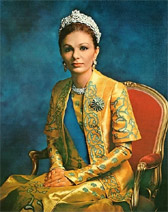
Farah Pahlavi
The First Crowned Empress of Iran and a Global Advocate for Culture and Humanitarian Reform
Born on September 14, 1938
Age: 88
Profession: Queen
Place of Birth: Tehran, Iran
Farah Pahlavi is the third and last wife of Mohammad Reza Shah Pahlavi, the final Shah of Iran. Born as Farah Diba on October 14, 1938, in Tehran, she was the only child of Sohrab Diba, an officer in the Iranian Air Force of Azerbaijani origin, and Farideh Ghotbi. Following the death of her father in 1947, Farah was raised by her mother and received a distinguished education shaped by both Iranian and European influences.
She first attended the Pietro Della Valle Italian School in Shemiran, then continued her studies at the prestigious Jeanne d’Arc French Girls’ School in Tehran. She completed her secondary education at Lycée Razi, a secular Persian-French high school. Farah later moved to France, where she studied architecture at the École Spéciale d'Architecture in Paris, an education that would deeply influence her later work in urban planning, cultural preservation, and public architecture.
In 1959, while still a university student in Paris, Farah Diba met Mohammad Reza Shah Pahlavi at an Iranian embassy reception. The couple became engaged on November 23, 1959, and married three weeks later on December 20, 1959. With her marriage, she assumed the name Farah Pahlavi. Their wedding attracted worldwide media attention. Her wedding gown was designed by Yves Saint Laurent, then a designer at Christian Dior, and she wore a crown adorned with the Noor-ol-Ain Diamond.
Farah Pahlavi and Mohammad Reza Shah Pahlavi had four children, two sons and two daughters:
– Reza Pahlavi (born October 31, 1960)
– Farahnaz Pahlavi (born March 12, 1963)
– Ali Reza Pahlavi (born April 28, 1966), who died by suicide in the United States on January 4, 2011
– Leila Pahlavi (born March 27, 1970), who died in London on June 10, 2001, following an overdose involving medication and cocaine
On October 26, 1967, during the coronation ceremonies held in Tehran, Mohammad Reza Shah Pahlavi was crowned with the title “Shahanshah” (King of Kings), while Farah Pahlavi was granted the title “Shahbanu” (Empress). In 1971, during the grand celebrations marking the 2,500th anniversary of the Persian Empire, the Shah officially placed the imperial crown upon her head, symbolizing her status as Empress of Iran.
Throughout the 1960s and 1970s, Empress Farah Pahlavi traveled extensively across Iran in support of wide-ranging social and economic reforms championed by her husband. Her efforts focused on women’s and children’s rights, disability advocacy, healthcare, science, culture, architecture, and environmental protection. Under the patronage of the Farah Pahlavi Foundation, she provided financial support to an extensive network of museums, cultural institutions, art centers, and dozens of charitable organizations.
She worked tirelessly to promote Iranian culture and the arts, reviving traditional crafts through community-based village enterprises. She played a central role in organizing landmark cultural events celebrating modern and contemporary Iranian creativity, including the Shiraz Arts Festival, the Isfahan Festival of Popular Traditions, the Kerman Traditional Music Festival, the Tehran International Film Festival, and the Children’s Film Festival.
As a trained architect, Empress Farah Pahlavi applied her expertise to urban and social development. She spearheaded initiatives to establish children’s libraries across both urban and rural areas to improve literacy rates. She actively lobbied to preserve historic buildings from demolition and worked to protect open land from overdevelopment, ensuring that parks and green spaces became defining features of crowded city centers. She also chaired the South Tehran Redevelopment Company, aimed at reducing poverty and improving living conditions in the city’s southern suburbs.
During her twenty years on the throne, Empress Farah Pahlavi overcame significant barriers. She became the first crowned female ruler in Iran’s history and the first woman in the Muslim world to be formally crowned. She was also the first woman in a Muslim country to publicly donate blood, challenging social taboos and setting a powerful public example.
Serving as her husband’s international representative, Empress Farah Pahlavi acted as Iran’s ambassador abroad, representing the country in nations such as China, the United States, and Senegal. She delivered major policy speeches and participated in international conferences, strengthening Iran’s cultural and diplomatic presence on the global stage.
Among her proudest achievements was her groundbreaking work on behalf of people affected by leprosy in Iran, a group long subjected to social exclusion and discrimination. In the late 1960s, she personally visited leper colonies and persuaded the Shah to donate land where affected individuals could live, receive education, and earn wages within a model community. She invited medical specialists from around the world to Iran and promoted community-based care methods. Her efforts to transform public perceptions of leprosy were widely recognized internationally as a progressive and humane initiative.
Following the Iranian Revolution, Empress Farah Pahlavi left Iran with her husband and children on January 16, 1979. After the death of Mohammad Reza Shah Pahlavi in 1980, she settled in the United States. In later years, she divided her life between Paris and Washington, D.C., continuing to be regarded as a prominent historical and cultural figure associated with modern Iranian history.
Source: Biyografiler.com
Frequently asked questions about Farah Pahlavi
Who is Farah Pahlavi?, Farah Pahlavi biography, Farah Pahlavi life story, Farah Pahlavi age, Farah Pahlavi facts, Farah Pahlavi birthplace, Farah Pahlavi photos, Farah Pahlavi videos, Farah Pahlavi career
Related Biographies

Lamine Yamal
Professional footballer

Erling Haaland
Professional footballer

Kylian Mbappe
Professional footballer

Bad Bunny
Rapper, Songwriter

Austin Abrams
Actor

Keanu Reeves
Actor


Hongjoong
Singer, Rapper, Songwriter, Composer

Ludacris
Rapper, Actor

Kwon Eunbi
Singer

Sarah Wayne Callies
Actress, Screenwriter, Producer, Director

LaTavia Roberson
Singer, Actress, Entrepreneur
Kylian Mbappe
Professional footballer
Lamine Yamal
Professional footballer

Sydney Sweeney
Actress
Austin Abrams
Actor

Jodie Foster
Actress

Charles Leclerc
Formula 1 Driver