
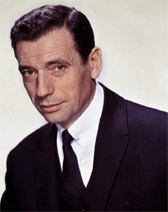
Yves Montand
Postwar France’s Politically Conscious “Latin Lover” Icon
Born on October 13, 1921
Died on November 9, 1991
Age at death: 70
Profession: Actor, Singer
Place of Birth: Monsummano Terme, Tuscany, Italy
Place of Death: Senlis, France
Yves Montand was an Italian-born French actor and singer who became one of the most influential cultural figures in post–World War II France. Nicknamed the “Latin Lover,” he gained international fame through his commanding stage presence, political engagement, and powerful performances in European cinema. Over a career that spanned nearly five decades, Yves Montand embodied the intersection of chanson, theater, and politically charged film.
Early Life and Exile from Fascist Italy
Yves Montand was born Ivo Livi on October 13, 1921, in Monsummano Terme, Tuscany, Italy, the youngest of three children of Josephine Livi and Giovanni Livi, a modest Jewish peasant family. In 1923, as Benito Mussolini’s fascist regime consolidated power, his family fled Italy and settled in Marseille, France. They became French citizens in 1929.
Growing up in a working-class district near the Marseille port, Yves Montand left school at eleven and worked as a barber’s assistant, factory laborer, and dockworker. Despite economic hardship, he dreamed of becoming a performer. A devoted admirer of Fred Astaire, he was deeply influenced by American cinema, jazz, and popular culture—elements that would later shape his stage style.
Rise Through Cabaret and Discovery by Edith Piaf
In 1938, Yves Montand began performing at the Alcazar in Marseille, singing songs by Charles Trenet and Maurice Chevalier while incorporating comic impersonations. During World War II, he avoided the Compulsory Work Service and moved to Paris, where he performed in cabarets.
In July 1944, he appeared at the Moulin Rouge before concerts by Edith Piaf. Piaf discovered him that same year and became both his mentor and lover. Until their separation in 1946, she played a decisive role in shaping his artistic direction, refining his repertoire, and introducing him to influential cultural circles.
Postwar Career: Music, Theater, and Cinema
After the war, Yves Montand developed his career across three primary axes. First, music—performing songs written by artists such as Francis Lemarque, Jacques Prévert, Joseph Kosma, and Henri Crolla. Second, theater—most notably appearing alongside his future wife Simone Signoret in productions such as Les Sorcières de Salem (The Crucible). Third, and most significantly, cinema.
His breakthrough in film came with The Wages of Fear (1953), directed by Henri-Georges Clouzot. The film’s international success established Yves Montand as a leading actor in European cinema. He later starred in politically resonant works such as Z (1969) and The Confession (1970), directed by Costa-Gavras, as well as The War Is Over (1966) by Alain Resnais. These films reflected his growing engagement with political themes.
Other notable performances included Grand Prix (1966), where he performed his own driving scenes alongside James Garner and Brian Bedford; César and Rosalie (1972); Vincent, François, Paul and the Others (1974); and the acclaimed Provençal dramas Jean de Florette (1986) and Manon of the Spring (1986), in which he portrayed César Soubeyran.
Musical Legacy and International Recognition
As a singer, Yves Montand moved fluidly between romantic ballads and politically charged chansons. His rendition of “Les feuilles mortes,” with lyrics by Jacques Prévert and music by Joseph Kosma, became internationally known as “Autumn Leaves.” He also recorded “C’est si bon,” composed by Henri Betti.
In 1959, he toured the United States, and in 1982 he became the first popular singer to perform at the Metropolitan Opera House, demonstrating his global stature beyond French-speaking audiences.
Personal Life and Public Fascination
Yves Montand married Simone Signoret on December 22, 1951. Their partnership became one of France’s most celebrated artistic unions. Following Signoret’s death on September 30, 1985, he married Carole Amiel in 1987. Their son, Valentin Livi, was born in 1988.
His private life frequently attracted international media attention. During the filming of Let’s Make Love (1960), he had a widely publicized relationship with Marilyn Monroe, a liaison that fueled global headlines.
Political Engagement and Ideological Evolution
Politically active throughout his life, Yves Montand initially supported the French Communist Party. However, following the Soviet Union’s invasion of Czechoslovakia in 1968, he distanced himself from communist ideology and later adopted more liberal positions, openly criticizing authoritarian regimes.
Paternity Case and Posthumous DNA Test
In 1990, a 22-year-old woman named Aurore Drossard filed a paternity suit claiming that Yves Montand was her biological father. Montand refused DNA testing during his lifetime. After his death, legal proceedings continued; in 1998, his grave at Père Lachaise Cemetery was opened for bone sampling. DNA testing definitively concluded that he was not her biological father.
Death
Yves Montand died of a heart attack on November 9, 1991, in Senlis, France, at the age of 70. He was buried in Paris at Père Lachaise Cemetery beside Simone Signoret. His life and career left a lasting imprint on French chanson, political cinema, and postwar European culture.
Filmography
1946 – Gates of the Night – (Diego) – Feature Film
1953 – The Wages of Fear – (Mario) – Feature Film
1956 – The Crucible – (John Proctor) – Feature Film
1957 – The Wide Blue Road – (Squarciò) – Feature Film
1960 – Let’s Make Love – (Jean-Marc Clément / Alexandre Dumas Sr.) – Feature Film
1961 – Goodbye Again – (Philip Van der Besh) – Feature Film
1962 – My Geisha – (Paul Robaix) – Feature Film
1965 – The Sleeping Car Murder – (Inspector Grazziani) – Feature Film
1966 – The War Is Over – (Diego Mora) – Feature Film
1966 – Grand Prix – (Jean-Pierre Sarti) – Feature Film
1967 – Live for Life – (Robert Colomb) – Feature Film
1969 – Z – (The Deputy) – Feature Film
1970 – On a Clear Day You Can See Forever – (Dr. Marc Chabot) – Feature Film
1970 – Le Cercle Rouge – (Corey) – Feature Film
1970 – The Confession – (Artur London) – Feature Film
1971 – Delusions of Grandeur – (Blaze) – Feature Film
1972 – Tout Va Bien – (Jacques) – Feature Film
1972 – César and Rosalie – (César) – Feature Film
1973 – State of Siege – (Philip Michael Santore) – Feature Film
1974 – Vincent, François, Paul and the Others – (Vincent) – Feature Film
1976 – Police Python 357 – (Marc Ferrot) – Feature Film
1977 – The Red and the Black Air – (Narrator) – Documentary
1979 – I… For Icarus – (Henri Volney) – Feature Film
1983 – Waiter! – (Alex) – Feature Film
1986 – Jean de Florette – (César Soubeyran) – Feature Film
1986 – Manon of the Spring – (César Soubeyran) – Feature Film
Source: Biyografiler.com
Frequently asked questions about Yves Montand
Who is Yves Montand?, Yves Montand biography, Yves Montand life story, Yves Montand age, Yves Montand facts, Yves Montand birthplace, Yves Montand photos, Yves Montand videos, Yves Montand career
Related Biographies


Lamine Yamal
Professional footballer

Sam Altman
Entrepreneur, Investor, CEO

Kylian Mbappe
Professional footballer

Alice Weidel
Politician, Economist

Erling Haaland
Professional footballer

Giorgia Meloni
Politician, Journalist


Hongjoong
Singer, Rapper, Songwriter, Composer

Ludacris
Rapper, Actor

Kwon Eunbi
Singer

Sarah Wayne Callies
Actress, Screenwriter, Producer, Director

LaTavia Roberson
Singer, Actress, Entrepreneur
Lamine Yamal
Professional footballer

Xi Jinping
Politician, Statesman, Head of State

Brad Pitt
Actor

Neymar
Professional footballer
Kylian Mbappe
Professional footballer

Pedro Sanchez
Politician