
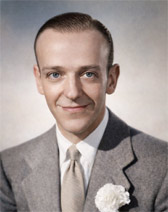
Fred Astaire
The legendary master who defined elegance in Hollywood musicals
Born on May 10, 1899
Died on June 22, 1987
Age at death: 88
Profession: Dancer, Singer, Actor
Place of Birth: Omaha, Nebraska, United States
Place of Death:
Fred Astaire was an American dancer, choreographer, singer, and actor, widely regarded as one of the greatest performers in the history of cinema. Renowned for his unmatched elegance, rhythm, and innovation, he revolutionized Hollywood musicals by seamlessly blending tap dance, ballroom technique, and theatrical storytelling. Frequently compared with contemporaries such as Gene Kelly and celebrated alongside icons like Judy Garland, Fred Astaire created some of the most memorable dance sequences ever captured on film, leaving a permanent imprint on the art of movement in cinema.
Early Life and Stage Beginnings
Fred Astaire, May 10, 1899 tarihinde United States’ın Nebraska eyaletindeki Omaha kentinde doğmuştur. Born Frederick Austerlitz Jr., he was the son of Frederic and Johanna Austerlitz. He entered the world of performance at an exceptionally young age, beginning his career at just five years old.
Together with his sister Adele Astaire, he formed a successful dance duo that quickly gained recognition on vaudeville stages. Their partnership flourished on Broadway and extended internationally, with performances in both the United States and United Kingdom. The siblings became leading figures in musical comedy during the early 20th century.
Transition to Hollywood and Breakthrough
After Adele Astaire retired from performing in 1932 following her marriage, Fred Astaire turned his focus toward Hollywood. His early film appearance in Dancing Lady (1933) marked his entry into cinema, but it was Flying Down to Rio (1933) that became a defining moment in his career.
In this film, he partnered with Ginger Rogers, forming one of the most iconic dance partnerships in film history. Together, they starred in a series of successful musicals, including The Gay Divorcee, Top Hat, Swing Time, Shall We Dance, and Carefree. Their chemistry and synchronized performances set a new standard for musical filmmaking.
Golden Era of Musical Cinema
During the 1940s and 1950s, Fred Astaire continued to dominate Hollywood musicals. He collaborated with a wide range of prominent performers, including Rita Hayworth, Eleanor Powell, Cyd Charisse, and Gene Kelly. His work during this period solidified his reputation as the embodiment of sophistication in dance.
Films such as Broadway Melody of 1940, You'll Never Get Rich, Ziegfeld Follies, Easter Parade, The Band Wagon, and Silk Stockings are considered classics of the genre. In these productions, Fred Astaire consistently pushed the boundaries of choreography, integrating narrative and movement in innovative ways.
Artistry and Influence
Fred Astaire appeared in more than 30 musical films, as well as dramatic roles and television productions. His approach to dance emphasized fluidity, precision, and emotional expression. Unlike many performers of his era, he insisted on filming dance sequences in long takes, allowing audiences to fully appreciate the choreography.
His influence extended beyond cinema, shaping the evolution of dance worldwide. Through collaborations with artists such as Audrey Hepburn, Bing Crosby, Jane Powell, Leslie Caron, Petula Clark, Nanette Fabray, and Joan Crawford, he demonstrated remarkable versatility across genres and styles.
Fred Astaire Dance Studios and Cultural Legacy
In 1947, Fred Astaire supported the establishment of Fred Astaire Dance Studios, a network dedicated to teaching ballroom dance to the general public. This initiative contributed to the popularization of dance as both an art form and a social activity.
His legacy as a performer has endured for decades, influencing generations of dancers, choreographers, and filmmakers. Many later artists, including Michael Jackson, cited his work as a major inspiration, particularly in terms of rhythm and stage presence.
Awards and Recognition
Throughout his career, Fred Astaire received numerous prestigious awards. In 1950, he was honored with an Academy Honorary Award, presented by Ginger Rogers. He also won Golden Globe and Emmy Awards and received the American Film Institute Life Achievement Award.
In 1978, he was among the first recipients of the Kennedy Center Honors, recognizing his extraordinary contribution to American culture and the performing arts.
Personal Life
Fred Astaire married Phyllis Livingston Potter in 1933, and the couple had two children, Fred Astaire Jr. and Ava Astaire-McKenzie. After her death in 1954, he later married Robyn Smith in 1980.
Death
Fred Astaire died on June 22, 1987, in Los Angeles, United States, due to pneumonia at the age of 88. His passing marked the end of an era in Hollywood, but his work continues to define excellence in dance and musical cinema.
“When you dance, your purpose is not to get to a certain place on the floor. It's to enjoy each step along the way.”Selected Filmography
1933 – Dancing Lady – (Feature Film)
1933 – Flying Down to Rio – (Feature Film)
1934 – The Gay Divorcee – (Feature Film)
1935 – Top Hat – (Feature Film)
1936 – Swing Time – (Feature Film)
1937 – Shall We Dance – (Feature Film)
1938 – Carefree – (Feature Film)
1940 – Broadway Melody of 1940 – (Feature Film)
1941 – You'll Never Get Rich – (Feature Film)
1942 – Holiday Inn – (Feature Film)
1946 – Ziegfeld Follies – (Feature Film)
1948 – Easter Parade – (Feature Film)
1953 – The Band Wagon – (Feature Film)
1957 – Funny Face – (Feature Film)
1957 – Silk Stockings – (Feature Film)
1968 – Finian's Rainbow – (Feature Film)
Source: Biyografiler.com
Frequently asked questions about Fred Astaire
Who is Fred Astaire?, Fred Astaire biography, Fred Astaire life story, Fred Astaire age, Fred Astaire facts, Fred Astaire birthplace, Fred Astaire photos, Fred Astaire videos, Fred Astaire career
Related Biographies




Lamine Yamal
Professional footballer

Sam Altman
Entrepreneur, Investor, CEO

Kylian Mbappe
Professional footballer

Alice Weidel
Politician, Economist

Erling Haaland
Professional footballer

Giorgia Meloni
Politician, Journalist


Hongjoong
Singer, Rapper, Songwriter, Composer

Ludacris
Rapper, Actor

Kwon Eunbi
Singer

Sarah Wayne Callies
Actress, Screenwriter, Producer, Director

LaTavia Roberson
Singer, Actress, Entrepreneur
Lamine Yamal
Professional footballer

Xi Jinping
Politician, Statesman, Head of State

Brad Pitt
Actor

Neymar
Professional footballer
Kylian Mbappe
Professional footballer

Pedro Sanchez
Politician