
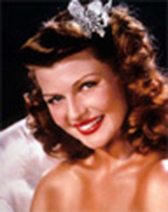
Rita Hayworth
Hollywood icon of the 1940s and one of classic cinema’s enduring sex symbols
Born on October 17, 1918
Died on May 14, 1987
Age at death: 69
Profession:
Place of Birth: Brooklyn, New York, United States
Place of Death: Manhattan, New York, United States
Rita Hayworth, born Margarita Carmen Cansino, was one of the most celebrated actresses of Hollywood’s Golden Age, renowned for her striking beauty, exceptional dance skills, and enduring screen presence. Rising from a childhood shaped by rigorous dance training, she became a defining figure of 1940s American cinema and a lasting cultural symbol whose image transcended film to become part of global popular memory.
Early Life and Background
Rita Hayworth was born on October 17, 1918, in the Brooklyn borough of New York City. Her father, Eduardo Cansino, was a Spanish-born flamenco dancer, while her mother, Volga Haworth, was an American dancer of Irish and English descent. Both parents were professional performers, and from an early age Hayworth was immersed in the discipline and demands of dance.
Raised in a household where performance was central to daily life, she began formal dance training as a child under her father’s strict guidance. Although dance initially dominated her upbringing, Hayworth gradually became aware that her ambitions extended beyond choreography and stage routines. Seeking a broader artistic path, she turned her attention toward acting.
At the age of 12, Rita Hayworth began taking acting lessons, and by 15 she had signed a contract with Fox Studios, marking the formal beginning of her professional screen career.
Career Beginnings
Rita Hayworth made her first on-screen appearance in 1926, at just eight years old, performing as a dancer alongside her father in the short film Anna Case in La Fiesta. Throughout the early years of her career, she appeared primarily in minor roles, often cast for her dance ability rather than her dramatic range.
Until 1937, she appeared in films under her birth name, Rita Cansino. That year, she adopted the stage name Rita Hayworth, a change that coincided with a deliberate studio-led transformation of her screen image and marked a turning point in her career trajectory.
Breakthrough and Stardom
After several years in supporting roles, Rita Hayworth attracted wider attention with her performance in Who Killed Gail Preston? (1938). Her breakthrough, however, came in the early 1940s with roles in The Strawberry Blonde (1941) and You’ll Never Get Rich (1941), films that established her as a major Hollywood star.
By the age of 23, Hayworth had become one of the most sought-after actresses in the industry. At the height of her physical beauty and public appeal, she was frequently featured in magazines and widely regarded as a leading sex symbol of the era. Her romantic relationships also drew intense media attention, further reinforcing her celebrity status.
Musicals, Wartime Image, and Rising Fame
Thanks to her extensive dance training, Rita Hayworth excelled in musical films, a genre in which she demonstrated both technical skill and charismatic screen presence. During this period, she solidified her standing with films such as You Were Never Lovelier and Tales of Manhattan.
As the United States entered World War II, Hayworth participated in morale-boosting activities for American soldiers, becoming a symbolic figure of wartime glamour. In 1944, she starred in Cover Girl, a film that emphasized her sensual image and further cemented her status as one of Hollywood’s most recognizable stars.
Gilda and Career Peak
Rita Hayworth reached the pinnacle of her career in 1946 with her performance in the film noir classic Gilda. The film proved to be the defining work of her career and secured her place in cinema history.
In the film, Hayworth portrayed Gilda, the alluring wife of casino owner Ballin Mundson, who is also the former lover of Johnny Farrell, a gambler working as a croupier in Mundson’s Buenos Aires casino. The complex emotional tension between the characters drives the narrative, culminating in one of the most iconic performances of the noir genre.
Hayworth’s performance, particularly the scene in which she performs “Put the Blame on Mame,” became legendary. The character of Gilda became inseparable from Hayworth’s public image, and the role generated countless myths and anecdotes. Among the most notable was the decision by the United States military to name a nuclear test bomb “Gilda,” underscoring the character’s cultural impact.
Later Career and European Work
Following the immense success of Gilda, Rita Hayworth carefully selected her subsequent roles, capitalizing on her fame throughout the late 1940s and early 1950s. After starring in Salome (1953), she stepped away from the screen for several years.
She returned to cinema in 1957 with the musical Pal Joey, after which she continued to appear primarily in music-oriented films. However, her output slowed significantly, and she appeared less frequently than during her peak years.
From 1966 onward, Hayworth sought new opportunities in Europe, particularly in Italy, where she appeared in films such as L’Avventuriero and Bastardi. These projects marked the final phase of her acting career.
Personal Life
Rita Hayworth’s personal life was marked by a series of high-profile marriages. Her first marriage, to Edward C. Judson, began on May 29, 1937, and ended in divorce on May 22, 1942, following a turbulent relationship.
On October 7, 1943, she married filmmaker Orson Welles. The couple divorced on December 1, 1948, after five years of marriage. They had one daughter, Rebeka, born on December 17, 1944.
Hayworth married Ali Aga Khan on May 27, 1949. The marriage ended in divorce on January 26, 1953, and produced a daughter, Yasemin, born on December 28, 1949.
Her fourth marriage, to singer Dick Haymes, lasted from October 24, 1953, to December 12, 1955. Her fifth and final marriage was to producer James Hill, whom she married on February 24, 1958. They divorced on October 1, 1961.
Illness and Death
In the late 1970s, Rita Hayworth was diagnosed with Alzheimer’s disease, an illness that gradually forced her withdrawal from public life and permanently ended her film career.
She died on May 14, 1987, in Manhattan, New York City, at the age of 68.
Filmography
As “Rita Cansino”
- 1926 – Anna Case in La Fiesta
- 1934 – Cruz Diablo (also known as *The Devil’s Cross*)
- 1935 – In Caliente
- 1935 – Under the Pampas Moon
- 1935 – Charlie Chan in Egypt
- 1935 – Dante’s Inferno
- 1935 – Piernas de Seda (*Legs of Silk*)
- 1935 – Paddy O’Day
- 1935 – Professional Soldier
- 1936 – Human Cargo
- 1936 – Dancing Pirate
- 1936 – Meet Nero Wolfe
- 1936 – Rebellion
- 1937 – Old Louisiana
- 1937 – Hit the Saddle
- 1937 – Trouble in Texas
As “Rita Hayworth”
- 1937 – Criminals of the Air
- 1937 – Girls Can Play
- 1937 – The Game That Kills
- 1937 – Life Begins with Love
- 1937 – Paid to Dance
- 1937 – The Shadow
- 1938 – Who Killed Gail Preston?
- 1938 – Special Inspector
- 1938 – There’s Always a Woman
- 1938 – Convicted
- 1938 – Juvenile Court
- 1938 – The Renegade Ranger
- 1939 – Homicide Bureau
- 1939 – The Lone Wolf Spy Hunt
- 1939 – Only Angels Have Wings
- 1940 – Music in My Heart
- 1940 – Blondie on a Budget
- 1940 – Screen Snapshots
- 1940 – Susan and God
- 1940 – The Lady in Question
- 1940 – Angels Over Broadway
- 1941 – The Strawberry Blonde
- 1941 – Affectionately Yours
- 1941 – Blood and Sand
- 1941 – You’ll Never Get Rich
- 1942 – My Gal Sal
- 1942 – Tales of Manhattan
- 1942 – You Were Never Lovelier
- 1943 – Show Business at War
- 1944 – Cover Girl
- 1945 – Tonight and Every Night
- 1946 – Gilda
- 1947 – Down to Earth
- 1948 – The Lady from Shanghai
- 1948 – The Loves of Carmen
- 1952 – Champagne Safari
- 1952 – Affair in Trinidad
- 1953 – Salome
- 1953 – Miss Sadie Thompson
- 1954 – Screen Snapshots: Hollywood Grows Up
- 1957 – Fire Down Below
- 1957 – Pal Joey
- 1958 – Separate Tables
- 1959 – They Came to Cordura
- 1959 – The Story on Page One
- 1962 – The Happy Thieves
- 1962 – Lykke og krone
- 1964 – Circus World
- 1965 – The Money Trap
- 1966 – The Poppy Is Also a Flower
- 1967 – L’Avventuriero
- 1968 – I Bastardi
- 1971 – The Naked Zoo
- 1971 – Road to Salina
- 1972 – The Wrath of God
Source: Biyografiler.com
Frequently asked questions about Rita Hayworth
Who is Rita Hayworth?, Rita Hayworth biography, Rita Hayworth life story, Rita Hayworth age, Rita Hayworth facts, Rita Hayworth birthplace, Rita Hayworth photos, Rita Hayworth videos, Rita Hayworth career
Related Biographies

Lamine Yamal
Professional footballer

Kylian Mbappe
Professional footballer

Erling Haaland
Professional footballer

Sam Altman
Entrepreneur, Investor, CEO

Austin Abrams
Actor

Bad Bunny
Rapper, Songwriter


Hongjoong
Singer, Rapper, Songwriter, Composer

Ludacris
Rapper, Actor

Kwon Eunbi
Singer

Sarah Wayne Callies
Actress, Screenwriter, Producer, Director

LaTavia Roberson
Singer, Actress, Entrepreneur
Lamine Yamal
Professional footballer

Pedro Sanchez
Politician

Adam Sandler
Actor

Cillian Murphy
Actor
Austin Abrams
Actor
Sam Altman
Entrepreneur, Investor, CEO